


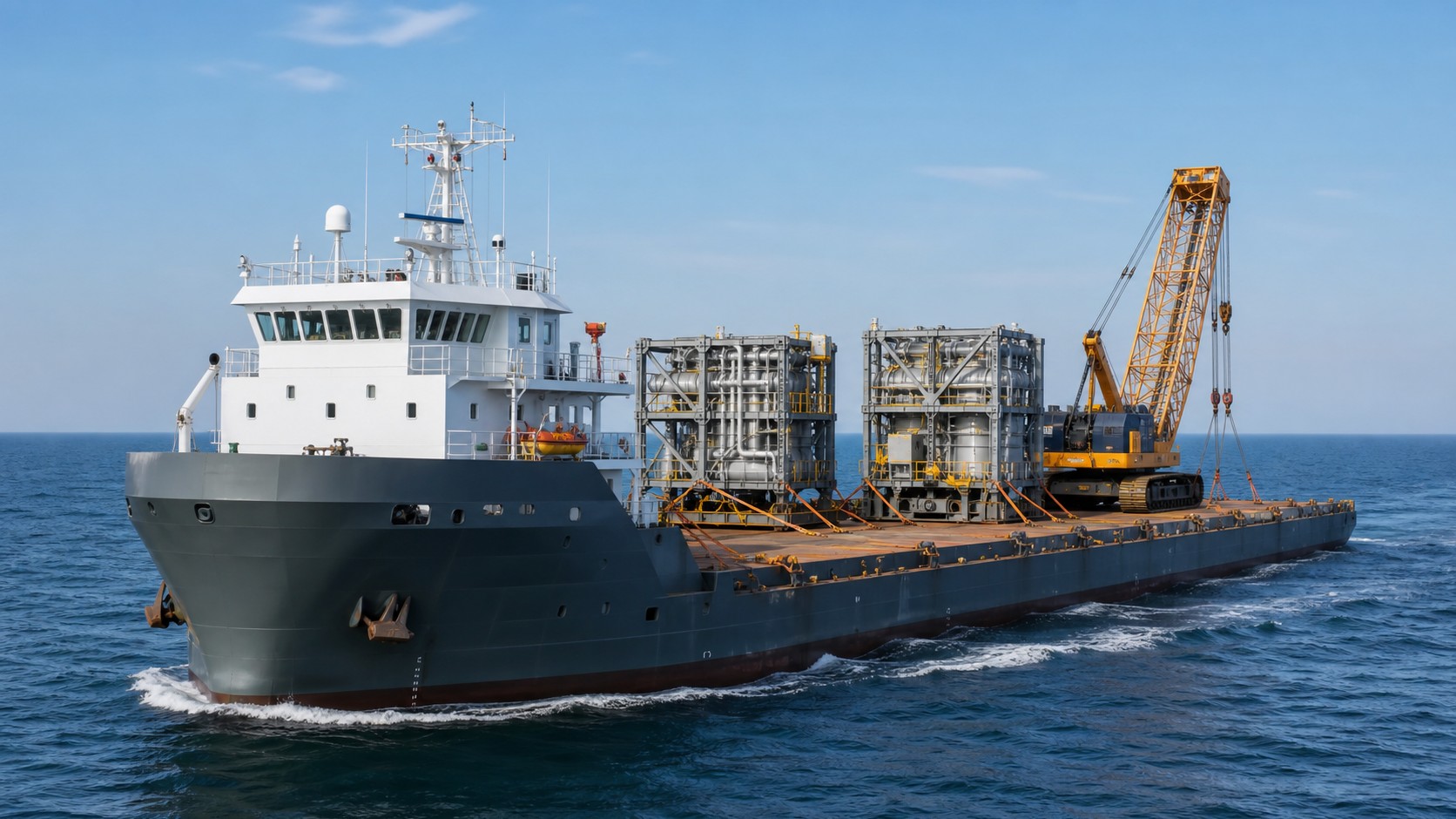
A deck barge is one of the most versatile assets on the water — it carries project cargo, modules, cranes, pipes, machinery, vehicles and bulk on a flat, open deck. But “deck barge” covers everything from a 1,200-DWT coastal flat to a 25,000-DWT ocean-going deck cargo vessel, and the wrong choice is expensive to undo. This guide walks through how to size a barge to your work, which surveys and certificates actually matter, and the due-diligence checklist to run before you sign.
First, get the terminology right: deck barge vs. self-propelled deck cargo vessel
The single biggest source of mispriced deals is buyers comparing two different things under the same word.
- Dumb (non-propelled) deck barge — no engine. It must be towed or pushed by a tug. Lower purchase price and lower operating cost, but you pay for towage and you’re tied to tug availability and weather windows.
- Self-propelled deck cargo vessel — has its own main engines (often twin-engine, twin-screw), a bridge, and frequently a bow or stern ramp for roll-on/roll-off loading. Higher price, but it moves on its own schedule, repositions cheaply, and can work unrestricted or near-coastal voyages without a tug.
Much of the modern tonnage on the market today is actually self-propelled deck cargo vessels rather than true dumb barges — so when you read a listing, check for main engines, navigation area (unrestricted vs. coastal/near-coastal), and whether a ramp is fitted. It changes the price, the crew you need, and the jobs you can take.
Tip: Decide propelled or towed before you shortlist. It’s the fork in the road that determines your operating model, not just the asset.
Step 1 — Size the barge to the job, not the other way around
Don’t start from DWT. Start from the heaviest, widest, and longest thing you need to carry, then work backwards to deck area, deck strength (t/m²), and stability. A barge can be “big enough” on tonnage and still wrong if the deck is too narrow or the uniform deck load is too low for your cargo.
The four numbers that decide fit:
| Spec | Why it matters |
|---|---|
| Deadweight (DWT) | Total cargo + fuel + stores it can lift. Your headline capacity. |
| Deck dimensions (L × B) & clear deck area | Whether your modules/units physically fit, and how you can arrange them. Wide-body hulls (40–42 m beam) suit project and offshore cargo. |
| Uniform deck load (t/m²) | The real constraint for heavy point loads — crawler cranes, transformers, jack-up legs. Ask for the deck strength plan. |
| Draft & navigation area | Loaded draft must suit your ports/rivers; “unrestricted,” “near-coastal (A1+A2),” and “coastal/inland” are very different certifications. |
As a rough orientation, here’s the spread you’ll see in the current in-stock range of deck cargo vessels and barges:
| Class of barge | Indicative DWT | Typical role |
|---|---|---|
| Small coastal | ~1,200–3,500 DWT | River/coastal moves, equipment ferrying, ramp-loaded vehicles |
| Mid coastal/near-coastal | ~7,000–11,000 DWT | Project cargo, near-shore construction, inter-island trade |
| Large ocean-going | ~22,000–25,000 DWT | Heavy modules, offshore structures, wide-beam project cargo |
See current availability and exact particulars: Deck barges & deck cargo vessels for sale →
A practical rule: buy ~15–20% more deck strength and area than your current biggest job. Cargo only gets bigger, and the resale market rewards flexibility.
Step 2 — Read the class and certificate status before you fall in love
A used barge is only as good as its classification and statutory standing. Before any physical inspection, confirm on paper:
- Class society & current class status — Is it in class with a recognized society (e.g. CCS, ABS, DNV, BV, LR), with no overdue surveys or outstanding Conditions of Class / recommendations? Modern Chinese-built tonnage is frequently CCS-classed; verify the society is acceptable to your flag, insurer, and charterers.
- Navigation/service area — Unrestricted, near-coastal, or coastal/inland. This caps where you can legally and safely trade.
- Special survey / drydocking dates — When is the next special survey or scheduled drydock due? A barge due for a costly special survey in 6 months should be priced accordingly.
- Statutory certificates — Load Line, Tonnage, and (for self-propelled) Safety Construction/Equipment, plus relevant pollution certificates. Self-propelled tonnage on international voyages also carries efficiency obligations — see EEXI and CII explained for vessel buyers.
- Hull age & renewal history — Build year, keel-laid date, and any steel-renewal or major repair records.
If a seller can’t produce a clean class status and survey position, treat every other claim with caution.
Step 3 — The physical survey: what a competent surveyor checks
Always commission an independent pre-purchase condition survey (and, for a serious purchase, a drydock/underwater survey). Never rely on the seller’s photos or your own walk-through. A good surveyor will focus on:
Structure & steel
- Deck plating thickness and corrosion (gaugings / ultrasonic thickness measurement)
- Hull bottom, side shell, and internal framing — wastage, deformation, cracks
- Double-hull / void spaces and ballast tanks: coating condition and corrosion
- Deck strength, securing points, and lashing/sea-fastening arrangements
Marine systems
- Ballast and bilge systems, pumps, valves
- Anchoring/positioning gear (e.g. four-anchor positioning systems on some barges)
- Ramp(s) — hydraulics, hinges, structural condition (if fitted)
For self-propelled units, additionally:
- Main engines, gearboxes, shafting and propellers (twin-screw arrangements double the inspection)
- Steering gear and rudders (single vs. twin rudder)
- Generators, electrical systems, bridge/navigation equipment
Documentation against reality
- Hull markings, plates, and equipment serials match the certificates and drawings
Tip: Budget for the survey and a sea trial (for propelled vessels). The few thousand dollars you spend here is the cheapest insurance in the entire transaction.
Step 4 — Due diligence: documents to obtain (often under NDA)
Reputable sellers release full vessel particulars to qualified buyers under an NDA, because complete specs include commercially and personally sensitive detail. Expect — and insist on — the following before committing:
- General Arrangement (GA) drawing and capacity/deck strength plans
- Class certificates and the current survey status report
- Statutory certificates (Load Line, Tonnage, Safety, pollution)
- Build specification and shipyard/builder details, year and keel date
- Maintenance, repair, and drydocking history
- For propelled vessels: machinery particulars, running hours, service records
- Clear title / ownership and confirmation the vessel is free of liens and encumbrances
Verifying clean title and no outstanding mortgages or maritime liens is non-negotiable — a debt attached to the hull can follow the vessel to its new owner. The document exchange sits inside a wider transaction; for the full sequence from offer to handover, see our guide to the ship sale and purchase process, from LOI to delivery.
Step 5 — Budget for the total cost of ownership, not just the price
The purchase price is the beginning. Build your budget around:
- Survey, drydock, and any class-condition rectification
- Delivery / towage / repositioning to your operating area
- Flag registration and re-flagging costs and timeline
- Class transfer (if changing society) and any associated surveys
- Insurance (H&M and P&I) — premiums depend on age, class, and trading area
- Modifications — ramps, sea-fastening, crane pedestals, deck reinforcement for your specific cargo
A cheaper barge that needs €/$ hundreds of thousands in steel renewal and class work is rarely cheaper than a well-maintained, in-class unit at a higher sticker price.
Quick pre-signing checklist
- ☐ Decided propelled vs. towed, and matched it to your operating model
- ☐ Cargo sized to deck area and deck strength (t/m²), with margin
- ☐ In class with an acceptable society, no overdue surveys / Conditions of Class
- ☐ Navigation area suits your intended trade
- ☐ Next special survey / drydock date understood and priced in
- ☐ Independent condition survey (+ drydock/sea trial) completed
- ☐ Full document set reviewed under NDA
- ☐ Clean title confirmed — no liens or mortgages
- ☐ Total cost of ownership budgeted (delivery, flag, class, insurance, mods)
Frequently asked questions
What’s the difference between a deck barge and a deck cargo vessel? A deck barge in the strict sense has no propulsion and must be towed or pushed by a tug. A self-propelled deck cargo vessel carries cargo on the same open deck but has its own engines, a bridge, and often a ramp — so it moves independently. Many modern listings described as “barges” are in fact self-propelled deck cargo vessels; always confirm whether main engines are fitted.
What size deck barge do I need? Work backwards from your heaviest and largest cargo to the required deck area, uniform deck load (t/m²), and stability — then check DWT and draft. Don’t buy on tonnage alone; a barge can have enough DWT but too little deck strength or beam for your cargo.
What certificates should a used deck barge have? At minimum: valid class certificate with current survey status (no overdue surveys or outstanding Conditions of Class), Load Line, Tonnage, and — for self-propelled units — Safety Construction/Equipment and pollution certificates. Confirm the next special-survey and drydock dates.
Do I always need a drydock survey before buying? For any significant purchase, yes. A drydock or underwater survey reveals hull-bottom condition, wastage, and damage you cannot see afloat. At a minimum, commission an independent condition survey with thickness gaugings.
How do I get full specifications on a vessel? Complete particulars are released to qualified buyers under an NDA, because they contain commercially and personally sensitive information. Expect to sign an NDA to receive GA drawings, class status, machinery details, and history.
Looking for a deck barge or deck cargo vessel now? Golden Shipyard carries in-stock and newbuilding deck cargo vessels and barges from roughly 1,200 to 25,000 DWT, including wide-body and self-propelled units. Browse current availability on our deck barges & deck cargo vessels for sale page, see the full fleet of vessels for sale, or learn about our ship sale & purchase brokerage services. To receive full particulars under NDA, email [email protected].
Buying, or want a second opinion?
Our sale & purchase desk can help you find, value and inspect the right tonnage. Tell us what you’re looking for and we’ll revert within one working day.