


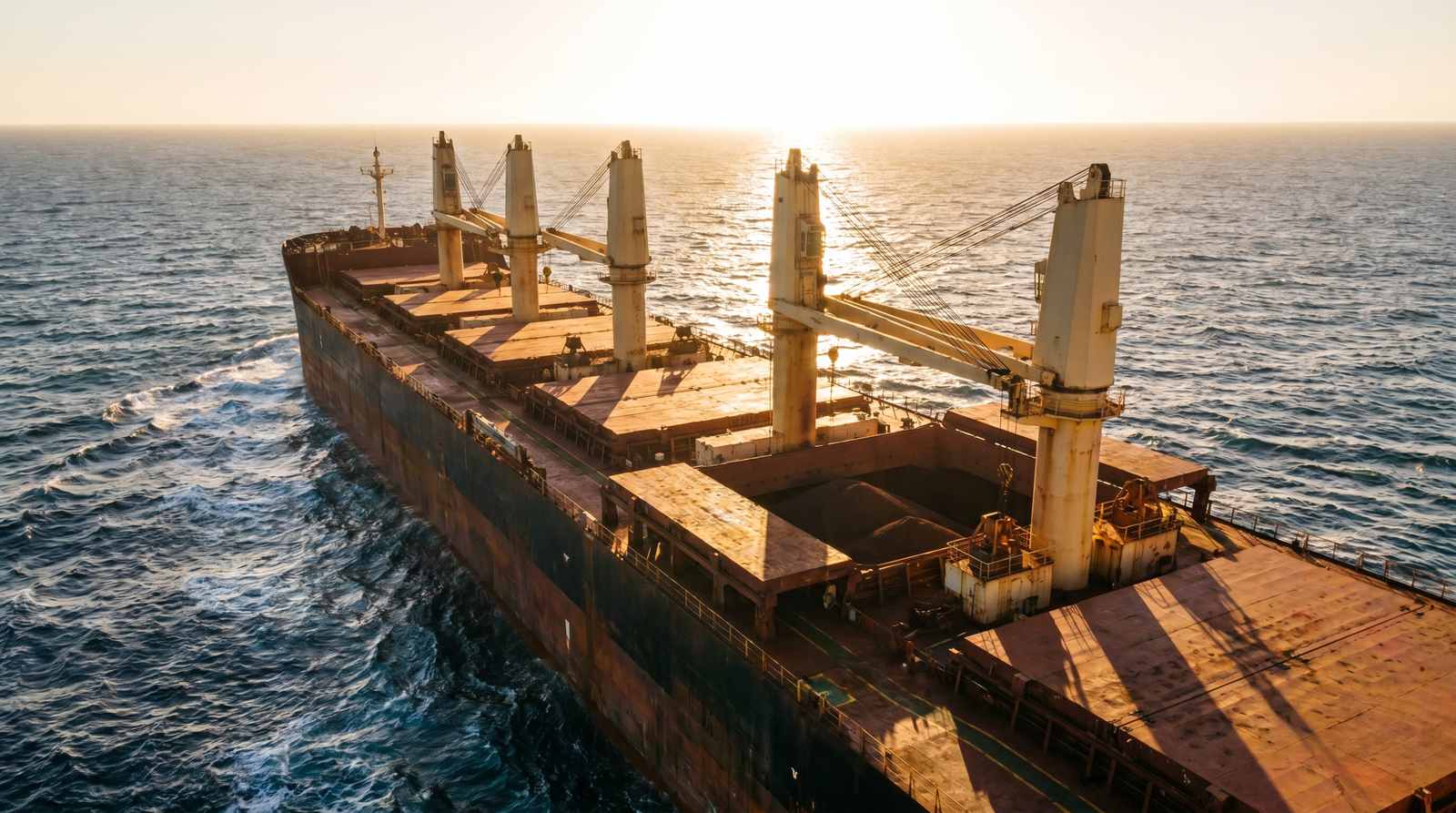
A secondhand bulk carrier is worth what a willing buyer will pay — but that figure is anything but arbitrary. Asset values track a handful of identifiable forces, and a buyer who understands them negotiates from evidence rather than hope. This is a broker’s read on what sets dry-bulk values in 2026, and how to weigh each driver against a specific ship.
FRVous préférez le français ? Lisez notre guide d’achat du navire vraquier.
Freight earnings set the floor and the mood
Above all else, a ship is a cash-generating asset, so its value follows what it can earn. When time-charter and spot rates in a segment firm up, secondhand values follow within weeks; when earnings soften, sellers’ expectations lag the market, the bid-offer gap widens, and deals slow to a trickle. Watch the segment your candidate sits in — Capesize, Panamax/Kamsarmax and the geared classes move on different demand stories. Capesize earnings ride iron ore and coal on long-haul routes; the geared classes track grain, minor bulks and regional trade. A strong Cape market does not automatically lift Supramax values, so always benchmark within the right segment rather than against the dry-bulk index as a whole.
Age and survey position
Value steps down with age, but not smoothly. It drops sharply around the major special surveys — typically at five-year intervals — when drydock, steel renewals and class work fall due. A ship just past a clean special survey commands a clear premium over an otherwise identical sister approaching one, because the buyer of the latter is also buying a near-term bill. Always price against the survey position: a cheaper, older ship with a special survey looming can cost more all-in than a dearer, younger one with its surveys behind it. The same logic applies to drydock timing and ballast water treatment retrofits — anything that forces the ship off-hire and into a yard.
Fuel efficiency and CII
Efficiency has become a value driver in its own right. With fuel a dominant slice of operating cost and the annual CII rating tightening year on year, a fuel-hungry or poorly rated ship carries a discount that widens as the rules bite. Two ships of the same age and segment can diverge materially in value on engine design, hull form and CII trajectory alone. Buyers increasingly pay up for efficient tonnage that will stay compliant without modification, and mark down ships facing speed restrictions, derating or capital work to hold their rating. The segment a ship sits in shapes this too — our size classes explainer sets out how design and intake differ across the bands.
Newbuild prices and scrap levels frame the range
Secondhand values sit between two anchors. Newbuilding prices set the ceiling: when ordering a new ship is expensive and yard slots are far out, buyers pay more for modern resale tonnage they can trade now, and the premium for young ships widens — you can see current programmes in our newbuilding section. Demolition (scrap) prices set the floor: when steel prices are high, even an old ship carries strong residual value, which supports prices at the bottom of the age curve and gives owners an alternative to a weak sale. Both anchors move with their own cycles, and as they shift they widen or compress the band a secondhand ship can trade in.
Putting it together
No single driver decides value; the skill is weighing them against a specific ship and trade. A younger, efficient Ultramax in a firming geared market with surveys behind it sits at the strong end of its range; an older, fuel-hungry Panamax approaching special survey in a soft market sits at the weak end — and that gap is exactly where negotiation happens. The buyer who can name which driver is pulling a price up or down argues from a stronger position. Browse current dry-bulk tonnage on our vessels for sale page, and if you are weighing order versus resale, our newbuild vs secondhand comparison sets out the trade-offs. For a valuation on a specific candidate, talk to a broker.