

Ask three brokers where Supramax ends and Ultramax begins and you will get three slightly different answers — the bands overlap, and yards keep nudging designs upward. But for anyone evaluating a dry-bulk purchase, the size class is the first thing that matters: it sets the cargo intake, the ports the ship can work, the cargoes you can chase, and the pool of buyers and charterers you will compete with. Get the class wrong for your trade and no amount of negotiating on price fixes it. Here is how the main segments break down, and what each one means when you are weighing a vessel.
FRVous préférez le français ? Lisez notre guide d’achat du navire vraquier.
Quick reference. Deadweight bands are conventions, not hard rules — they drift upward as designs evolve, and individual ships straddle the lines. Treat the table below as orientation, then judge each candidate on its actual deadweight, draft, gear and design.
| Class | Typical DWT | Gear | Typical cargoes & trade |
|---|---|---|---|
| Handysize / Handymax | 10,000–40,000 | Geared | Grain, steel, cement, fertiliser, project cargo; minor-bulk and shallow/regional ports |
| Supramax | 50,000–58,000 | Geared | Grain, coal, minerals, agribulk; ports without reliable shore cranes |
| Ultramax | 61,000–65,000 | Geared | As Supramax, more intake per voyage; the geared newbuilding sweet spot |
| Panamax | 65,000–80,000 | Gearless | Coal, grain, bauxite; larger, well-equipped terminals |
| Kamsarmax | ~82,000 | Gearless | As Panamax, sized to Port Kamsar; dominant new ordering spec |
| Capesize & above | 100,000+ | Gearless | Iron ore, coal; long-haul, deep-water terminals only |
Indicative dry-bulk size classes. DWT bands are market conventions and overlap at the edges.
Handysize and Handymax: roughly 10,000–40,000 DWT
The workhorses of minor-bulk and regional trades. Handysize vessels carry grain, steel products, cement, fertiliser and project cargo into ports too small or too shallow for larger tonnage, and most are geared — fitted with their own cranes — so they do not depend on shore equipment that smaller terminals often lack. Their shallower draft opens river and tidal berths that exclude bigger ships entirely. For buyers, the appeal is flexibility and a deep, liquid secondhand market; the trade-off is lower economies of scale, so the cost per tonne carried is higher than a larger bulker on the same route. The segment is sometimes split into “Handysize” and the larger “Handymax” (around 40,000 DWT) as designs crept up over the years.
Supramax and Ultramax: roughly 50,000–65,000 DWT
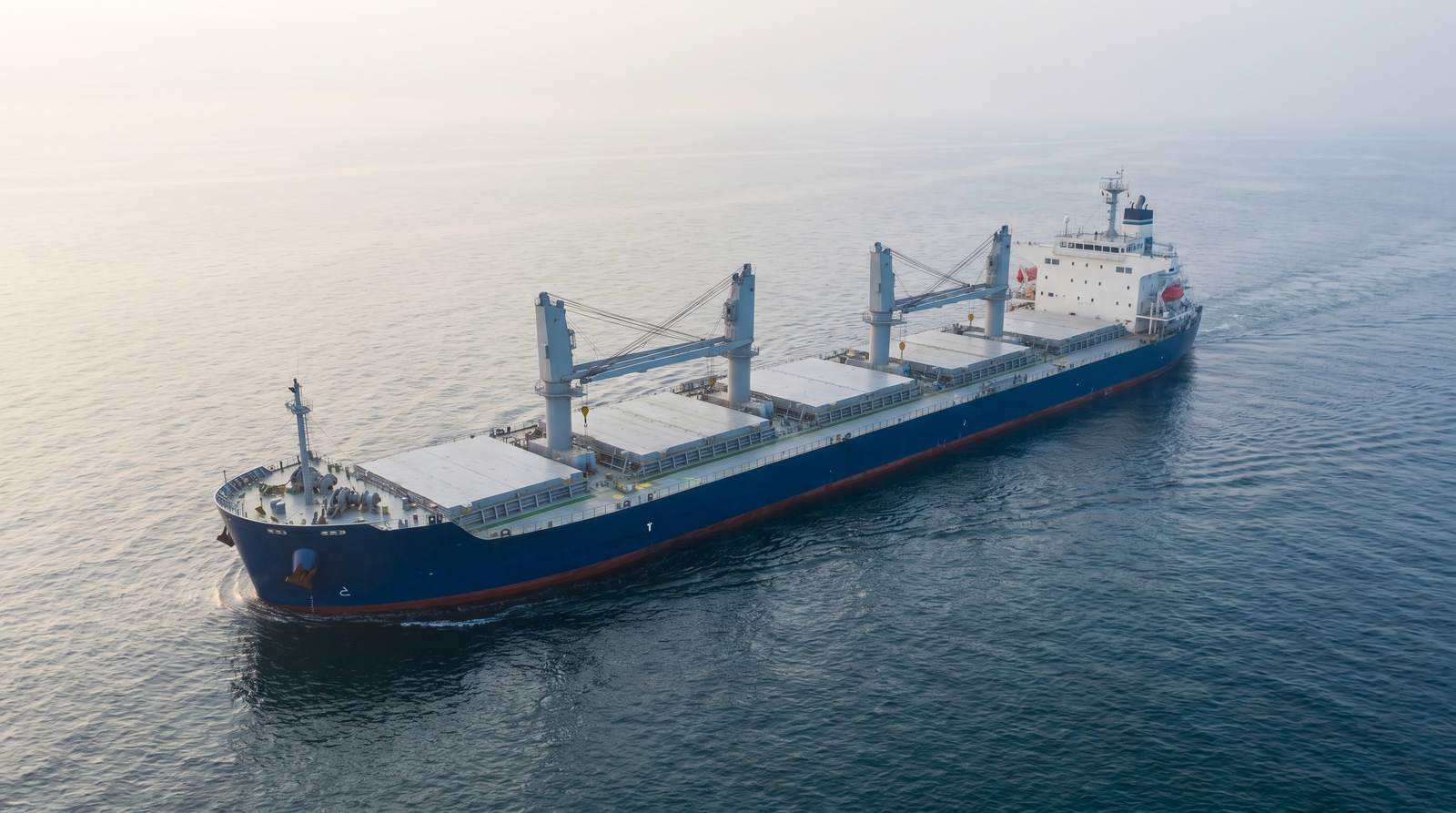
This is the most actively traded geared segment, and for many regional owners the natural entry point into mid-size dry bulk. A Supramax sits around 50,000–58,000 DWT; the modern Ultramax pushes that to roughly 61,000–65,000 DWT on a similar hull, with better cargo intake and noticeably better fuel performance per tonne-mile. Both keep their own cranes, which makes them the default choice for ports without reliable shore gear across South-East Asia, Africa and Latin America. Because the Ultramax carries more cargo for only a marginal change in operating cost, it has become the newbuilding sweet spot in the geared classes — which is also why secondhand Ultramax tonnage holds its value relatively well. You can see current Ultramax and Kamsarmax examples in our newbuilding section.
Panamax and Kamsarmax: roughly 65,000–85,000 DWT
Named for the old Panama Canal locks, the classic Panamax runs about 65,000–80,000 DWT and is gearless, relying on shore cranes — which ties it to larger, well-equipped terminals moving coal, grain and bauxite. Lose access to shore gear and the ship cannot work, so the trade pattern is less flexible than a geared bulker’s. Kamsarmax is the evolution: around 82,000 DWT, sized to the maximum length that can load at Port Kamsar in Guinea, and now the dominant newbuilding spec in the segment. The extra intake over a traditional Panamax comes with little operating penalty, which is why so much recent ordering has concentrated here — and why an older plain Panamax should be priced against that more efficient benchmark, not in isolation. If you are weighing a new order against buying resale, our newbuild vs secondhand comparison lays out the trade-offs, and our buyer’s due-diligence guide covers what to check on a secondhand candidate.
Capesize and above: 100,000 DWT and up
Too large for the Panama Canal locks (historically routing via the Cape of Good Hope or Cape Horn, hence the name), Capesize vessels of roughly 150,000–180,000 DWT — and the larger Newcastlemax and VLOC classes above them — move iron ore and coal on long-haul routes between a handful of deep-water terminals. They offer the lowest cost per tonne in the entire dry-bulk fleet but the least flexibility: only a limited number of ports can take them, and a single cargo type dominates. Their earnings swing hard with the iron-ore and coal trades, a markedly different risk profile from the steadier, more diversified geared segments that most regional owners buy into first.
Beyond deadweight: age, class and compliance
Size class narrows the field, but it does not finish the decision. Within any band, a vessel’s value turns on build year, the classification society and its survey status (CCS, ABS, DNV, BV, LR or NK), yard pedigree, and increasingly its environmental standing under EEXI and the annual CII rating. A poorer CII rating can mean speed limits or costly modifications down the line, so two ships of identical deadweight can carry very different real costs of ownership. A younger, fuel-efficient Ultramax may out-earn a cheaper, older Panamax once bunkers and compliance are factored in — which is precisely why headline deadweight and asking price are only the starting point of a sensible valuation.
Which class should a buyer target?
Start from the cargo and the ports, not the headline deadweight. If your trade runs through smaller or under-equipped ports, a geared Handysize, Supramax or Ultramax keeps you independent of shore cranes and open to more berths. If you are feeding large terminals on grain or coal, a Panamax or Kamsarmax lowers your cost per tonne. If you are committed to long-haul iron ore between deep-water terminals, Capesize economics are hard to beat — provided you can live with the volatility. Then weigh age, class society and fuel performance against price before you commit. You can browse current options across these segments on our vessels for sale page, and if you want a steer on which class fits a specific trade, talk to a broker before you commit to an inspection.