

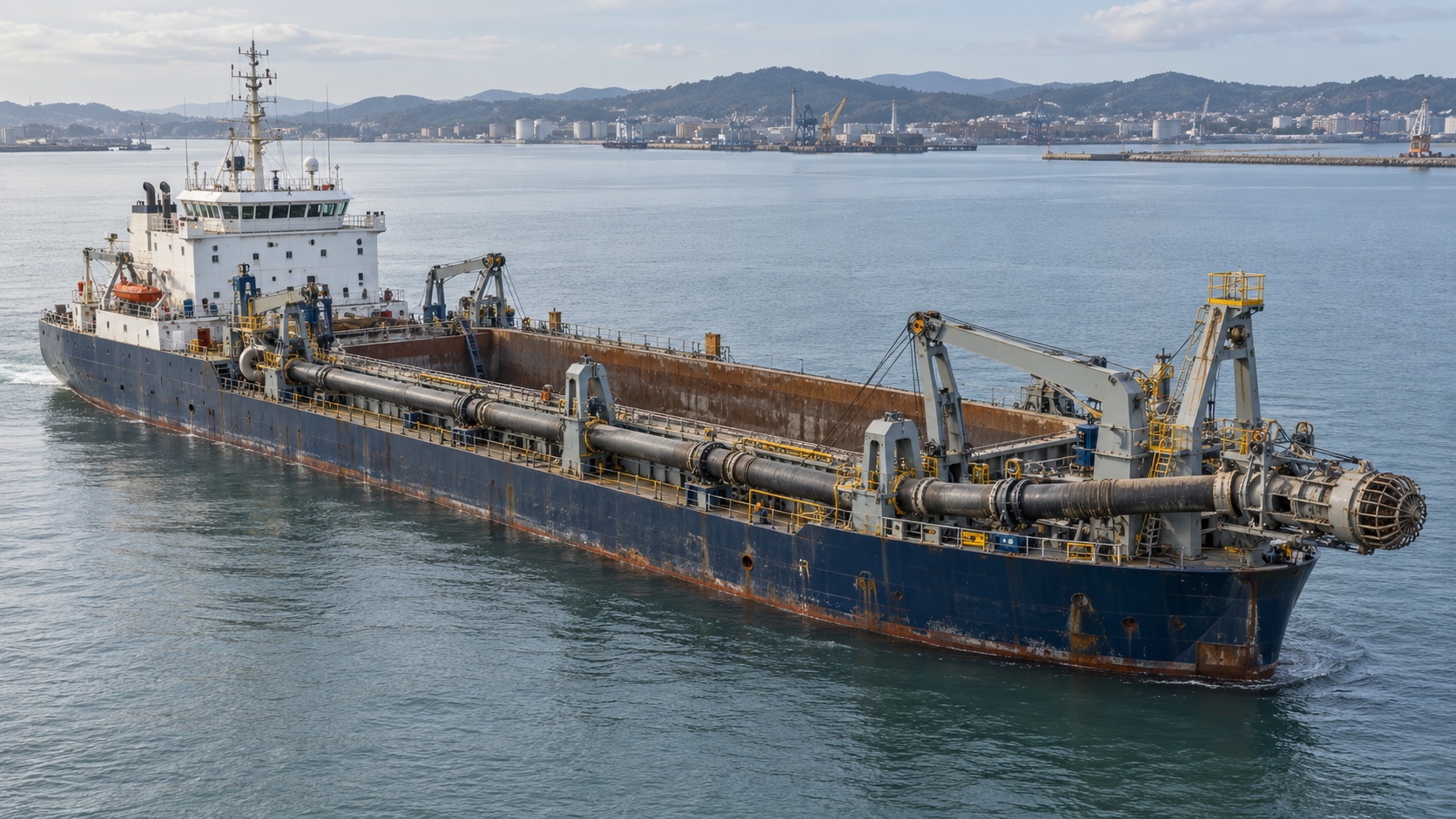
A used trailing suction hopper dredger (TSHD) should be assessed as both a ship and a working dredging plant. A seaworthy hull does not establish that the pumps, drag arms or hopper discharge system can deliver the production your project needs. Before committing to a vessel, turn the sales particulars into a documented inspection plan and agree what the seller will demonstrate.
This checklist is for buyers comparing secondhand TSHDs and preparing a pre-purchase survey. For vessel selection and dredger types, start with our TSHD buying guide. To explore available candidates, browse dredgers for sale and request current particulars.
1. Set the project requirements before inspecting the vessel
Write down the material to be dredged, required seabed level, access restrictions and intended discharge route. Include the sailing distance to the placement site and the operating window. These become the criteria for accepting a candidate, rather than treating hopper volume as the deciding number.
- Ground conditions: obtain the available geotechnical information, including grain size, compactness and any debris or obstructions. Ask which drag head and jetting arrangement has worked on comparable material.
- Depth and access: specify dredging depth, channel limits and the draft available along the entire loaded route, including the discharge location.
- Placement method: establish whether the job needs bottom dumping, pumping ashore or rainbowing, and what pipeline equipment must accompany the vessel.
- Production basis: define the quantity to be delivered and how it will be measured. Hopper mixture volume and accepted in-place volume are different measures.
2. Request a document pack before travelling
Ask for dated records that identify the vessel and its installed equipment. A brochure for the original design does not prove the present configuration. Record missing documents and resolve major gaps before paying for mobilisation of the inspection team.
- General arrangement, hopper plan, capacity information and approved stability documentation relevant to the intended loading condition.
- Current class status, survey dates, outstanding conditions or recommendations, and applicable statutory certificates. Have the surveyor identify restrictions relevant to the intended operation.
- Dredge-pump specifications and curves, drive ratings, suction-pipe drawings, drag-head details and the installed discharge arrangement.
- Drydock reports, hull thickness measurements, machinery maintenance records and dredging-plant repair history, including modifications.
- Recent dredging logs or trial records with soil, depth, loading and discharge conditions; an inventory of spares and equipment included in the sale.
Keep technical acceptance separate from ownership checks. Use appropriate sale-and-purchase advisers to establish title, encumbrances and the documentation needed for delivery. Our ship acquisition due diligence guide provides a broader framework.
3. Inspect the dredging plant systematically
Commission an independent surveyor with dredger experience and involve a dredging engineer where the work requires performance assessment. The table below is a practical inspection brief; the final scope should reflect access, equipment design and the vessel’s condition.
| System | Inspection focus | Question to resolve |
|---|---|---|
| Dredge pumps and drives | Review wear measurements, impeller and casing condition, shaft seals, bearing records and drive maintenance. Inspect accessible parts using agreed safe isolation. | Which components need replacement, and does the installed pump match the supplied curve? |
| Drag arms and suction pipes | Check abrasion, elbows, joints, supports, lifting points and evidence of repairs. Compare measurements with drawings and applicable acceptance criteria. | Is the advertised depth available with the arms and extensions included in the sale? |
| Drag heads and jetting | Inspect wear parts, water passages, connections and any active components. Review the jet-pump condition and controls. | What material was the head configured to dredge, and what conversion is required for our job? |
| Gantries, winches and hydraulics | Inspect wires, sheaves, cylinders, foundations and hoses; witness controlled deployment and recovery when safe. | Can the arm be handled reliably, and are leaks or control faults recorded? |
| Hopper and bottom discharge | Review abrasion and corrosion, local repairs, door or valve seals, actuators and accessible structural areas. | Do the closures operate and seal properly, and what requires drydock access? |
| Pump-ashore equipment, if fitted | Check the bow coupling, valves, pipework, jetting and discharge controls; reconcile equipment against the sale inventory. | Can the installed arrangement serve the proposed pipeline duty? |
| Monitoring and controls | Compare depth, flow, density and loading indications with calibration records or agreed reference checks. Test relevant alarms and interlocks. | Are the trial readings dependable, and are software access and support available? |
4. Check draft, payload and operating restrictions together
Hopper capacity is a volume, not an unconditional payload allowance. Establish the weight of the intended load and the permissible loading condition from vessel-specific documentation. Fuel, stores and other weights also affect what can be carried. A larger hopper offers little benefit if the vessel cannot use it on the project route.
As a concrete example, Damen’s published TSHD 1000 specification lists a 1,000 m³ hopper, 1,400 tonnes deadweight and 3.90 m dredging draft as separate figures. It also states dredging-service restrictions in the class notation. Those particulars illustrate why a buyer must check capacity, draft and service limits individually; they are not specifications for every TSHD.
Ask the surveyor to reconcile the candidate’s certificates, stability information and proposed operation. Do not assume a dredging draft is permitted for every transit condition, or that navigation capability automatically establishes the permitted conditions for dredging.
5. Agree a working trial that produces usable evidence
A machinery demonstration alongside is useful, but it cannot establish production on your target soil. Before the trial, record the test location, material, water depth, vessel condition, equipment configuration, measurements and acceptance criteria. Where representative conditions are unavailable, identify the resulting uncertainty in the inspection report.
- Record deployment and recovery of the drag arm, depth control and the response of the dredging controls.
- During loading, log available flow and density readings, pump speed or power, draft changes and the duration of loading. Record how instruments were checked.
- Witness the installed discharge method relevant to the purchase. Pumping through a short test line does not establish performance through the project’s longer pipeline.
- Record faults, leaks, abnormal vibration and interruptions. Agree how failed demonstrations will be repeated or investigated.
Evaluate the full operating cycle: loading, loaded transit, discharge, return and operational delays. Request comparable historical logs and have an engineer distinguish measured performance from a forecast. Two dredgers with similar hopper volumes may produce different delivered quantities over a working day.
6. Include overflow conditions in the production assessment
Overflow can affect both retained material and the environmental conditions of the work. Confirm the applicable project requirements before using historical loading records to forecast output. Identify whether the trial and the planned job permit the same overflow regime, and test fitted controls within the agreed operating limits.
An environmental valve or monitoring package is equipment to inspect, not proof that the vessel is accepted for a particular site. Obtain the project-specific requirements and account for any resulting limits in the production estimate.
7. Price the defects and missing equipment before agreeing delivery
Turn the findings into a costed repair list with a responsible party and completion date. Obtain quotations for major pump work, pipe repairs, hopper closures and controls. Identify which items can be addressed afloat and which need docking, specialist labour or long-lead components.
- Separate immediate repairs from maintenance expected during the first operating period.
- Confirm included drag heads, spare impellers, wear parts, pipeline sections and couplings by an itemised inventory.
- Budget transport to the project, crew familiarisation, commissioning, insurance and any required flag or class changes.
- Have advisers reflect inspection access, agreed tests, defect resolution and delivery documentation in the transaction terms.
Pre-purchase sign-off checklist
- Project soil, depth, access draft and discharge route documented.
- Installed configuration reconciled with drawings and sale inventory.
- Class status, survey liabilities and service restrictions reviewed.
- Hull and dredging-plant inspection completed, with inaccessible areas identified.
- Working trial assessed against agreed conditions and measurements.
- Repair quotations, missing equipment and mobilisation costs included in the budget.
- Ownership and delivery documentation reviewed by the appropriate advisers.
Frequently asked questions
Can I buy a TSHD based on hopper capacity alone?
No. Check the permitted load, access draft, dredging depth, plant condition and discharge arrangement against the job. Use working records to assess the operating cycle rather than assuming every hopper load represents the same delivered quantity.
Does a sea trial prove dredging performance?
A conventional sea trial can demonstrate aspects of propulsion and navigation. Dredging performance needs an agreed working trial with the relevant plant operating and its conditions recorded. Ask for both scopes where appropriate.
Is pump-ashore capability standard on every TSHD?
Confirm it on the specific vessel. Damen’s TSHD 1000 sheet lists the self-emptying arrangement with bow coupling and rainbow nozzle as an option, showing why a design’s available features must be distinguished from installed equipment.
Technical references
For equipment principles, see IADC’s trailing suction hopper dredger overview. For the vessel-specific example and optional equipment, see Damen’s TSHD 1000 product sheet. Inspection recommendations above are a buyer’s planning framework; acceptance depends on the candidate vessel and agreed survey scope.
To request a shortlist, send the required hopper capacity, dredging depth, material, access draft, discharge method and delivery window through our enquiry form. Include the proposed working area so the initial comparison can address operating restrictions as well as vessel size.
Buying, or want a second opinion?
Our sale & purchase desk can help you find, value and inspect the right tonnage. Tell us what you’re looking for and we’ll revert within one working day.