

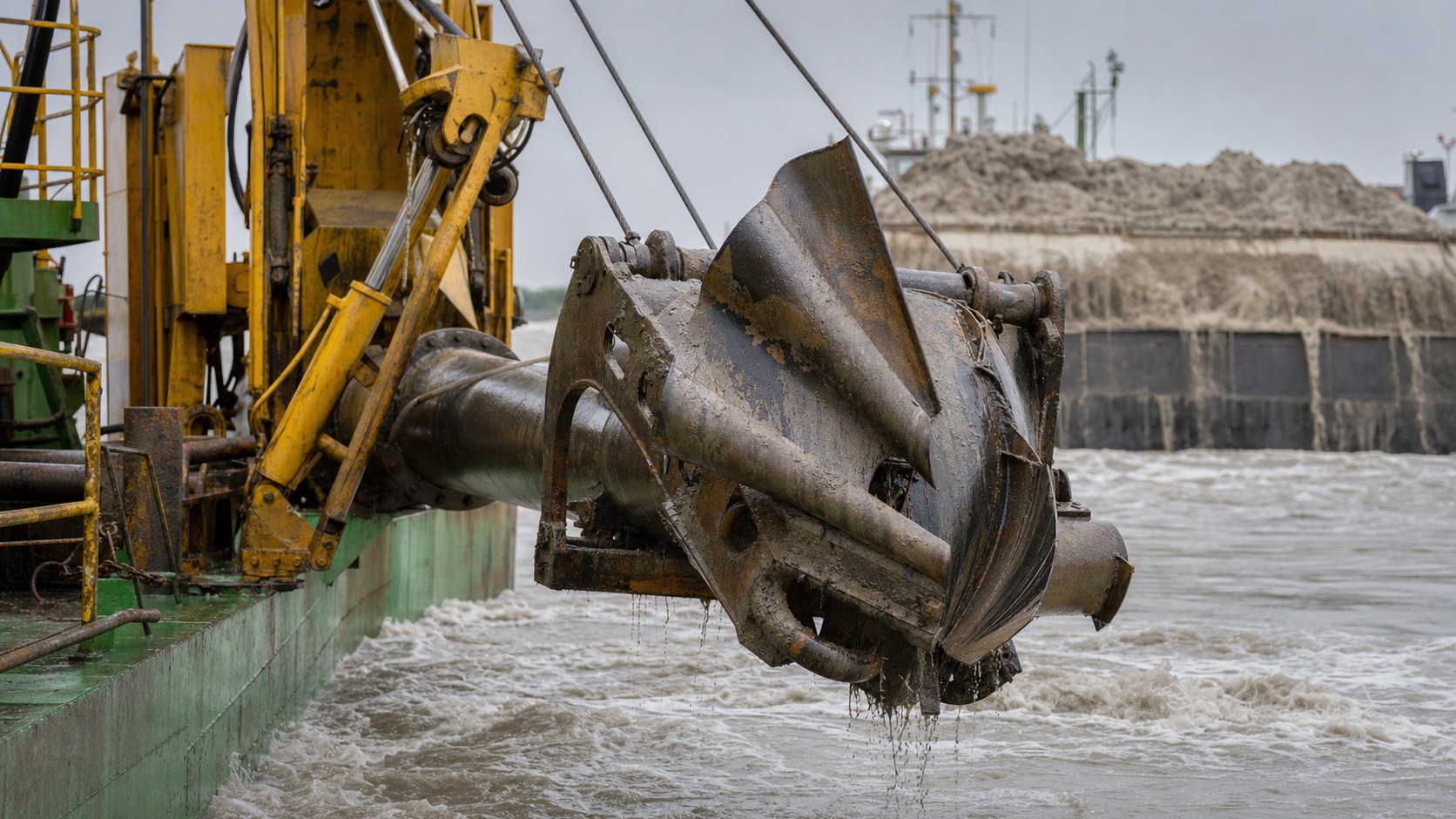
A dredger is a capital-heavy, highly specialised asset, and the trailing suction hopper dredger (TSHD) is the workhorse of maintenance dredging, capital dredging, and land reclamation. It’s essentially a self-propelled ship that vacuums material off the seabed into its own hopper while under way, then sails off to discharge. Two TSHDs of similar hopper size can suit completely different jobs depending on dredging depth, pump power, and how they discharge. This guide explains the type, the numbers that matter, and what to check before you buy or order.
Dredger types: TSHD vs. CSD vs. mechanical
Match the dredger to the job and the soil before anything else:
| Type | How it works | Best for |
|---|---|---|
| Trailing Suction Hopper Dredger (TSHD) | Self-propelled; drags suction pipe(s) along the seabed, loads its own hopper under way | Maintenance dredging, capital dredging, land reclamation, sand mining — in open/exposed water |
| Cutter Suction Dredger (CSD) | Stationary; a rotating cutter head breaks hard soil, pumped ashore via pipeline | Hard/compact soil, rock, sheltered water, continuous pumping to shore |
| Backhoe / Grab / Bucket | Mechanical excavator on a pontoon | Confined areas, quays, hard/mixed material, precise work |
The TSHD’s advantage is mobility and open-water capability: it works without anchors or a fixed pipeline, sails to the disposal or reclamation site, and discharges itself.
See current availability on our dredgers for sale page.
The numbers that define a TSHD
A “9,000 m³ dredger” only tells you the hopper size. What actually decides whether it can do your job:
| Spec | Why it matters |
|---|---|
| Hopper capacity (m³) | Load carried per cycle — headline productivity, but only with depth and pump to match |
| Dredging depth | Maximum depth the suction pipe(s) can reach — often different per arm (e.g. 35 / 40 / 50 / 60 m) |
| Number of suction pipes | Single vs. twin drag arms — twin doubles intake and suits larger jobs |
| Dredge pump power & type | Whether it can lift your soil at depth; inboard/submerged pumps |
| Drag head type | Suited to sand, silt, or clay — the wrong head loads slowly |
| Self-propelled + twin screw | Independent transit and manoeuvring on the dredging track |
| Light / design / dredging draft | Access to shallow sites vs. loaded operating draft |
In-stock and newbuilding TSHDs are commonly self-propelled, twin-drag-arm units around 9,000 m³ with dredging depth to 40–60 m — capable of both maintenance and deeper capital work.
How it discharges: the feature that fits it to your project
How a TSHD unloads decides which projects it suits:
- Bottom dumping — hopper doors or conical bottom valves open to dump material at a disposal site. Fast; for offshore disposal and deep-water reclamation.
- Bow (pump-ashore) discharge / “rainbowing” — material is pumped through a bow coupling onto a reclamation area or sprayed (“rainbowed”) to build up land. Essential for land reclamation.
- Self-discharge combinations — many modern units offer bottom doors and bow coupling for flexibility across disposal and reclamation jobs.
Tip: If your work is land reclamation, confirm the bow-coupling / pump-ashore capability and pump power — not just hopper size. If it’s offshore disposal, bottom-door discharge speed matters most.
Class, ice, and dredging notations
A dredger’s class notations tell you what it’s certified to do:
- Class & status — in class with a recognised society (e.g. CCS, ABS, DNV, BV, LR), no overdue surveys or outstanding Conditions of Class.
- Dredger class notation — e.g. “Trailing Suction Hopper Dredger” with a dredging service/area restriction (dredging within a defined sea area/range).
- Ice class — if you’ll work high-latitude or seasonal-ice waters.
- Statutory certificates — Load Line, Tonnage, Safety, and pollution certificates; note that loaded dredging draft differs from design draft.
- Automation / survey notations — unmanned machinery space, in-water survey, etc., which affect crewing and docking costs.
Newbuilding vs. secondhand
Dredgers are highly engineered around a specific dredge-pump, drag-arm, and hopper configuration, so they’re often ordered new to a project’s exact depth and soil requirements — or bought secondhand for immediate mobilisation at lower cost. A modern newbuilding gives you the exact dredging depth, pump, and discharge fit plus a clean survey history; a quality secondhand unit is available now and cheaper. Weigh lead time and specification against price and immediate availability. For carrying dredging equipment or spoil on deck alongside the dredger, compare a self-propelled deck cargo vessel; for fixed lifting at the worksite, a floating crane.
Survey: the dredging plant gets tested, not just inspected
Commission an independent pre-purchase condition survey, and a drydock survey for any serious purchase. On a TSHD the dredging system is the heart of the deal:
- Dredge pumps — condition, wear, and performance; the most expensive components.
- Suction pipes, gantries & drag heads — wear, hydraulics, and winches.
- Hopper & bottom-discharge system — doors/conical valves, seals, and structural condition (heavy abrasion and corrosion here).
- Bow-coupling / pump-ashore system — if fitted.
- Overflow, degassing & dredge-monitoring/automation — operational tests.
- Hull & propulsion — thickness gaugings (abrasion-prone), main engines, twin screws, and steering.
Tip: A cheap dredger with worn pumps, drag heads, or a tired bottom-door system can cost far more than a dearer, well-maintained unit once you add overhaul and lost dredging days. Survey and test the dredging plant before the price tempts you.
Due diligence and total cost of ownership
Reputable sellers release full particulars to qualified buyers under an NDA. Insist on the GA, dredging-installation specification (pump curves, drag depth, hopper/discharge details), class certificates and survey status, maintenance and drydock history, and a clean title free of liens. Then budget beyond the price: survey and any class rectification, dredge-pump/drag-head overhaul reserve, mobilisation to the worksite, flag and class transfer, insurance, and spares.
Quick pre-signing checklist
- ☐ Dredger type (TSHD vs CSD vs mechanical) matched to soil and site
- ☐ Hopper capacity, dredging depth (per arm), and pump power confirmed for your job
- ☐ Number of suction pipes and drag-head type suited to your material
- ☐ Discharge method (bottom doors and/or bow coupling) fits disposal vs. reclamation
- ☐ Class notation, dredging area restriction, and ice class checked
- ☐ Light / design / dredging drafts suit your sites
- ☐ In class, no overdue surveys / Conditions of Class; special survey priced in
- ☐ Independent condition survey (+ drydock), dredging plant tested
- ☐ Full documents under NDA; clean title confirmed
- ☐ Total cost of ownership budgeted (incl. pump/drag-head overhaul reserve, mobilisation)
Frequently asked questions
What is a trailing suction hopper dredger (TSHD)? A TSHD is a self-propelled dredging ship that drags one or two suction pipes along the seabed and loads dredged material into its own hopper while under way, then sails to a disposal or reclamation site to discharge. It’s used for maintenance dredging, capital dredging, land reclamation, and sand mining, especially in open water.
What’s the difference between a TSHD and a cutter suction dredger (CSD)? A TSHD is mobile and self-loading, working in open/exposed water without anchors. A CSD is stationary, using a rotating cutter head to break harder soil or rock and pumping it ashore through a pipeline — better for hard soil and sheltered water. Choose by soil type and site exposure.
What hopper capacity and dredging depth do I need? Match them to your project: hopper capacity drives per-cycle productivity, but only if dredging depth and pump power reach and lift your soil. Confirm the maximum dredging depth (often different per suction arm, e.g. 40–60 m) and the pump performance for your material, not just the hopper size.
How does a TSHD discharge its load? By bottom dumping (hopper doors or conical bottom valves) for offshore disposal and deep reclamation, and/or by bow-coupling pump-ashore and “rainbowing” for land reclamation. Many modern units offer both for flexibility.
Should I buy secondhand or order a newbuilding? Dredgers are engineered around a specific pump, drag-arm, and hopper configuration, so they’re often ordered new to an exact depth/soil spec — or bought secondhand for immediate, lower-cost mobilisation. Weigh lead time and specification against price and availability.
Looking for a dredger now? Golden Shipyard offers in-stock and newbuilding dredgers, including self-propelled trailing suction hopper dredgers around 9,000 m³ with deep dredging capability and combined bottom-door and bow-coupling discharge. Browse current availability on our dredgers for sale page, or learn about our ship sale & purchase brokerage services. To receive full particulars under NDA, email [email protected].
Buying, or want a second opinion?
Our sale & purchase desk can help you find, value and inspect the right tonnage. Tell us what you’re looking for and we’ll revert within one working day.