

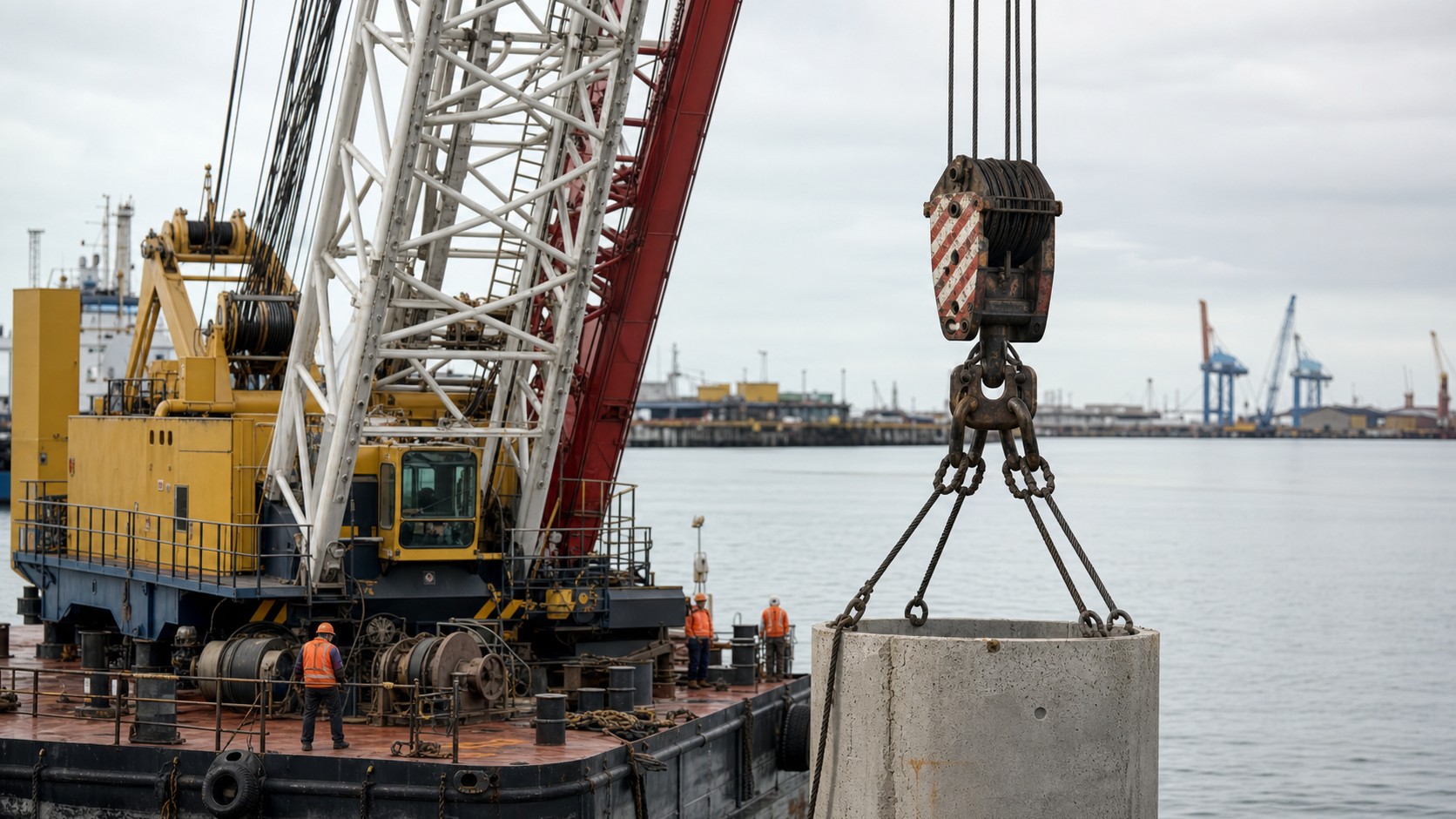
A floating crane — also called a crane barge, crane vessel, or sheerleg — is a workhorse for port construction, salvage, offshore installation, bridge building, and heavy-lift transfers afloat. It’s a specialist asset, and the spec sheet hides what really matters: not just how many tonnes it lifts, but at what radius, whether the crane revolves, whether the hull can move itself, and how it holds position over the lift. Get those wrong and the crane can’t do your job at all. This guide covers what to check before you buy.
What a floating crane is — and the three things that define it
A floating crane is a crane mounted on a pontoon or ship-shaped hull. Three choices define what any given unit can do:
1. Crane type — fixed/sheerleg vs. fully revolving. 2. Propulsion — self-propelled vs. non-propelled (towed). 3. Lifting capacity at radius — the SWL curve, not a single headline number.
In-stock floating cranes commonly run in the 200–300 t lifting-capacity range, both self-propelled and non-propelled, with four-anchor positioning for coastal and near-coastal work.
See current availability on our floating cranes for sale page.
Fixed (sheerleg) vs. revolving crane
This is the first fork, and it decides how you can work a load:
- Fixed / sheerleg — the boom is fixed in line with the hull; you luff (raise/lower) and slew the whole vessel to position the load. Very high capacity for the cost, extremely stable, ideal for repetitive heavy lifts (caissons, bridge spans, salvage). Less flexible for placing loads around the deck.
- Fully revolving — the crane slews 360° independently of the hull. Far more flexible for construction, loading barges alongside, and placing cargo on deck — usually at a somewhat lower capacity-to-cost ratio than a sheerleg.
Tip: Match the crane type to the task pattern. Repetitive straight-ahead heavy lifts → sheerleg. Varied placement and alongside work → revolving.
Self-propelled vs. non-propelled — read the certificate carefully
Just like deck cargo vessels, floating cranes split into two operating models — and here the distinction has a legal edge:
- Self-propelled — has main engines and can transit on its own (often twin-engine, twin-screw), repositioning between jobs without a tug.
- Non-propelled — must be towed. Note a common trap: some “non-propelled” units carry engines only for on-site repositioning, with the certificate expressly prohibiting self-navigation. Don’t assume an engine means it can sail — check the certificate’s restriction note.
If you’ll move the crane between ports often, a self-propelled unit saves repeated towage; if it works one harbour, a non-propelled barge is cheaper to buy and run.
Lifting capacity: read the load chart, not the headline
A “300-tonne crane” only lifts 300 t at a specific (usually short) radius. What matters:
| Spec | Why it matters |
|---|---|
| SWL at radius (load chart) | Maximum safe load falls as the hook reaches further out — get the full curve |
| Main hook vs. auxiliary hook | Heavy lifts on the main hook; faster, lighter work on the aux/whip |
| Maximum & minimum radius / outreach | Whether the hook reaches your load over the quay, barge, or structure |
| Lifting height above deck/water | Clearance for tall units and tide |
| Revolving vs. fixed limits | Slew range and any capacity reduction off the bow |
For project and offshore cargo that also has to be carried, weigh a floating crane against a self-loading deck cargo vessel or a heavy-lift multipurpose vessel with its own cranes.
Stability, positioning, and working area
A crane afloat is only as good as the platform under it:
- Stability during lift — the hull must stay within safe heel/trim as the load swings; review the stability booklet and any ballast/counter-ballast system.
- Four-anchor (or spud) positioning — how the unit holds station over the lift; check winches, wires, and anchors.
- Deck strength & space — for cargo, rigging, and any skidding.
- Service/navigation area — coastal, near-coastal (A1+A2), or sheltered water only — this caps where you can legally and safely work.
- Working water depth — relevant for anchoring and spud-equipped units.
Survey: the crane gets tested, not just inspected
Commission an independent pre-purchase condition survey, and a drydock survey for any serious purchase. On a floating crane the lifting plant is the heart of the deal:
- Crane load test — review the latest load-test certificate and, ideally, witness a test lift.
- Wires, hooks, sheaves & winches — wear, certification, and replacement history.
- Slew bearing / pivot (revolving) or sheerleg structure (fixed) — the most expensive components to repair.
- Hydraulics / luffing system — condition and leaks.
- Hull & pontoon — thickness gaugings, corrosion, watertight integrity, ballast system.
- Anchoring/positioning gear — winches, wires, anchors.
- For self-propelled units — main engines, shafting, steering.
Tip: A cheap crane with an out-of-date load-test certificate or a worn slew bearing can cost more than a dearer, well-certified unit once you add overhaul and lost working days. Survey and load-test the gear before the price tempts you.
Class, certificates, and due diligence
Before committing, confirm on paper and under NDA:
- Class & status — in class with a recognised society (e.g. CCS, ABS, DNV, BV, LR), no overdue surveys or outstanding Conditions of Class.
- Lifting appliance certification — crane register, load-test records, and any statutory lifting-gear certificates.
- Statutory certificates — Load Line, Tonnage, and (for self-propelled) Safety and pollution certificates; plus the service-area/navigation restriction note.
- GA, crane load chart, stability booklet, and maintenance/repair history.
- Clean title — no liens, mortgages, or maritime claims attached to the hull.
Then budget beyond the price: survey and load test, any crane/structure rectification, delivery or towage, flag and class transfer, insurance, and modifications for your work.
Quick pre-signing checklist
- ☐ Crane type (sheerleg vs revolving) matched to your task pattern
- ☐ Propulsion confirmed — and certificate’s self-navigation restriction read
- ☐ Full SWL-at-radius load chart reviewed (main + auxiliary hooks)
- ☐ Outreach, lifting height, and slew range suit your loads
- ☐ Stability booklet and ballast/positioning system checked
- ☐ Service/navigation area suits where you’ll work
- ☐ In class, no overdue surveys / Conditions of Class
- ☐ Crane load-test certificate current; gear surveyed (slew bearing/sheerleg, wires, winches)
- ☐ Full documents under NDA; clean title confirmed
- ☐ Total cost of ownership budgeted (survey, overhaul reserve, delivery, class transfer)
Frequently asked questions
What is a floating crane? A floating crane is a crane mounted on a pontoon or ship-shaped hull, used for heavy lifts afloat — port construction, salvage, offshore installation, bridge building, and barge loading. It may have a fixed (sheerleg) or fully revolving crane and may be self-propelled or towed.
What’s the difference between a sheerleg and a revolving floating crane? A sheerleg has a fixed boom in line with the hull and positions loads by moving the whole vessel; it offers very high capacity and stability for repetitive heavy lifts. A revolving crane slews 360° independently of the hull, giving far more flexibility for construction and alongside work, usually at a lower capacity-to-cost ratio.
Does a floating crane lift its rated capacity at any radius? No. A “300-tonne” crane lifts 300 t only at a specific (usually short) radius; capacity falls as the hook reaches further out. Always review the full SWL-at-radius load chart, not the headline figure.
Can a non-propelled floating crane move on its own? Generally no — it must be towed. Some non-propelled units carry engines only for on-site repositioning, with the certificate prohibiting self-navigation. Always read the certificate’s restriction note before assuming a unit can transit.
What survey does a floating crane need? An independent condition survey plus, ideally, a witnessed crane load test. Focus on the lifting plant — load-test certificate, wires, hooks, winches, slew bearing or sheerleg structure, hydraulics — alongside hull thickness gaugings and the positioning system.
Looking for a floating crane now? Golden Shipyard carries in-stock floating cranes and crane barges, including self-propelled and non-propelled units in the 200–300 t lifting-capacity range with four-anchor positioning. Browse current availability on our floating cranes for sale page, or learn about our ship sale & purchase brokerage services. To receive full particulars under NDA, email [email protected].
Buying, or want a second opinion?
Our sale & purchase desk can help you find, value and inspect the right tonnage. Tell us what you’re looking for and we’ll revert within one working day.