


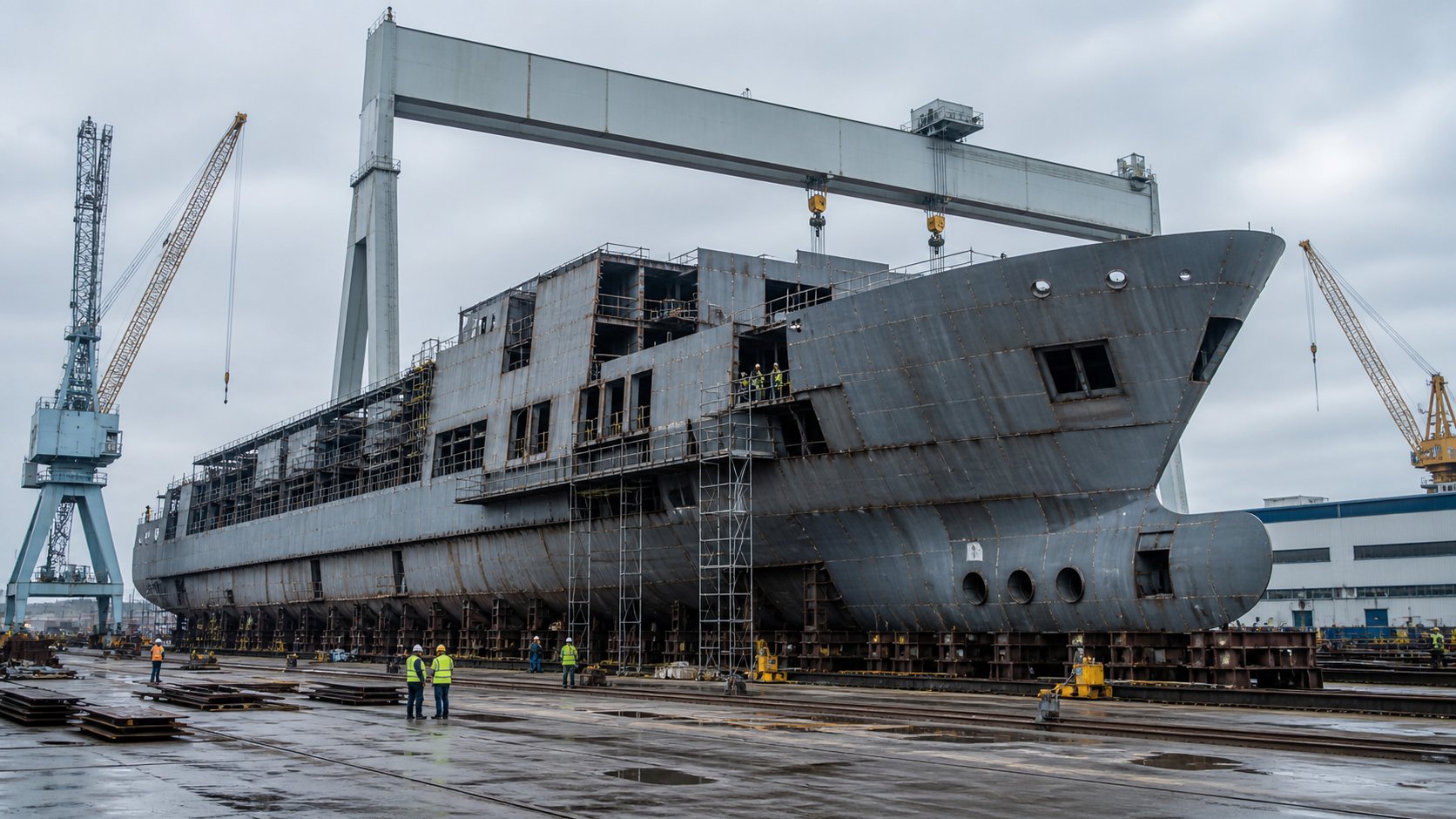
Buying a newbuilding is a different transaction from buying a ship that already exists. There is no hull to inspect, no survey history to read, and no class record to check — instead you are buying a set of drawings, a yard’s reputation, and a payment schedule stretched over two or three years before the vessel ever touches water. Done well, a newbuild gives you a ship built exactly to your trade, with a full class cycle ahead of it and no inherited maintenance debt. Done poorly, it ties up capital for years against a yard that slips its delivery date or a specification that was never pinned down tightly enough to enforce.
Newbuilding vs secondhand: the real trade-off
The newbuild premium buys three things a secondhand ship cannot offer: a specification built to your trade, a full survey cycle ahead rather than one already part-used, and compliance headroom against emissions rules that keep tightening. What it costs you is time — typically 18 to 30 months from signing to delivery — and price risk, since steel, labour and equipment costs can move against you over that window depending on the contract’s price-adjustment terms. A buyer who needs tonnage within the year is usually better served by secondhand; see how much does a container ship cost for what that comparison looks like on the water.
Choosing a yard
| What to check | Why it matters |
|---|---|
| Track record on the same ship type | A yard’s first attempt at a design carries more schedule and quality risk than its twentieth |
| Current order book and slot availability | A yard booked years out has less flexibility to absorb your changes without delivery slipping |
| Financial standing and refund guarantee provider | Instalments are paid before delivery; a bank-backed refund guarantee is what gets your money back if the yard fails |
| Classification society relationship | Yards work faster and cleaner with societies they build against routinely — see class notations |
| Sister-ship references | Inspecting a completed sister ship shows you the yard’s actual build quality, not its brochure |
The contract and payment schedule
Newbuilding contracts are almost always paid in instalments tied to build milestones rather than as a lump sum on delivery. A typical structure spreads roughly 20% across signing, steel cutting, keel laying and launching, with the balance — often 50–60% — due on delivery. Every instalment before delivery should be covered by a refund guarantee from a first-tier bank, so that a yard failure or late delivery returns your money rather than leaving you an unsecured creditor. The other terms worth negotiating as hard as price are the liquidated-damages rate for late delivery, the performance warranties on speed and fuel consumption, and the buyer’s right to a third-party supervisor on site throughout the build.
Specification: what actually gets negotiated
Steel and coatings. Coating specification is one of the highest-leverage decisions in the whole contract, because ballast tank and cargo hold coatings decide how much steel renewal the ship needs at its first and second special surveys. A higher-grade coating system costs more at build but can defer expensive steelwork for years — this is the detail behind newbuilding coatings searches, and it belongs in the contract’s technical specification, not left to the yard’s standard practice.
Main engine and gear box. Engine selection should be checked against fuel availability on your intended trades and against the emissions standard it needs to meet at delivery, not just today’s rules — see EEXI and CII explained.
Class notation. The notation you contract for follows the ship for its working life and should match the trades you actually intend to run, not the yard’s default — see what is class notation in shipping.
Cargo flexibility. Gear, tween decks or reefer capability decided at the design stage are far cheaper to build in than to retrofit — worth weighing against a purpose-built multi-purpose vessel specification if your trade pattern varies.
Build timeline
| Stage | Typical timing |
|---|---|
| Contract signing | T+0 — first instalment due |
| Steel cutting | 3–6 months after signing |
| Keel laying | 6–10 months after signing |
| Launching | 12–20 months after signing |
| Sea trials and delivery | 18–30 months after signing, depending on ship type and yard order book |
Tip: Put a supervisor on site from steel cutting onward, not just for delivery inspection. Coating thickness, weld quality and equipment installation are far cheaper to correct mid-build than after the ship is afloat.
Newbuilding contract checklist
- ☐ Yard’s track record confirmed on this ship type, not just this yard generally
- ☐ Refund guarantee in place from a first-tier bank for every pre-delivery instalment
- ☐ Coating specification set in writing, not left to yard standard
- ☐ Class notation matches intended trades
- ☐ Engine and emissions standard confirmed against rules in force at delivery
- ☐ Liquidated-damages rate for late delivery negotiated and capped
- ☐ Buyer’s right to an independent on-site supervisor confirmed
- ☐ Sister-ship inspected where one exists
Frequently asked questions
How long does it take to build a newbuilding vessel? Typically 18 to 30 months from contract signing to delivery, depending on ship type, size and how full the yard’s order book is at the time of signing.
Is a newbuilding cheaper than a secondhand ship? Not usually on price alone — a newbuild carries a premium for a full-life ship and current-generation specification. It can be cheaper on a total cost of ownership basis once you account for the survey and steel renewal costs a secondhand ship will incur sooner.
What is a refund guarantee? A bank instrument that returns your pre-delivery instalments if the yard fails to deliver, whether from insolvency or default. Every reputable newbuilding contract requires one, issued by a first-tier bank rather than the yard itself.
Can I change the specification after signing? Yes, through a variation order process, but changes get more expensive and schedule-risky the later they come — anything affecting steel or major equipment should be locked in before steel cutting.
Do I need my own supervisor at the yard? Strongly recommended. An independent supervisor represents your interests during construction in a way the yard’s own quality control does not, and catches coating and welding issues while they are still cheap to fix.
How does newbuilding pricing compare across yards? Price varies with yard tier, country, current order-book pressure and steel prices at time of contracting — get quotes from more than one yard and compare on a like-for-like specification, not headline price alone.
Considering a newbuild? Golden Shipyard advises buyers through yard selection, contract negotiation and build supervision from steel cutting to delivery. Browse current tonnage under vessels for sale, or talk to us about a newbuilding project through our ship sale & purchase brokerage services. For a confidential discussion, email [email protected].
Buying, or want a second opinion?
Our sale & purchase desk can help you find, value and inspect the right tonnage. Tell us what you’re looking for and we’ll revert within one working day.