

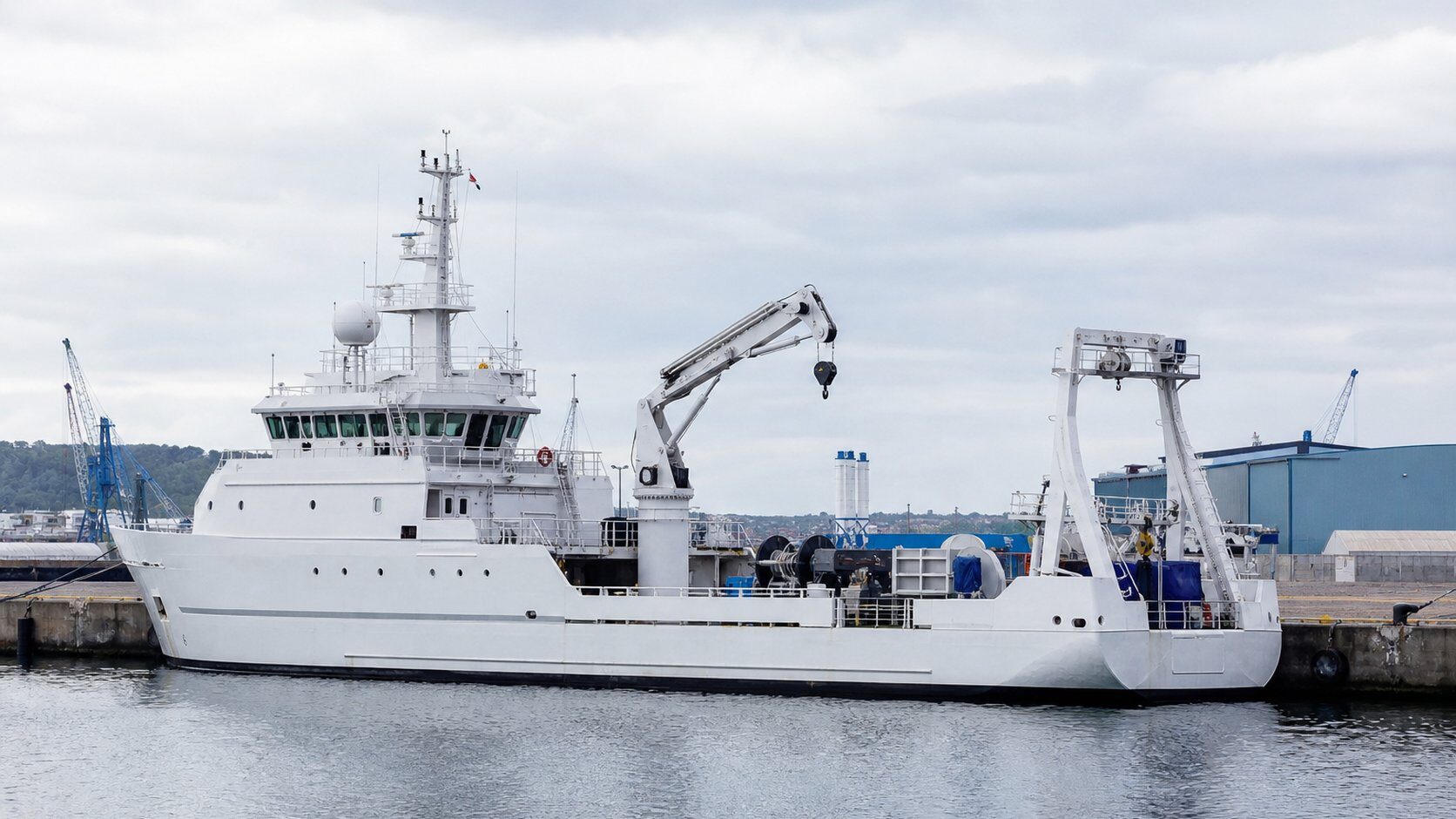
Special purpose vessels do not fit the standard categories a ship buyer usually works from. There is no size class, no TEU count, no deadweight table that tells you whether one suits your mission — because each was built or converted around a specific role: oceanographic research, offshore accommodation, submarine cable lay, hydrographic survey, or another niche task with its own deck equipment and endurance requirements. Buying one means starting from the mission, not the ship type, and checking the things that actually decide whether the vessel can do the job.
What counts as a special purpose vessel
| Type | Built for | Defining equipment |
|---|---|---|
| Research / oceanographic | Scientific survey, sampling, environmental monitoring | Wet and dry labs, moon pool, winches, low-noise propulsion |
| Accommodation | Housing offshore workforce alongside platforms or construction sites | Cabin capacity, DP, gangway or bridge-link system, galley and messing |
| Cable-lay / repair | Laying or repairing submarine power and telecom cable | Cable tanks, linear cable engines, bow/stern chutes, ROV spread |
| Survey / hydrographic | Seabed mapping, geotechnical and geophysical survey | Multibeam sonar, moon pool or over-side deployment, DP |
| Other niche conversions | Training, patrol, salvage support and one-off roles | Varies entirely by original build and conversion history |
Golden Shipyard sources and lists special purpose tonnage as availability allows — see current stock under special purpose vessels for sale. Because listings in this category are irregular, tell us the mission and we match candidates from the wider market.
Start from the mission, not the ship
A conventional cargo ship purchase starts with a size and trade, then narrows on condition. A special purpose vessel purchase runs the other way: define the mission first — what equipment must be aboard, what endurance and range it needs, what deck and crane capacity the work requires — and only then look at hulls that can carry it. Two vessels of identical length and tonnage can be worlds apart in what they can actually do, because the value sits in the mission fit-out, not the steel.
What to check before you commit
- Mission equipment condition and calibration — sonar, winches, cranes, cable engines or lab equipment are usually the most expensive and hardest-to-source items aboard; confirm they work, not just that they are fitted.
- Conversion history — many special purpose vessels started life as something else. A clear paper trail of what was converted, by whom, and to what class-approved standard matters more here than on a purpose-built cargo ship.
- Class and survey status — confirm the vessel is in class for its actual current role, not just generally in class; a research or cable-lay notation is not automatic and may need to be applied for.
- Propulsion, DP and endurance — station-keeping (DP1/DP2) is essential for survey, cable and accommodation roles; range and fuel capacity decide how far from support the vessel can operate.
- Crew and mission-team accommodation — scientific, technical or workforce complements beyond the standard crew need certified berths, and headcount often caps what the vessel is licensed to carry.
- Spares and support availability — specialised equipment from a single manufacturer can mean long lead times on repair; check what spares come with the vessel and what the OEM support situation looks like.
Survey: what a surveyor needs to know before they start
A standard condition survey covers hull, machinery and safety systems the same way on any ship — see pre-purchase ship inspection for that baseline. On a special purpose vessel, brief the surveyor on the mission equipment specifically, ideally with someone who has operated that type of gear, since a generalist marine surveyor may not be equipped to assess whether a multibeam array or a cable engine is fit for purpose. Budget for a specialist inspection of the mission systems as a separate line item from the hull and machinery survey.
Tip: Ask for the equipment maker’s service records, not just the ship’s class certificates. A cable engine or scientific winch with no service history is a bigger unknown than a hull with a gap in its survey record, because there is often no independent society standard to fall back on.
Newbuild, conversion, or as-is purchase
Three paths lead to a special purpose vessel: a purpose-built newbuild to an exact mission spec (see newbuilding vessels for how that process runs), a conversion of a suitable secondhand hull, or buying a vessel already fitted for the role. A conversion can be the cheapest route if a hull with the right size, deck space and power already exists, but conversion costs are notoriously hard to fix in advance — get a firm yard quote before assuming it beats a newbuild on price.
Special purpose vessel checklist
- ☐ Mission defined in writing: equipment, endurance, crew/team headcount
- ☐ Conversion history documented, with class-approved standards referenced
- ☐ Class notation confirmed as valid for the intended current role
- ☐ DP class and station-keeping capability matched to the work
- ☐ Mission equipment inspected by a specialist, separate from the hull survey
- ☐ OEM service records and spares availability confirmed for key equipment
- ☐ Accommodation certified for the full crew plus mission-team headcount
- ☐ Conversion-vs-newbuild cost compared against a firm yard quote, not an estimate
Frequently asked questions
What is a special purpose vessel? A ship built or converted for a dedicated non-standard role — research, accommodation, cable-lay, survey or another niche task — where mission equipment, not cargo capacity, defines its value.
How is buying a special purpose vessel different from buying a cargo ship? The starting point is the mission rather than a size and trade. Two hulls of similar size can differ enormously in usable capability depending on their fit-out, conversion history and equipment condition.
Should I buy a converted vessel or a purpose-built newbuild? A conversion of a suitable secondhand hull can be faster and cheaper if the right base vessel exists, but get a firm yard quote before committing — conversion costs are difficult to estimate accurately in advance. A newbuild gives an exact spec with no inherited unknowns.
Who should survey a special purpose vessel? A standard marine surveyor for the hull, machinery and safety systems, plus a specialist familiar with the specific mission equipment — sonar, cable engines, scientific winches — since generalist surveys usually cannot assess whether that equipment is fit for purpose.
Does Golden Shipyard have special purpose vessels for sale? Availability is irregular since this is a niche category — see current stock under special purpose vessels for sale, or tell us your mission requirement and we will match candidates from the wider market under NDA.
Looking for a vessel to fit a specific mission? Golden Shipyard sources research, accommodation, cable-lay and survey tonnage to match your requirement, with in-house technical vetting before full particulars are released. Browse current stock under special purpose vessels for sale, or talk to us through our ship sale & purchase brokerage services. For a confidential discussion, email [email protected].
Buying, or want a second opinion?
Our sale & purchase desk can help you find, value and inspect the right tonnage. Tell us what you’re looking for and we’ll revert within one working day.