

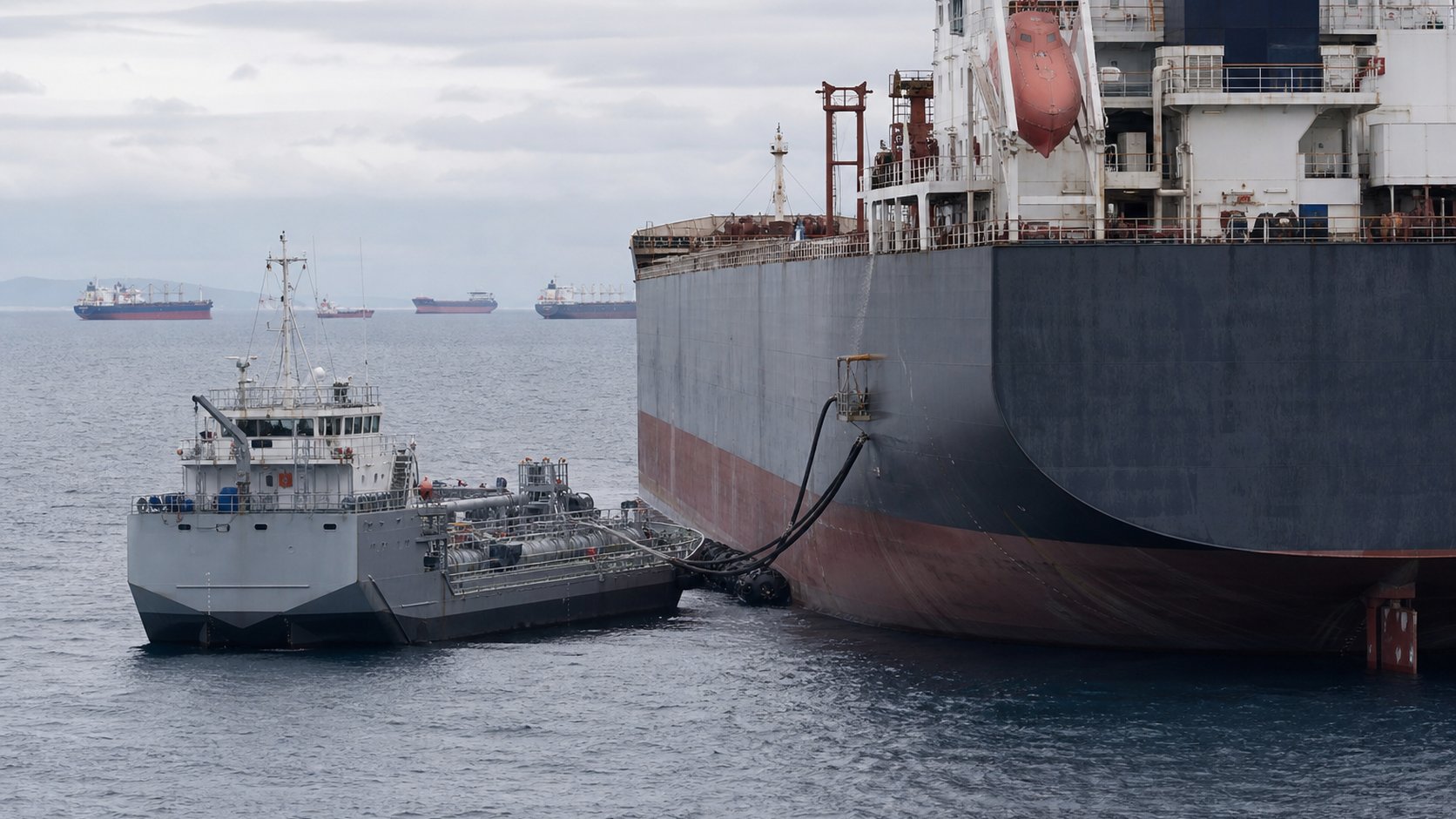
A bunker tanker doesn’t carry cargo to a discharge port — it delivers fuel to other ships, often mid-voyage or at anchorage, via ship-to-ship (STS) transfer. That single difference in mission changes what actually matters when you buy one. A product tanker is judged on tank coatings and cargo segregations for a single discharge; a bunker tanker is judged on how fast, how accurately and how safely it can transfer fuel alongside a moving or anchored customer, day after day, often to several different ships in a single port call.
What a bunker tanker is built to do
Bunker tankers supply marine fuel — heavy fuel oil, marine gasoil, or increasingly LNG and methanol — to ships at anchorage, in port, or occasionally underway. The work is repetitive and operationally intense compared with a single-parcel cargo run: multiple STS deliveries per day are normal at a busy bunkering hub, each one timed against the customer ship’s schedule. That operating pattern is what the specification and the survey need to be checked against.
What decides a bunker tanker’s capability
| Factor | Why it matters |
|---|---|
| Cargo segregation and tank plan | More segregated tanks mean more fuel grades carried at once, matching what a busy anchorage’s mixed customer base actually orders |
| Pumping rate and manifold configuration | Faster delivery per call means more calls per day; manifold size and hose reach must match typical customer ship freeboard and manifold height |
| Metering system and certification | Certified mass flow metering is now standard at major bunkering ports and increasingly mandatory — an uncertified or outdated system is a commercial dealbreaker, not just a nice-to-have |
| Fenders and mooring arrangement | STS work means the hull is alongside another ship constantly; fender condition and mooring winch capacity see far more wear than on a cargo tanker |
| Heating and viscosity handling | Heavy fuel oil grades need tank heating and pump capacity suited to viscosity, or delivery rates fall off badly in cold conditions |
| STS equipment and fendering approvals | OCIMF-compliant fenders and an STS plan are required at most major bunkering ports before a vessel is accepted for transfer work |
See current stock under tankers for sale, which spans coastal and bunkering tonnage up to handy product carriers.
Metering and measurement: the commercial heart of the business
A bunker tanker’s revenue depends on trust in its delivered quantity as much as on the fuel itself — disputed quantities are one of the most common sources of dispute in the bunkering trade. Mass flow meters, calibrated and certified to the standard required by the ports you intend to serve, are now close to a prerequisite for winning business at major hubs. Before buying, confirm exactly which metering standard is fitted, when it was last calibrated, and whether it meets the certification the ports on your intended trade actually require — retrofitting an approved system after purchase is a real cost, not a footnote.
STS operations: what the ship needs to be approved
- OCIMF-compliant fendering — condition and specification of fenders sized for the range of customer ship sizes you intend to serve.
- Mooring winches and lines — capacity and condition for repeated alongside operations, which see far more cycles than a cargo tanker’s mooring gear.
- STS transfer plan and crew competency — documented procedures and crew experience are checked by port authorities and increasingly by customers before a bunker tanker is accepted for STS work.
- Communication and safety equipment — VHF, fire-fighting capability, and emergency shutdown/disconnection systems suited to alongside fuel transfer.
Tip: Ask for the vessel’s STS transfer record, not just its cargo manifest. A bunker tanker with a strong record of clean, on-time deliveries and no metering disputes is worth more in this trade than one with slightly better tank coatings but a thin operating history.
Class, certificates and due diligence
- Class and status — in class with a recognised society (e.g. CCS, ABS, DNV, BV, LR), no overdue surveys or outstanding Conditions of Class.
- IMO type and cargo certification — matched to the fuel grades you intend to carry; see chemical tanker IMO types for how the classification framework works if you also expect to carry non-fuel parcels.
- Metering system certification — current calibration certificate and compliance with the standard required at your intended ports.
- STS approvals and equipment certificates — fender and hose certification, transfer plan on file.
- Statutory certificates — Load Line, tonnage, safety, pollution and any bunker-supply-specific licensing required by your operating ports.
- Clean title — no liens, mortgages or maritime claims.
Survey: hoses, meters and fenders get the scrutiny
Commission an independent pre-purchase condition survey that specifically covers the equipment a cargo-only tanker survey would treat as secondary: cargo hoses and manifold condition, metering system accuracy and certification, fender condition and mooring gear wear, and heating-coil integrity in the cargo tanks. General hull, machinery and tank-coating condition should still be checked the same way as any tanker.
Newbuilding vs secondhand
A newbuild bunker tanker lets you specify segregation count, pump rate and metering system to match your target ports exactly — see newbuilding vessels for how that process runs. A secondhand unit trades sooner, but confirm its metering system meets current certification standards before committing — a vessel bought without checking this can be effectively locked out of ports that require certified mass flow metering.
Bunker tanker checklist
- ☐ Cargo segregation count matched to the range of fuel grades you intend to supply
- ☐ Metering system identified, calibration current, certified to the standard your ports require
- ☐ Pumping rate and manifold configuration checked against typical customer ship freeboard
- ☐ Fenders and mooring gear inspected for STS-cycle wear, not just cargo-tanker norms
- ☐ STS transfer plan and equipment certification on file
- ☐ Heating coils and pump capacity suited to your fuel grades’ viscosity
- ☐ In class, no overdue surveys or outstanding Conditions of Class
- ☐ STS operational/delivery record reviewed, not just the cargo manifest
Frequently asked questions
What is a bunker tanker? A tanker that delivers marine fuel to other ships, typically via ship-to-ship transfer at anchorage or in port, rather than carrying a cargo parcel to a discharge terminal — the operational and equipment priorities differ from a standard product tanker.
How is a bunker tanker different from a product tanker? A product tanker is optimised for carrying and discharging a cargo parcel once per voyage. A bunker tanker is optimised for repeated ship-to-ship deliveries — metering accuracy, fendering, mooring-gear durability and manifold configuration matter more than they do for a single-discharge cargo run.
Why does the metering system matter so much? Delivered-quantity disputes are one of the most common sources of conflict in the bunkering trade. Certified mass flow metering, calibrated to the standard your ports require, is close to a prerequisite for winning and keeping bunkering business.
What equipment does a bunker tanker need for STS operations? OCIMF-compliant fenders, mooring winches and lines rated for repeated alongside cycles, a documented STS transfer plan, and crew competency in alongside fuel-transfer operations.
Should I buy new or secondhand? A secondhand bunker tanker mobilises faster and costs less upfront, but its metering system certification should be checked before price is agreed — an uncertified or non-compliant system can lock the vessel out of ports that require certified metering. A newbuild lets you specify the metering and segregation setup exactly to your target ports.
Looking for a bunker tanker? Golden Shipyard sources bunker and product tankers as newbuildings and surveyed resales, with class, metering and STS-equipment records released to qualified buyers under NDA. Browse current stock under tankers for sale, or talk to us through our ship sale & purchase brokerage services. For a confidential discussion, email [email protected].
Buying, or want a second opinion?
Our sale & purchase desk can help you find, value and inspect the right tonnage. Tell us what you’re looking for and we’ll revert within one working day.