

A chemical tanker is the most specialised vessel in the wet fleet. It carries listed chemicals, vegetable oils, and clean petroleum products — often several grades at once — under the IMO IBC Code, with cargo tanks built or coated to survive aggressive cargoes. Two ships of the same deadweight can serve completely different markets depending on tank material, IMO type, and segregations. The headline DWT tells you almost nothing; the Certificate of Fitness tells you everything. This guide covers what to check before you buy or order.
Chemical tanker vs. product tanker vs. oil tanker
The three “tankers” follow different rulebooks:
- Oil tanker — crude or petroleum products under MARPOL Annex I.
- Product tanker — an oil tanker optimised for clean refined products, usually coated. (See our product tanker buying guide.)
- Chemical tanker — certified under the IBC Code to carry listed chemicals, with stainless or specially coated tanks and an IMO Type 1 / 2 / 3 rating. A chemical tanker can usually also carry clean products and vegetable oils, which is why many trade as flexible “chemical/oil” or “parcel” tankers.
Tip: A chemical tanker is defined by its Certificate of Fitness (CoF) — the document that lists exactly which cargoes it may load. Buy to the CoF and your charterers’ approvals, not to a label.
IMO ship types 1, 2, 3 — what the vessel may carry
The IBC Code assigns an IMO ship type that caps the hazard level of cargo and dictates tank location and survival standards:
| IMO ship type | Carries | Typical vessel |
|---|---|---|
| Type 1 | The most hazardous cargoes (severe environmental/safety hazard) | Rare, specialist |
| Type 2 | Moderately hazardous cargoes | Most chemical / parcel tankers |
| Type 3 | Least hazardous cargoes | Many product / easy-chemical tankers |
Most modern chemical tonnage is IMO Type 2, which opens the broadest practical cargo book while keeping build cost reasonable. In-stock and newbuilding examples are commonly stainless-steel, double-hull, IMO Type 2 ships of around 25,000–26,000 DWT.
See current availability on our chemical tankers for sale page.
Tank material: stainless steel vs. coated — the biggest value driver
What the tanks are made of (or coated with) decides which cargoes the ship can carry, how easily it switches grades, and how much it’s worth:
| Tank type | Cargo range | Notes |
|---|---|---|
| Stainless steel (e.g. 316L) | Widest — aggressive chemicals, acids, high-purity | Highest value; easiest to clean between grades; no recoating bill |
| Zinc silicate coating | Many solvents, some chemicals, clean products | Sensitive to some acids/alkalis and certain products |
| Epoxy / phenolic-epoxy coating | Vegetable oils, clean products, easier chemicals | Cheapest; coating age & condition are critical |
| Marbolite / specialist coatings | Specific cargoes | Check compatibility carefully |
For a stainless ship, the deciding questions are grade, extent (full stainless vs. stainless upper/coated lower), and weld/passivation condition. For a coated ship, the coating maker, age, and last condition report are everything — recoating tanks is one of the most expensive jobs in shipping.
Tip: Match tank material to your core cargo book, then check the last two coating/tank condition reports. A “chemical tanker” with tired coatings is a recoating bill and weeks of off-hire waiting to happen.
Segregations, parcels, and the cargo system
Chemical/parcel trades live or die on flexibility and cleanliness:
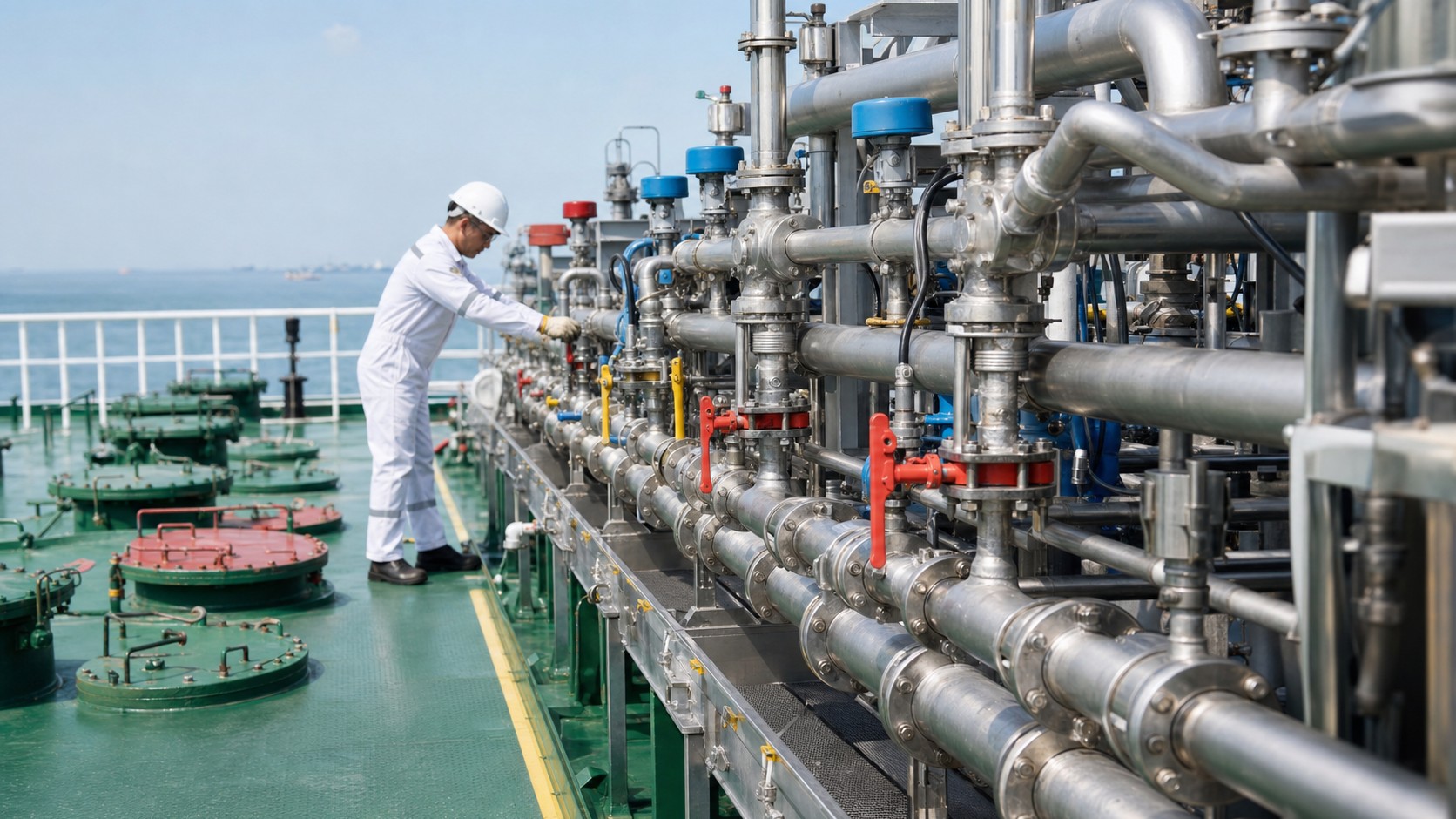
- Number of tanks & segregations — more independent segregations = more grades carried simultaneously = more charter options. Each tank ideally has its own pump and line.
- Deepwell cargo pumps — type, capacity, and stripping performance (low residue matters for parcel trades).
- Independent piping & valves — to keep grades fully segregated and avoid contamination.
- Tank heating — coils or external; material and capacity for waxy/viscous cargoes.
- Tank cleaning, slops & residue handling — machines, heater, and slop capacity.
- Inert gas / nitrogen — IGS and/or N2 for cargoes needing an inert or padded atmosphere.
- Vapour control & N2 padding — for sensitive cargoes.
Class, certificates, and emissions — the paperwork that defines the asset
Before any inspection, confirm:
- Certificate of Fitness (CoF) and the full cargo list it permits — the single most important document.
- Class & status — in class with a recognised society (e.g. CCS, ABS, DNV, BV, LR), no overdue surveys or outstanding Conditions of Class. Look for relevant class notations (Chemical/Oil Tanker, Double Hull, Type 2, IGS, PSPC, AUT, in-water survey).
- Double hull — mandatory; confirm and check ballast tank coatings.
- Statutory & survey position — Load Line, Tonnage, IOPP/IBC, special survey and drydock dates.
- Vetting history — SIRE/CDI inspections and oil-major/charterer approvals carry real value on a chemical tanker.
- Emissions standing — for international voyages, review the vessel’s EEXI and CII rating; it affects future trading and value.
Newbuilding vs. secondhand
Because tank material and coatings are so hard (and costly) to change later, chemical tankers are often ordered new to an exact specification — stainless grade, number of segregations, IMO type, and pump/heating fit. A modern stainless IMO Type 2 newbuilding gives you the widest cargo book and a clean survey history; a quality secondhand unit trades sooner and cheaper. Weigh lead time and specification against price and immediate availability.
Survey: the tanks and CoF get the scrutiny
Commission an independent pre-purchase condition survey, and a drydock survey for any serious purchase. On a chemical tanker the surveyor focuses on:
- Cargo tanks — stainless weld/surface condition and passivation, or coating breakdown and pitting; close-up internal survey.
- Pumps, lines & valves — segregation integrity, stripping, and contamination risk.
- Heating, IGS/N2, and tank-cleaning systems — operational tests, not just paperwork.
- CoF vs. reality — that the cargo list and equipment match the ship as built.
- Steel & ballast tanks — thickness gaugings and coating condition.
- Vetting/approval records — recent SIRE/CDI and any observations.
Tip: On chemical tankers, recent vetting approvals and a clean tank/coating condition can justify a materially higher price than a cheaper sister — the discount usually disappears once you add tank work and lost approvals.
Due diligence and total cost of ownership
Reputable sellers release full particulars to qualified buyers under an NDA. Insist on the CoF, GA and pumping/piping diagram, class certificates and survey status, coating/tank condition reports, vetting history, maintenance and drydock records, and a clean title free of liens. Then budget beyond the price: survey and any class rectification, tank coating/repair reserve, delivery, flag and class transfer, insurance (H&M and P&I), and modifications.
Quick pre-signing checklist
- ☐ Certificate of Fitness covers your intended cargoes (and charterer approvals)
- ☐ IMO ship type (1/2/3) suits your cargo book
- ☐ Tank material confirmed (stainless grade/extent or coating type, age, condition reports)
- ☐ Number of segregations, pumps, and independent lines match your parcel needs
- ☐ Heating, IGS/N2, and tank-cleaning systems tested and in class
- ☐ Double hull confirmed; ballast tank coatings checked
- ☐ In class, no overdue surveys / Conditions of Class; special survey priced in
- ☐ EEXI/CII and vetting/approval history reviewed
- ☐ Independent condition survey (+ drydock), tanks included
- ☐ Full documents under NDA; clean title confirmed
- ☐ Total cost of ownership budgeted (incl. tank/coating reserve)
Frequently asked questions
What’s the difference between a chemical tanker and a product tanker? A product tanker carries clean refined petroleum products under MARPOL Annex I, usually in coated tanks. A chemical tanker is certified under the IBC Code with an IMO Type 1/2/3 rating to carry listed chemicals, typically in stainless steel or specially coated tanks — and can usually also carry products and vegetable oils. Chemical tankers cost more but trade a wider cargo book.
What do IMO Type 1, 2 and 3 mean on a chemical tanker? They rank how hazardous a cargo the ship may carry, from Type 1 (most hazardous, rare) to Type 3 (least hazardous). The type drives tank location and survival standards and is shown on the Certificate of Fitness. Most chemical/parcel tankers are IMO Type 2.
Stainless steel or coated tanks — which is better? Stainless steel (e.g. 316L) carries the widest range including aggressive cargoes, cleans easily between grades, and has no recoating bill — but costs more. Coated tanks (zinc silicate, epoxy/phenolic) are cheaper and fine for products, vegetable oils, and easier chemicals, but coating age and condition are critical. Match the tanks to your core cargo book.
What is the Certificate of Fitness? The Certificate of Fitness (CoF) is the document that lists exactly which chemical cargoes a tanker is certified to carry under the IBC Code. It is the single most important paper when buying a chemical tanker — buy to the CoF, not to a label.
Should I buy secondhand or order a newbuilding? Because tank material and coatings are costly to change, chemical tankers are often ordered new to an exact specification (stainless grade, segregations, IMO type, pumps, heating). A newbuilding gives the widest cargo book and a clean history; a secondhand unit trades sooner and cheaper. Weigh lead time and spec against price and availability.
Looking for a chemical tanker now? Golden Shipyard offers in-stock and newbuilding chemical tankers, including stainless-steel, double-hull IMO Type 2 tonnage around 25,000–26,000 DWT. Browse current availability on our chemical tankers for sale page, compare with our product tanker guide, or learn about our ship sale & purchase brokerage services. To receive full particulars under NDA, email [email protected].
Buying, or want a second opinion?
Our sale & purchase desk can help you find, value and inspect the right tonnage. Tell us what you’re looking for and we’ll revert within one working day.