


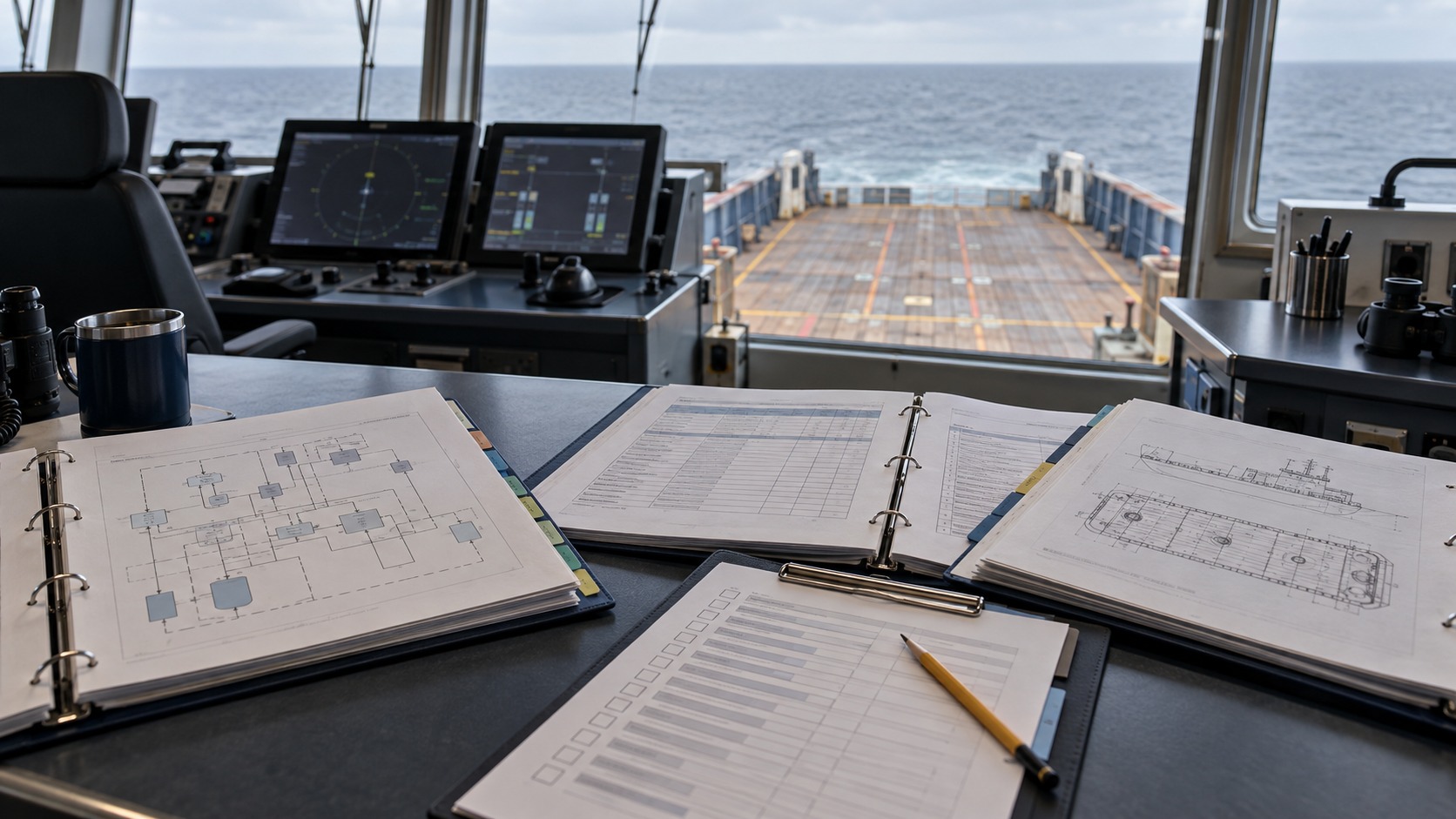
A used DP2 vessel’s document package may contain an FMEA, a recent trials report and a list marked “closed”. The purchase question is whether those documents describe the system installed today, and whether the evidence supports each claimed closure. A controller change after the last trial, an untested repair or an unexplained report revision can leave a gap that a tidy document index conceals.
For a candidate PSV, AHTS or other DP2 vessel, build a traceable record connecting the current configuration, the relevant analysis, the tests performed and the disposition of findings. The output is a buyer’s evidence register for an independent DP specialist to assess. The register organises questions and evidence; it does not certify DP capability or acceptance for a particular offshore job. Vessel selection remains in our OSV buyer’s guide; this review starts once a specific candidate’s documents are available.
1. Establish which document set belongs to this vessel
Ask the seller or technical manager for a dated document index identifying the vessel by IMO number, document number, revision, issue date and issuing organisation. Include approval or acceptance evidence where applicable, together with any qualifications. An old vessel name can be legitimate; an unexplained mismatch in identity or equipment needs resolving.
Request complete reports and referenced appendices through the agreed confidential data room. A cover page, summary letter or statement that trials were completed cannot show the scope and results of individual tests. If material is withheld, record exactly what remains unavailable and arrange controlled access for the buyer’s specialist.
| Document or record | What to connect it to | Buyer follow-up |
|---|---|---|
| Current DP notation and relevant verification or acceptance documentation | Vessel identity, stated operating basis and any qualifications | Ask the relevant issuer to clarify uncertain status or scope |
| FMEA, revision history and associated drawings | The installed system and subsequent modifications | Identify changes whose treatment in the analysis is unclear |
| FMEA proving-trials report and applicable later test reports | Analysis references, tested configuration and recorded results | Obtain missing test sheets, appendices and follow-up records |
| Latest annual DP trials report and earlier reports needed to trace findings | Test programme, exceptions and recurring issues | Carry unresolved or unsupported items into the evidence register |
| Modification, repair and software-change records | Document updates and any assessment or testing arising from the change | Request the dated assessment and its supporting references |
| Findings register and close-out attachments | Each original finding, corrective action and verification | Record who accepted closure and on what evidence |
| Latest applicable periodical DP test report | The relevant FMEA, test scope and subsequent findings | Include this evidence separately from the annual report |
| Current DP operations manual and relevant configuration references | Operating modes referenced in analysis, trials and later changes | Have the specialist reconcile discrepancies in the documented operating basis |
This is a purchase-review request list, rather than a prescribed approval checklist. Confirm the governing basis with the vessel’s flag Administration and classification society, and identify any change needed for the intended flag. Where a DPVAD applies, a flag transfer affects its validity under section 5.2.6; obtain the incoming Administration’s requirements. The preamble to IMO MSC.1/Circ.1580 distinguishes the construction dates for which the newer guidance is recommended and the earlier MSC/Circ.645 guidance may continue to apply. An older vessel’s reference to MSC/Circ.645 is not, by itself, a document deficiency.
2. Reconcile the FMEA with the current configuration
The failure modes and effects analysis (FMEA) examines how failures affect the DP system. For a buyer, the immediate task is to establish which revision represents the vessel being offered. Ask the technical manager to identify the current FMEA and explain how changes since its issue have been assessed and incorporated.
Use a simple chronology: analysis issued, trials conducted, equipment changed, documents revised, follow-up testing completed. Attach a reference to each event. This makes it easier to spot a report that predates a modification or a drawing that has been superseded.
- Equipment references: can the specialist reconcile the equipment identifiers in the analysis and test reports with the current equipment list?
- Software and controls: do change records identify relevant versions, dates and the assessment of their effects?
- Drawings: are the referenced revisions available, and are later revisions explained?
- Change disposition: where the manager says no further analysis or testing was necessary, is there a recorded basis for that conclusion?
A date mismatch needs explanation; it does not automatically establish a technical failure. MSC.1/Circ.1580, section 5.1.2, calls for a current FMEA supported by proving trials. Sections 5.1.1.4 and 5.1.4 address surveys and tests following defects, accidents, significant repairs or alterations, and the Administration’s sanction for significant changes. A repair-replacement exception in section 5.1.4 should not be treated as a blanket exemption from section 5.1.1.4. Have the specialist identify the applicable process and evidence.
Sections 4.6 and 5.1.1 of MSC.1/Circ.1580 distinguish operating documentation and initial, periodical and annual test records. Keep their references separate in the index so a recent annual report does not stand in for the complete history.
3. Read the trials report beyond the summary letter
Start with the report’s scope, configuration and references. Ask which analysis revision the programme used, what was actually tested, what was unavailable and whether any tests were deferred or qualified. Then follow the results into the findings list and its attachments.
IMCA’s M190 code of practice addresses annual DP trials programmes, their conduct and reporting. Its M225 example links redundancy concepts and system configurations with tests and report examples. The public IMCA catalogue pages describe these publications’ scope; the buyer’s register here is an editorial tool, not an IMCA-prescribed form. These references help frame the specialist’s review; possessing a report bearing their names does not itself establish acceptance of a particular vessel.
In the buyer’s register, keep three entries separate: the test date, the report issue date and the date of any later close-out evidence. A newly issued report may describe an earlier configuration. Likewise, a recent annual report does not, by its date alone, resolve questions about a modification made afterwards.
Ask the specialist to explain the significance of omitted tests and qualifications in the context of the applicable programme. Use the programme’s stated acceptance criteria and record any unresolved exceptions. A summary letter alone does not establish the scope or results of every relevant test.
4. Trace each finding to its close-out evidence
Give each finding a stable reference: source report, revision, page and item number. Preserve the report’s original wording and category, then add the seller’s response separately. Category labels should be read using that report’s definitions.
For each claimed closure, ask for an evidence chain:
- Finding: what was observed, and under which test or configuration?
- Action: what was repaired, changed or clarified, by whom and when?
- Verification: what inspection, assessment or retest supports the action, and where is the result recorded?
- Disposition: who reviewed or accepted closure, within what remit, and were any restrictions retained?
A service invoice can support that work occurred. Its scope may not establish that the original finding was resolved. A manager’s “closed” entry likewise needs the attachments and technical explanation on which it rests. Ask the specialist to distinguish document clarification from corrective work requiring survey, testing or formal acceptance. Obtain evidence from the responsible authority where that acceptance is required; a buyer-appointed specialist’s opinion does not replace it.
Use buyer-review statuses such as evidence received, clarification requested and specialist review pending. Keep these separate from the report author’s technical categories and from formal class or flag status.
5. Worked example: a controller change after annual trials
Hypothetical example: a seller supplies annual trials completed in February, an FMEA issued the previous year and a June service record describing replacement of a DP control component. The sales summary says all DP findings are closed. The package contains no clear reference connecting the June work to a change assessment or subsequent verification.
The buyer records a specific gap: “June replacement: relationship to current FMEA and tested configuration unconfirmed.” The seller is asked to provide the component and software details, the assessment of the change, any revised documents and the supporting verification records.
The buyer’s DP specialist may establish that this was a documented direct replacement, or identify a change requiring further assessment, survey, testing or acceptance. Ask for confirmation from the relevant approving party where required. The decision follows that evidence. The February trial date and the June invoice, considered alone, do not settle the question.
6. Turn the review into a dated seller query list
Send one consolidated register with a row for each issue. Include the document reference, the exact discrepancy, the requested evidence, the responsible respondent and the specialist’s review status. Link replies to the original row so an email exchange does not become a second, conflicting findings list.
Before the buyer makes the next purchase decision, ask the specialist to identify which questions remain material and what would resolve them. If the vessel continues trading or undergoes work during negotiations, request an update covering changes, incidents and new findings since the review cut-off date.
The completed register should show what has been checked, what remains uncertain and who must decide. Use it alongside the transaction-wide checks in our ship acquisition due-diligence guide. For notation terminology, use ship class notations explained; for general hull and machinery scope, use the pre-purchase condition-survey guide.
Reviewing a specific DP2 candidate? Share the vessel reference and the document index through our sale and purchase desk. We can coordinate the seller’s information response and help arrange the independent DP review needed to resolve the outstanding questions.
Buying, or want a second opinion?
Our sale & purchase desk can help you find, value and inspect the right tonnage. Tell us what you’re looking for and we’ll revert within one working day.