

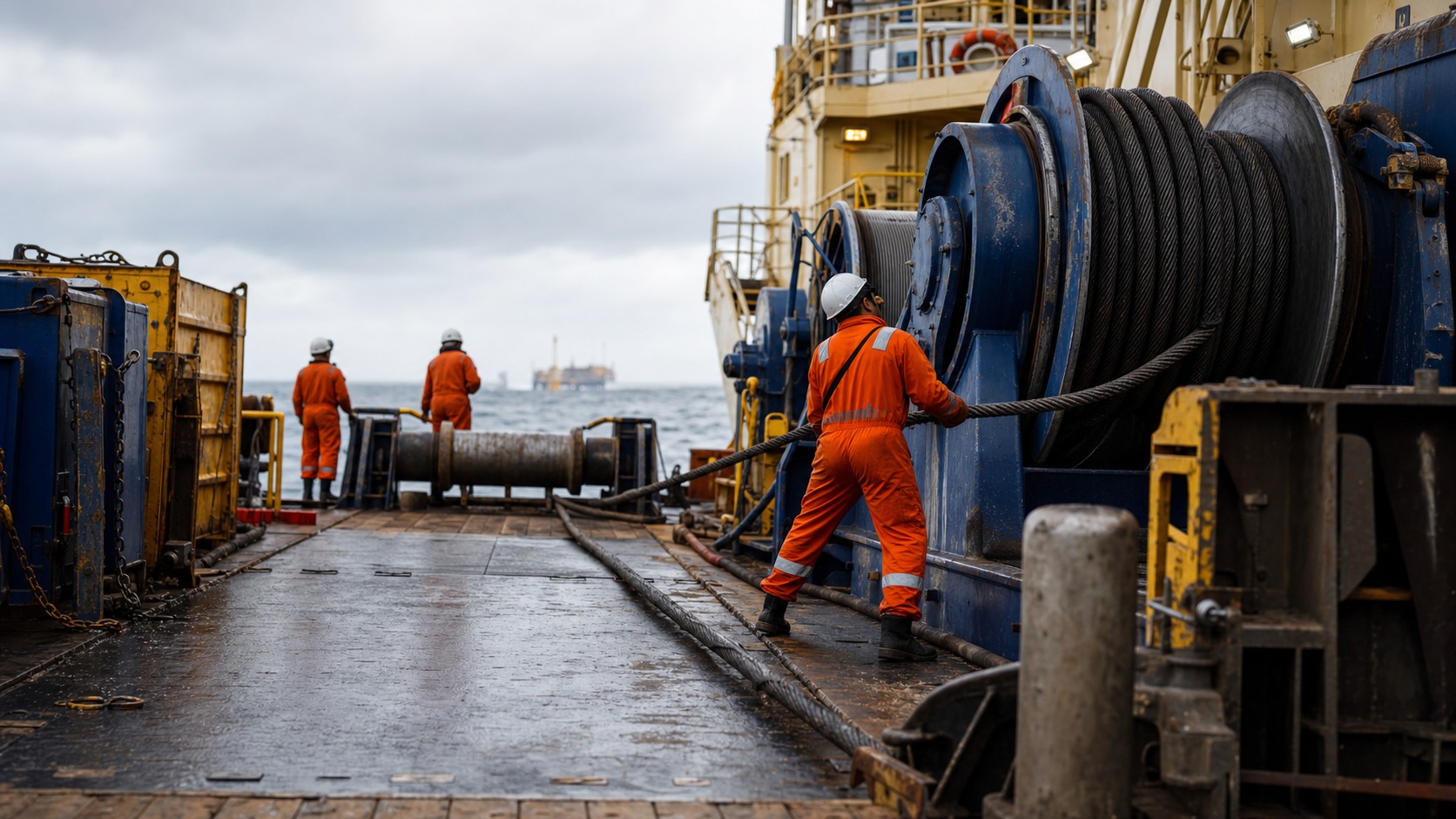
Offshore support vessels (OSVs) are purpose-built work boats that keep offshore operations running — supplying platforms, handling anchors, towing, standby, and construction support. “OSV” spans several very different ship types, and the right one depends entirely on the job: carrying cargo to a platform, pulling anchors for a rig, or serving as a general work boat. This guide explains the OSV family, the numbers that matter, and what to check before you buy an offshore support vessel.
The OSV family: PSV, AHTS, and work boats
Match the type to the task first:
| Type | Built for | Key features |
|---|---|---|
| PSV (Platform Supply Vessel) | Carrying cargo to/from offshore platforms | Large clear aft deck, liquid/dry-bulk tanks, DP |
| AHTS (Anchor Handling Tug Supply) | Towing and handling rig anchors, plus supply | High bollard pull, anchor-handling winch, stern roller, towing pins |
| AHT / Tug | Towing rigs, barges, structures | Bollard pull, towing gear |
| Crew boat / FSV | Fast transfer of crew and light cargo | Speed, passenger seating, light deck |
| Multipurpose work / support vessel | General offshore and near-shore work | Long open work deck, deck crane options, flexible fit |
In-stock tonnage includes near-coastal multipurpose work/support vessels with a forward bridge and a long open aft work deck — AHTS/OSV-styled boats suited to regional offshore, construction, and support work.
See current availability on our work & offshore vessels for sale page.
The aft work deck: the heart of an OSV
Almost every OSV job happens on the open aft deck:
- Clear deck area (m²) — space for containers, equipment, pipe, and cargo. The bigger and clearer, the more versatile.
- Deck strength (t/m²) — for heavy skids, containers, and equipment, not just light cargo.
- Cargo rails, cargo securing, and clear working length — a long, unobstructed deck matters for pipe and long units.
- Deck crane / handling gear — if fitted, its SWL and outreach; for heavier lifting compare a floating crane or heavy-lift vessel.
Tank capacities and what a PSV really carries
A supply vessel’s value is in what it can carry below deck as well as on it:
- Fuel oil & fresh water — for the platform and the vessel’s own range.
- Drill water & ballast
- Liquid mud & brine — dedicated tanks and pumps for drilling support.
- Dry bulk (cement/barite) — pressurised tanks.
- Deck cargo capacity & deadweight — total lift on deck.
Match the tank fit to your intended service — a general work boat won’t have the mud/bulk systems a drilling-support PSV needs.
AHTS specifics: bollard pull and anchor handling
If towing or anchor handling is the job, these decide capability:
- Bollard pull (tonnes) — the vessel’s towing force; the headline AHTS figure.
- Anchor-handling / towing winch — pull, wire capacity, and condition.
- Stern roller, towing pins & shark jaws — for anchor and towing work.
- A-frame / crane — for subsea and anchor deployment.
Propulsion, DP, FiFi, and trading area
- Propulsion & manoeuvrability — twin-screw, azimuth/Z-drive, or thrusters; bow thrusters for station-keeping.
- Dynamic Positioning (DP1/DP2) — essential for close-quarters platform and construction work; confirm DP class and trials status.
- Fire-fighting (FiFi 1/2) — external fire-fighting capability for standby/rescue roles.
- Oil recovery / standby / rescue — if required by your contracts.
- Navigation/service area — near-coastal (A1+A2) vs. unrestricted — caps where the vessel can legally work.
Class, certificates, and due diligence
Before committing, confirm on paper and under NDA:
- Class & status — in class with a recognised society (e.g. CCS, ABS, DNV, BV, LR), no overdue surveys or outstanding Conditions of Class; note any rebuild/conversion history.
- Relevant notations — DP, FiFi, oil recovery, standby, and service area.
- Statutory certificates — Load Line, Tonnage, Safety, pollution.
- GA, capacity plan, deck strength, and machinery particulars.
- Clean title — no liens, mortgages, or maritime claims.
Survey: deck, winches, and DP get the scrutiny
Commission an independent pre-purchase condition survey, and a drydock survey for any serious purchase. On an OSV the surveyor focuses on:
- Work deck & structure — thickness gaugings, deck strength, corrosion, and securing points.
- Winches & anchor-handling gear (AHTS) — condition, wires, and certification.
- Tanks, pumps & cargo systems — mud/bulk/fuel/water integrity and segregation.
- DP system & thrusters — trials/FMEA and redundancy (if fitted).
- FiFi & safety systems — operational tests.
- Hull, machinery & steering — twin-screw propulsion and general condition.
Tip: A cheap OSV with worn winches, tired thrusters, or a DP system needing overhaul can cost far more than a dearer, well-maintained unit once you add repairs and lost charter days. Test the deck gear, tanks, and DP before the price tempts you.
Newbuilding vs. secondhand, and total cost
Work boats are often bought secondhand for immediate mobilisation, or ordered new for an exact fit (deck size, tanks, bollard pull, DP). For flat open-deck cargo without offshore systems, compare a self-propelled deck cargo vessel. Budget beyond the price: survey and any class rectification, winch/thruster/DP overhaul reserve, mobilisation, flag and class transfer, insurance, and spares.
Quick pre-signing checklist
- ☐ OSV type (PSV / AHTS / work boat / crew boat) matched to your service
- ☐ Clear aft deck area and deck strength (t/m²) adequate for your cargo/equipment
- ☐ Tank fit (fuel/water/mud/bulk) suits your intended support role
- ☐ AHTS: bollard pull, winch, stern roller, and towing gear confirmed
- ☐ DP class (and trials) and FiFi as required by your contracts
- ☐ Navigation/service area suits where you’ll work
- ☐ In class, no overdue surveys / Conditions of Class; rebuild history reviewed
- ☐ Independent condition survey (+ drydock); deck, winches, tanks, DP tested
- ☐ Full documents under NDA; clean title confirmed
- ☐ Total cost of ownership budgeted (winch/thruster/DP overhaul, mobilisation)
Frequently asked questions
What is an offshore support vessel (OSV)? An OSV is a work boat that supports offshore operations — supplying platforms, handling anchors, towing, standby, and construction support. The main types are the PSV (platform supply vessel), AHTS (anchor handling tug supply), tugs, crew boats, and multipurpose work/support vessels.
What’s the difference between a PSV and an AHTS? A PSV (Platform Supply Vessel) is built to carry cargo — deck cargo plus fuel, water, mud and bulk in tanks — to and from platforms, with a large clear aft deck and usually DP. An AHTS (Anchor Handling Tug Supply) adds towing and anchor-handling: high bollard pull, an anchor-handling winch, stern roller, and towing gear. Many AHTS can also do supply work.
What is bollard pull? Bollard pull is the towing force an AHTS or tug can exert, measured in tonnes — the headline figure for towing and anchor-handling capability. Match it to the rigs, barges, or structures you need to tow.
Why does the aft work deck matter so much? Almost all OSV work happens on the open aft deck. Clear deck area, deck strength (t/m²), and unobstructed working length determine what cargo and equipment the vessel can carry and handle — often more than headline deadweight.
Should I buy a newbuilding or secondhand OSV? Work boats are often bought secondhand for immediate, lower-cost mobilisation, or ordered new for an exact fit (deck size, tanks, bollard pull, DP). Newbuildings give a clean history and precise spec; secondhand units trade sooner and cheaper — with an independent condition survey.
Is an OSV boat the same as a regular work boat? Not quite. Every OSV is a work boat, but not every work boat is an OSV — the term specifically covers vessels built and certified for offshore platform and rig support, with the DP, deck strength, and tank fit that near-shore work boats usually lack.
What is an OSV vessel used for? Supplying offshore platforms with cargo, fuel, water and drilling fluids; handling rig anchors and towing; providing standby, fire-fighting or construction support; and, in the crew-boat variant, moving personnel to and from installations.
Where can I find OSVs for sale? Golden Shipyard carries in-stock and newbuilding offshore support vessels — see current work & offshore vessels for sale, or email us for full particulars under NDA.
Looking for an offshore support vessel now? Golden Shipyard carries in-stock and newbuilding work and offshore support vessels, including near-coastal multipurpose work boats with long open aft decks. Browse current availability on our work & offshore vessels for sale page, or learn about our ship sale & purchase brokerage services. To receive full particulars under NDA, email [email protected].
Buying, or want a second opinion?
Our sale & purchase desk can help you find, value and inspect the right tonnage. Tell us what you’re looking for and we’ll revert within one working day.