


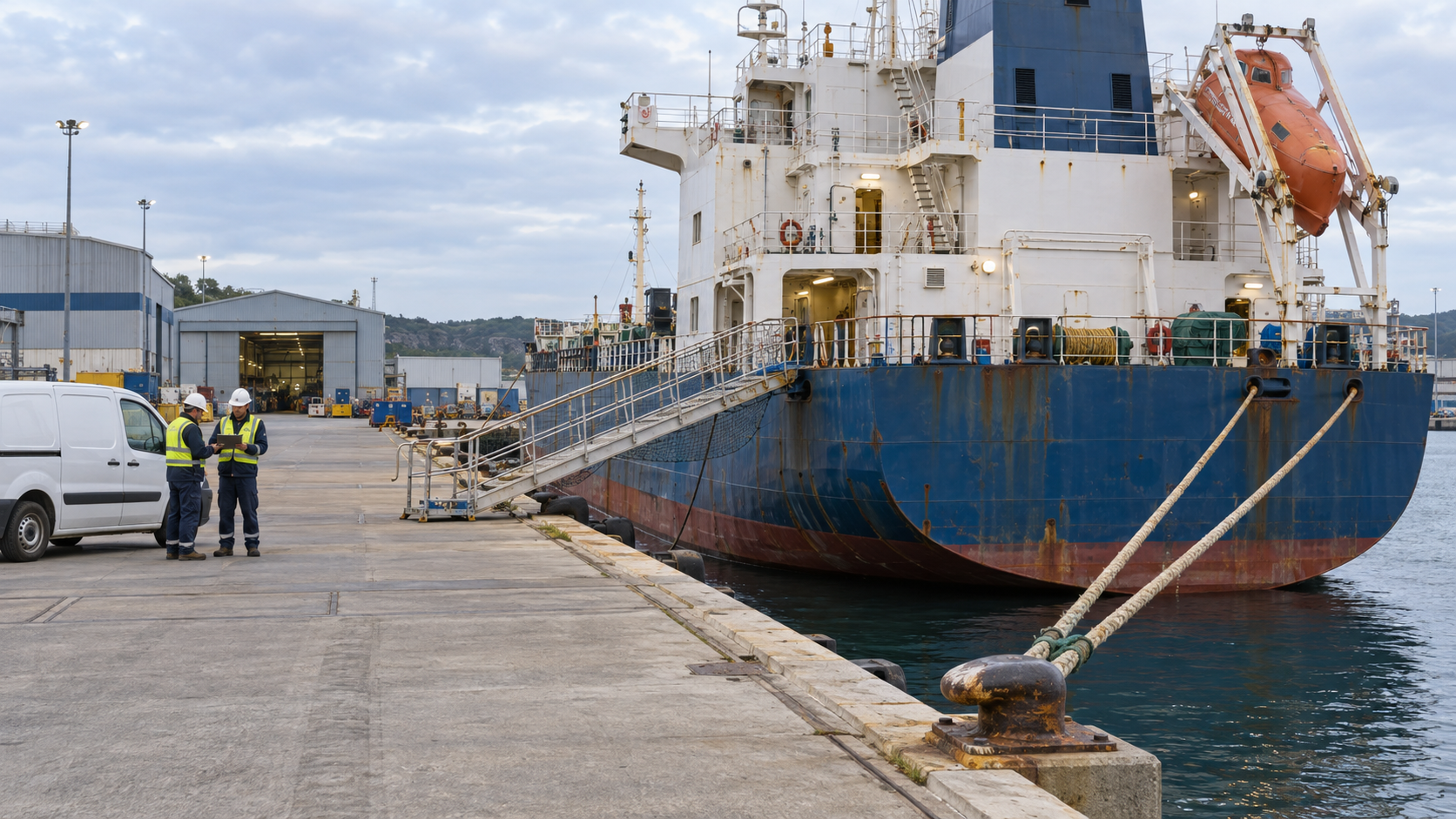
A laid-up vessel offered as “ready in a few weeks” may be an attractive purchase, but the date needs a work programme behind it. What remained in operation, what was preserved, what has deteriorated and which services are actually booked can change both the budget and the earliest useful operating date.
Before pricing the purchase, turn the seller’s reactivation estimate into a defined scope with evidence, dependencies and unresolved conditions. Our ship-age buyer’s guide covers age and remaining-life decisions; this article deals specifically with the transition from lay-up to the intended service.
1. Define what “ready” means for this purchase
Separate the contractual delivery date from the date the vessel can undertake the buyer’s work. Ask the seller and proposed technical manager to identify the milestone behind every quoted date:
- Ready to move: the permitted movement, destination and conditions have been established for the proposed transfer.
- Ready for trials: the necessary preparation, personnel, permissions and test arrangements are in place.
- Ready for the intended service: required technical work and verification are complete, certification and insurance arrangements are addressed, and any relevant customer or project acceptance is established.
These are suggested planning labels, not statutory categories. Define them in the transaction documents with the relevant advisers. A successful engine start, a seller’s delivery promise and an acceptable return-to-service programme answer different questions.
DNV’s public lay-up service description treats preservation, supervision and recommissioning as distinct areas of work. Obtain the actual status records and the scope of any declaration supplied; its title alone should not substitute for a complete readiness assessment.
2. Reconstruct what happened during lay-up
“Hot” or “cold” lay-up is a starting description. Ask which machinery remained powered, what systems were isolated, how the arrangements changed and who maintained them. Record entry into lay-up, any changes of location or caretaker, preservation interruptions, inspections, repairs and the latest verified status on one timeline.
For each material period, link the plan to execution evidence: dated logs, inspection or service reports, test results and recorded defects. A preservation procedure shows intended work; it does not demonstrate that the work occurred. Where records are unavailable, ask the assessor how that uncertainty affects the proposed inspection and recommissioning scope.
In its 2019 technical account of recommissioning problems, DNV describes missing preservation logs, damage associated with an unsuitable preservation fluid and deterioration of machinery outside class scope. The buying implication is to trace equipment-specific preservation evidence rather than assume that class status establishes every system’s condition.
Carry the timeline’s gaps into the scope request. For example, an undocumented interval is a question for the technical team to investigate, not automatic proof of damage and not a reason to insert an arbitrary overhaul allowance. Keep the seller’s statement, the supporting evidence and the buyer’s unresolved question separate.
3. Obtain a vessel-specific scope before seeking a firm budget
Ask class, the flag Administration or its recognised organisation, the proposed operator and the relevant equipment specialists to identify their respective requirements. Obtain dated responses tied to the vessel’s lay-up history, current condition, intended trade and any proposed ownership or flag change. Confirm the survey position directly rather than assuming the normal cycle was reset or paused on favourable terms.
Bureau Veritas’ NI545 guidance, February 2018 edition, describes dated lay-up records and a condition assessment to help establish recommissioning scope. Its guidance is a reference for planning; the class society must confirm the requirements applicable to the actual vessel.
Keep equipment preparation alongside the survey programme. ABB’s Stacking Care service description shows that reinstatement planning for its equipment may include deferred maintenance and additional work. Ask the relevant manufacturers or qualified service providers for instructions and scope appropriate to the installed models and preservation history. A generic restart checklist is not an adequate substitute.
For a DP vessel, refer configuration, analysis and testing questions to the DP specialist using our DP2 document-review guide. Keep that specialist work as a referenced package in the overall programme instead of treating a general reactivation inspection as proof of DP readiness.
The Norwegian Maritime Authority’s 2021 advice for laid-up ships also warns about problems during or shortly after recommissioning and points non-Norwegian vessels to their own flag and class requirements. Do not turn one flag’s elapsed-time thresholds into a rule for every sale.
4. Build the budget around packages and exclusions
Request an itemised programme rather than one combined “reactivation cost”. The register below is an editorial buying aid. Have the technical team populate the actual work and verification requirements; it is not a prescribed engineering checklist.
| Package | Budget basis and exclusions | Dependency and completion evidence |
|---|---|---|
| Condition and scope confirmation | Inspection quotation; access, travel and specialist attendance; distinguish assessment from repair | Records and access available; report identifies required work and remaining unknowns |
| Machinery and electrical reinstatement | Equipment-specific labour, parts, consumables and testing; identify deferred-maintenance overlap | Agreed scope, parts and service team; service reports and verification results |
| Yard or underwater work, if required | Quoted scope, movement and facility charges; record repair discoveries and waiting-time exclusions | Required permissions and confirmed facility slot; work completion and acceptance records |
| Surveys, audits and trials | Agreed attendance and test scope; identify retests and follow-up work excluded from the price | Preparation completed; dated findings, close-out and applicable certification |
| Operating and commercial readiness | Crew, provisions, required service arrangements and insurance; identify buyer-specific costs | Operator’s mobilisation plan and relevant confirmations for the intended work |
For every row, add a named owner, quotation reference, currency, validity date, start condition and status. Separate quoted work from provisional allowances and unpriced discoveries. Avoid double counting a repair included in both a yard estimate and an OEM quotation. Ask which costs continue while the ship waits for parts, a berth or attendance.
Gard’s lay-up and reactivation guidance highlights the demands on external engineers and yard resources and recommends early insurer involvement. Obtain the insurer’s actual requirements and proposed cover arrangements before relying on a movement or operating date; class completion alone does not resolve the insurance question.
5. Test the readiness date with a dependency example
Fictional planning example only. Assume the relevant parties have already agreed the initial scope and prerequisites. Day 0 is an illustrative planning start, not automatically the purchase date. Every duration below is invented for the example and expressed in working days; none is a typical industry turnaround or a supplier commitment.
Package A takes four days to complete. Package B, which can run in parallel, takes ten days including its assumed parts lead time and service work. Integration cannot begin until both packages finish; allow three further days for integration, two for the agreed trials and two for the remaining document review. With no overlap between those later stages and no unresolved finding, the illustrative sequence reaches Day 17: the longer initial branch of ten days, followed by three, two and two.
If Package B slips five working days, the same assumptions move the planning result to Day 22. Adding the original four-day and ten-day parallel packages together would instead overstate the initial branch. Conversely, treating everything as parallel would conceal the prerequisite for integration and trials.
Record assumptions beside the date. This example includes no additional yard requirement, adverse test finding or approval delay. If any arises, obtain a revised programme rather than keep the old date by increasing an unexplained contingency. Confirm which approvals must precede movement or trials; the example’s final document-review allowance is not permission to postpone necessary approvals.
6. Make the purchase decision on evidence and remaining exposure
Before relying on a proposed readiness date, ask the technical manager for a dated programme showing completed tasks, outstanding findings, booked resources and the evidence still needed at each milestone. Distinguish a requested service visit from a confirmed booking, and an estimated parts lead time from a commitment. Update the programme when the scope or inspection findings change.
Ask the commercial and legal teams to identify who commissions and pays for each package, how access will be arranged, what evidence is required at delivery and how unresolved work is treated under the actual agreement. The reactivation register supports that negotiation; it does not create a right to deduct costs or require the seller to perform work absent an agreement.
Use our pre-purchase condition-survey guide for the wider inspection scope and the survey-cycle guide for background terminology. The laid-up purchase decision still needs its own evidence of preservation, vessel-specific reinstatement work and a credible path to the buyer’s service.
Share the candidate’s lay-up timeline, available records and proposed operating requirement with Golden Shipyard’s sale and purchase team. We can coordinate the seller’s information and the outstanding scope questions with the relevant advisers. Browse vessels for sale for the wider search; a listing does not itself establish reactivation cost or readiness.
Buying, or want a second opinion?
Our sale & purchase desk can help you find, value and inspect the right tonnage. Tell us what you’re looking for and we’ll revert within one working day.