

A ship keeps its class — and its right to trade — by passing a rolling programme of surveys. The biggest and most expensive is the special survey every five years, alongside drydocking. For a buyer, where a ship sits in this cycle is money: a vessel with a special survey and drydock just done is worth more than an identical ship about to face both. Understanding the survey cycle lets you read a ship’s “survey position” and price it properly. This guide explains it.
The 5-year class cycle at a glance
A classification society (CCS, ABS, DNV, BV, LR and others) surveys a ship on a five-year cycle tied to its class certificate:
| Survey | When | What it covers |
|---|---|---|
| Annual survey | Every year (±3 months of the anniversary) | General condition, statutory items, a light check |
| Intermediate survey | Once between the 2nd and 3rd year | More detailed; adds ballast tank and (for older ships) some thickness checks |
| Special survey (SS) | Every 5 years | The big one — full hull, structure, machinery; extensive thickness gaugings; class renewed |
| Drydocking | Twice in 5 years (max ~36 months apart) | Hull below the waterline, tailshaft, rudder, valves — usually paired with SS |
Pass the special survey and the class certificate is renewed for another five years; miss or overrun a survey and the ship risks losing class — and with it, insurance and the right to trade.
The special survey — the expensive one
The special survey (also called class renewal survey) is the most thorough and costly event in a ship’s life:
- Hull & structure — extensive close-up survey and thickness gaugings to check steel wastage; more demanding as the ship ages.
- Machinery — main engine, auxiliaries, and systems opened up and examined.
- Tanks & spaces — ballast tanks, cargo holds/tanks, and voids.
- Repairs — any wastage or defects found must be rectified to renew class.
Its cost and off-hire rise sharply with age — a 15- or 20-year-old ship’s special survey can be a major bill, which is exactly why survey position matters to a buyer.
Drydocking vs. in-water survey
The underwater hull must be examined too:
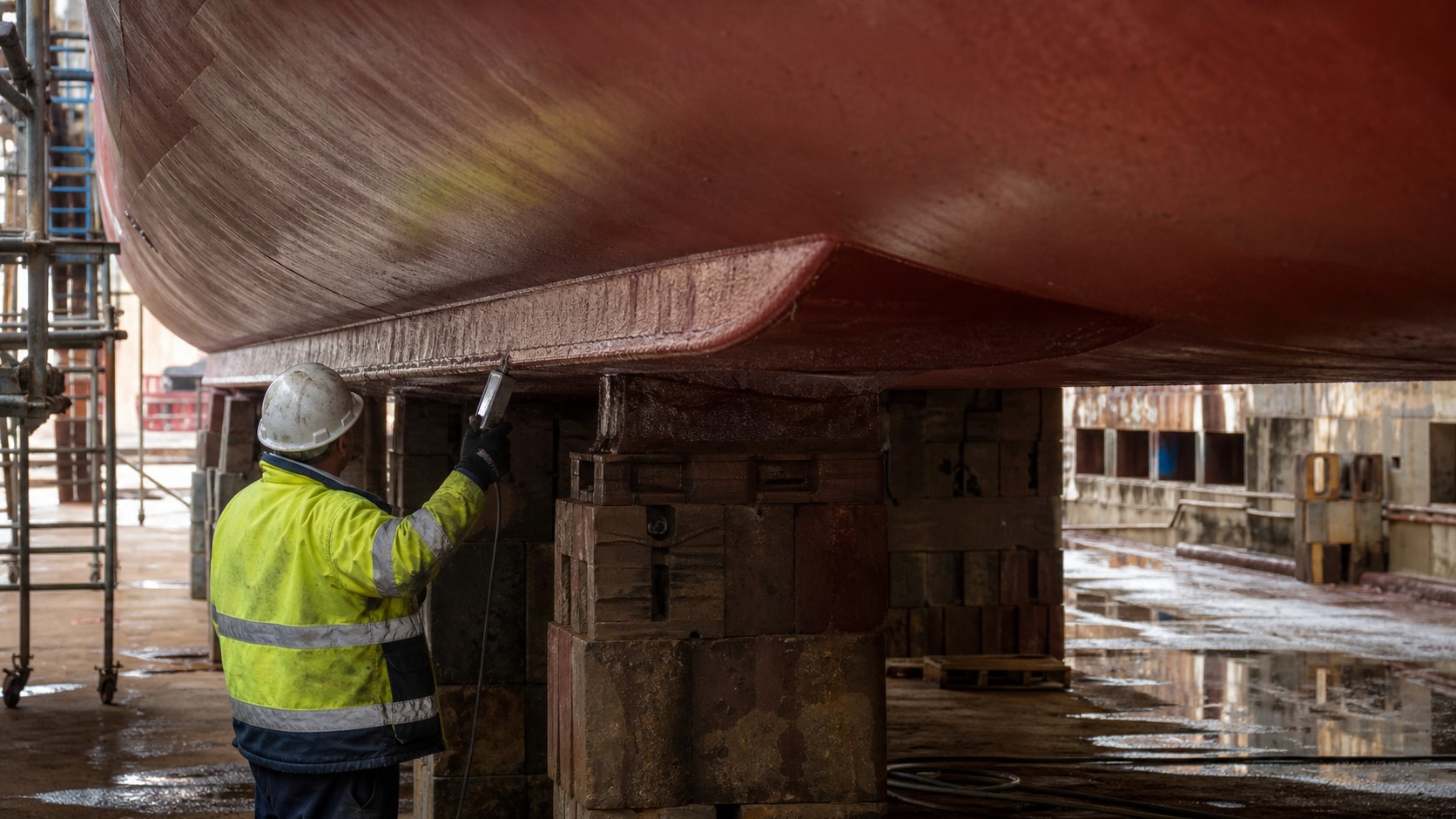
- Drydocking — the ship is taken out of the water in a dry dock so the bottom, tailshaft, rudder, sea valves, and propeller can be inspected and painted. Class requires two dockings in the five-year cycle (generally no more than ~36 months apart).
- In-water survey (IWS) — some ships carry an in-water survey notation allowing one underwater inspection by divers to substitute for a drydocking, saving cost and off-hire (see class notations in how to read a ship specification).
Continuous survey and statutory surveys
- Continuous survey — many owners spread machinery (and sometimes hull) survey items across the cycle rather than doing them all at the special survey, smoothing cost and off-hire.
- Statutory surveys — separate from class, the flag state (or class on its behalf) surveys statutory items — Load Line, Safety, pollution — on their own schedules. See flag state and registration.
- Conditions of Class — if a defect is found but rectification is deferred, class imposes a condition (recommendation) with a deadline; outstanding conditions are a red flag for buyers.
Why survey position matters when you buy
This is where the cycle hits the price:
- A ship with SS and drydock just done trades at a premium — years of clean class ahead and no imminent bill.
- A ship due for special survey soon should be discounted for the coming cost and off-hire — or the seller does the SS before delivery.
- Outstanding Conditions of Class or overdue surveys are warning signs; price and investigate them.
- Deferred maintenance that’s been pushed to the next SS is a hidden cost — a condition survey helps reveal it.
Always factor the next special survey and drydock dates into your valuation and offer.
Tip: Ask three questions on any purchase: When is the next special survey? When is the next drydock due? Are there any outstanding Conditions of Class? The answers can move the fair price by a lot.
Quick survey-position checklist
- ☐ Ship’s position in the 5-year cycle understood (last/next special survey)
- ☐ Next drydocking date known (or in-water survey notation confirmed)
- ☐ Last annual and intermediate surveys up to date
- ☐ No overdue surveys; class certificate valid
- ☐ Any Conditions of Class listed, dated, and priced
- ☐ Thickness-gauging history and steel condition reviewed
- ☐ Continuous survey items and machinery status checked
- ☐ Statutory (Load Line, Safety, pollution) surveys current
- ☐ Cost of the next SS/drydock estimated and reflected in the offer
- ☐ Condition survey used to reveal deferred maintenance
Frequently asked questions
What is a special survey on a ship? A special survey (or class renewal survey) is the most thorough classification survey, carried out every five years. It covers the hull and structure with extensive thickness gaugings, the machinery, and tanks, and any defects must be repaired to renew the ship’s class for another five years.
How often must a ship be drydocked? Class requires two drydockings within each five-year cycle, generally no more than about 36 months apart, so the underwater hull, tailshaft, rudder, and sea valves can be inspected. Ships with an in-water survey notation may substitute a diver survey for one of the dockings.
What is the difference between an annual, intermediate, and special survey? The annual survey is a lighter yearly check; the intermediate survey (once between years two and three) is more detailed; the special survey every five years is the comprehensive class-renewal examination. Together they form the five-year class cycle.
What is an in-water survey (IWS)? An in-water survey is an underwater inspection of the hull by divers, permitted for ships with the relevant class notation to replace one of the two required drydockings — saving drydock cost and off-hire.
Why does a ship’s survey position affect its price? A special survey and drydock are large, periodic costs. A ship that has just completed them trades at a premium; one due for special survey soon should be discounted for the coming cost and off-hire, or the seller completes it before delivery. Outstanding Conditions of Class also affect price.
Checking a ship’s survey position? Golden Shipyard helps buyers read survey status, class, and condition, and factor it into value and the deal. Browse current availability under vessels for sale, or get an informed view with our ship sale & purchase brokerage services. To receive full particulars under NDA, email [email protected].
Buying, or want a second opinion?
Our sale & purchase desk can help you find, value and inspect the right tonnage. Tell us what you’re looking for and we’ll revert within one working day.