

Every vessel listing is a wall of abbreviations — DWT, GT, LOA, draft, TEU. To a first-time or cross-industry buyer it can look impenetrable, but each figure answers a simple question: how big is it, how much does it carry, and where can it go? Once you know what each number means, a specification tells you almost everything about whether a ship fits your trade. This guide decodes the vessel particulars you’ll see on every listing.
The three groups of numbers
A ship’s specification breaks into three families: dimensions (how big), tonnage (how heavy/how much volume), and cargo capacity (how much it carries). Read them together — one number alone rarely tells the story.
Dimensions: how big the ship is
| Term | What it means | Why it matters |
|---|---|---|
| LOA (Length Overall) | Total length, bow to stern | Berth length, locks, and canal limits |
| LBP (Length Between Perpendiculars) | Length used for calculations | Naval-architecture reference, not berthing |
| Beam (Breadth) | Maximum width | Locks, canals, and berth width (e.g. Panamax beam) |
| Depth | Keel to main deck | Hull volume and structural depth (not the same as draft) |
| Draft (Draught) | Keel to waterline — how deep it sits | Whether it can enter your ports/rivers; changes with load |
| Air draft | Waterline to the highest point | Clearance under bridges and cranes |
Draft is the number buyers most often confuse: it’s how deep the hull sits in the water (and it increases as the ship loads), while depth is a fixed structural dimension. Loaded draft decides port access.
Tonnage: the most misunderstood figures
“Tonnage” mixes weight and volume — and DWT vs GT trips up almost everyone:
| Term | Measures | In plain terms |
|---|---|---|
| DWT (Deadweight) | Weight the ship can carry (cargo + fuel + stores + water), in tonnes | The ship’s carrying capacity — the headline for bulkers/tankers |
| Lightweight (LWT) | Weight of the empty ship itself | Steel weight; matters for scrap/conversion |
| Displacement | Total weight of ship + everything aboard | Lightweight + deadweight |
| GT (Gross Tonnage) | Volume of enclosed spaces (a unitless index) | Ship’s overall size for rules, fees, and manning |
| NT (Net Tonnage) | Volume of cargo/earning spaces | Used for port dues and canal tolls |
The key distinction: DWT is weight (how much cargo it lifts), GT is volume (an index of overall size used for regulations, port fees, and crewing). A ship can have high DWT but modest GT, or vice versa — they answer different questions.
Tip: For carrying capacity, read DWT. For “how big is it” in a regulatory/cost sense, read GT. Don’t compare a DWT figure on one ship with a GT figure on another — they’re different units.
Cargo capacity: measured by ship type
Carrying capacity is quoted differently by segment — match the metric to the type:
- Bulk carriers / tankers — DWT (tonnes), plus grain/bale or cubic capacity.
- Container ships — TEU (twenty-foot equivalent units); see container ship sizes explained.
- Tankers — cubic metres (CBM) of cargo tanks, plus number of tanks/segregations.
- Ro-Ro / car carriers — lane metres and CEU (car equivalent units).
- Deck cargo / barges — deck area (m²) and uniform deck load (t/m²); see the deck barge guide.
- Dredgers — hopper capacity (m³).
Performance, machinery, and class
Beyond size, a spec lists how the ship performs and what it’s certified as:
- Main engine, power (kW/BHP), and service speed / consumption — the economics of running it.
- Year built, builder, and flag.
- Classification society and class notations (e.g. ice class, DP, PSPC) — what it’s certified to do; confirm the class is recognised by your flag and insurer.
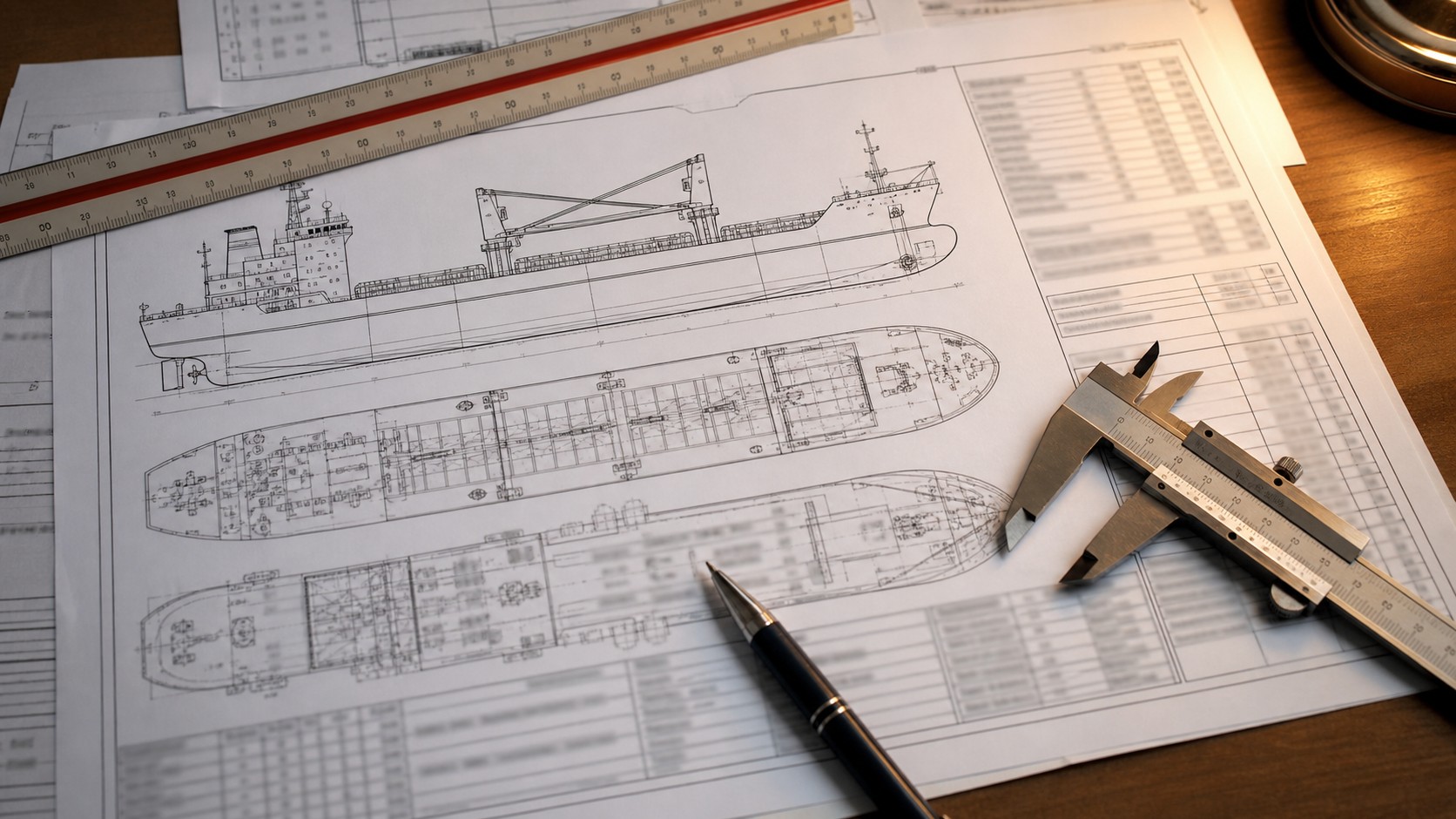
- GA (General Arrangement) — the drawing showing decks, tanks, and layout.
What is a Q88?
The Q88 is a standardised vessel questionnaire (originally for tankers, now widely used) that gathers a ship’s key particulars, ownership, class, and history on one form. It’s the quick-reference “vessel CV” that charterers and buyers use to screen a ship. On a purchase, the Q88 (or an equivalent particulars sheet) plus the GA give you the headline picture before you request full particulars under NDA.
From spec to decision — and full particulars
A specification tells you whether a ship could fit your trade; it doesn’t replace due diligence. Once a ship looks right on paper, verify it with a pre-purchase condition survey and full documents. Reputable sellers release complete particulars to qualified buyers under an NDA. Browse listings and their key particulars under vessels for sale.
Quick spec-reading checklist
- ☐ Draft (loaded) suits your ports/rivers; air draft clears your bridges
- ☐ LOA and beam fit your berths, locks, and canals
- ☐ DWT (weight capacity) read correctly — not confused with GT (volume index)
- ☐ Cargo capacity in the right metric for the type (TEU / CBM / lane m / m³ / deck area)
- ☐ Deck strength (t/m²) checked for heavy or project cargo
- ☐ Year, builder, flag, and classification society/notations reviewed
- ☐ Class recognised by your intended flag and insurer
- ☐ Q88 / particulars sheet and GA obtained for the headline picture
- ☐ Full particulars requested under NDA before committing
- ☐ Spec confirmed by an independent condition survey
Frequently asked questions
What is the difference between DWT and GT? DWT (deadweight) is a weight — how many tonnes of cargo, fuel, stores and water a ship can carry — and is the headline capacity for bulkers and tankers. GT (gross tonnage) is a volume index of the ship’s enclosed spaces, used for regulations, port fees, and manning. They measure different things and shouldn’t be compared directly.
What is the difference between draft and depth? Draft (draught) is how deep the hull sits in the water, measured from the keel to the waterline — it increases as the ship loads and decides port access. Depth is a fixed structural dimension from the keel to the main deck. Draft changes with load; depth does not.
What does deadweight (DWT) include? Deadweight is the total weight a ship can carry at its load line — cargo plus fuel, fresh water, stores, and crew. It’s the difference between the ship’s loaded displacement and its lightweight (empty) weight.
What is a Q88? A Q88 is a standardised vessel questionnaire that summarises a ship’s particulars, ownership, class, and history on one form — a quick “vessel CV” used by charterers and buyers to screen a ship before requesting full details.
How is cargo capacity measured? It depends on the ship type: deadweight (DWT) for bulkers and tankers, TEU for container ships, cubic metres (CBM) for tanker cargo tanks, lane metres and CEU for Ro-Ro/car carriers, deck area and t/m² for deck cargo vessels, and hopper cubic metres for dredgers.
Ready to read some real specifications? Golden Shipyard lists in-stock and newbuilding tonnage with clear particulars across every major ship type. Browse current availability under vessels for sale, or get help interpreting a spec and sourcing the right ship with our ship sale & purchase brokerage services. To receive full particulars under NDA, email [email protected].
Buying, or want a second opinion?
Our sale & purchase desk can help you find, value and inspect the right tonnage. Tell us what you’re looking for and we’ll revert within one working day.