

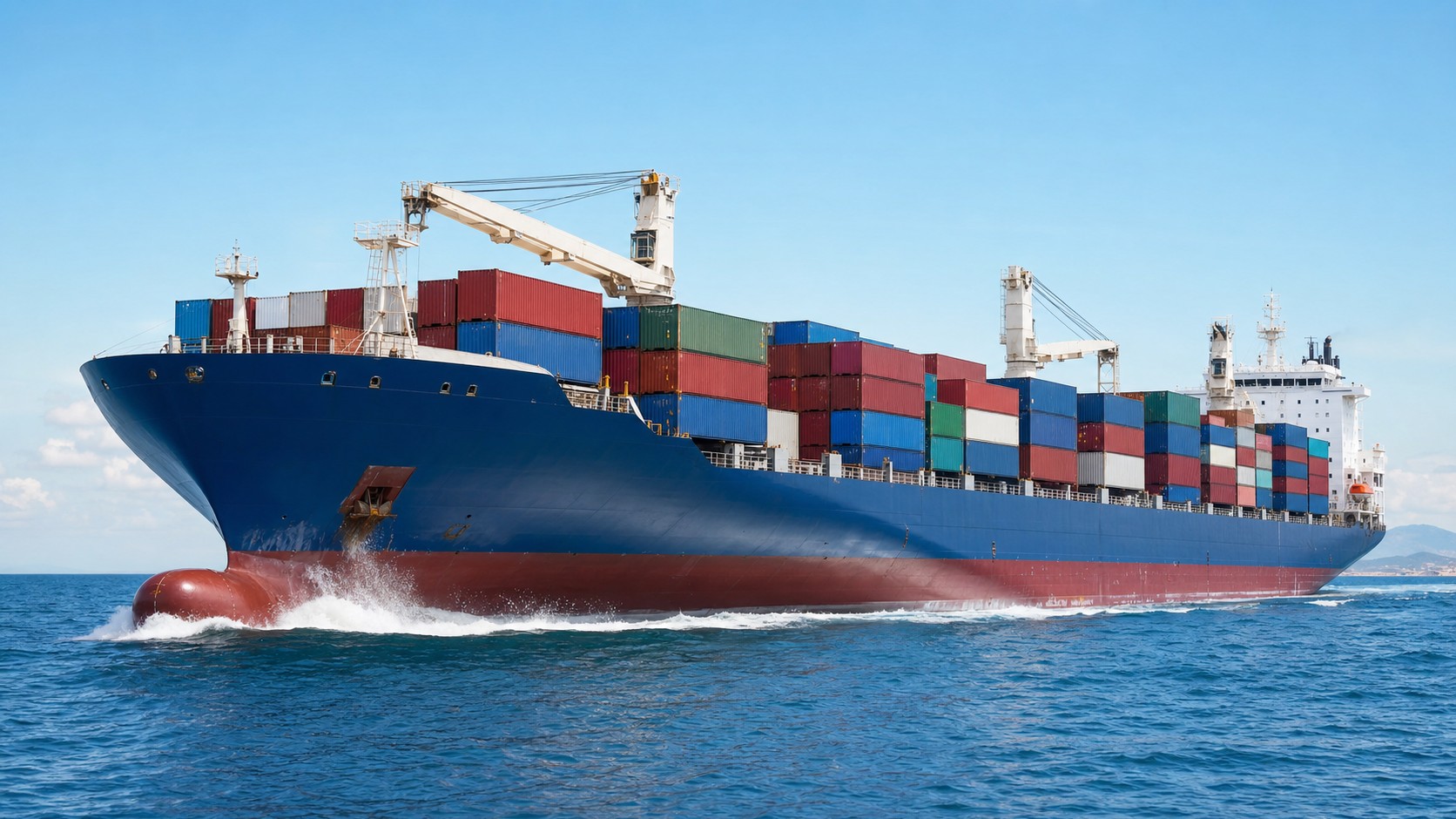
Container ships are sorted into classes by capacity in TEU (twenty-foot equivalent units), and the class you buy decides far more than how many boxes you carry. It sets which ports you can call, which trades you can serve, what crane arrangement you need, and how the vessel will trade under tightening emissions rules. This guide explains the size classes, the features that matter inside each one, and how to match a class to your route.
What a TEU actually tells you — and what it doesn’t
One TEU is one twenty-foot container slot. A 1,500 TEU ship can nominally carry 1,500 twenty-foot boxes (or 750 forty-foot boxes, which count as two TEU each). But nominal TEU is a headline number, not the whole story:
- Homogeneous vs. nominal capacity — the realistic intake at a typical cargo weight is lower than the nominal maximum.
- Reefer plugs — how many refrigerated containers the ship can power changes which cargoes (and trades) you can win.
- Stack weights and lashing — limit how high you can load heavy boxes on deck.
Tip: Compare ships on useful intake for your cargo mix and reefer demand, not just the nominal TEU on the spec sheet.
The container ship size classes
| Class | Indicative capacity | What it’s for |
|---|---|---|
| Small feeder | up to ~1,000 TEU | Short coastal/regional hops, shallow secondary ports |
| Feeder | ~1,000–2,000 TEU | Regional networks feeding hub ports; the workhorse intra-Asia size |
| Feedermax | ~2,000–3,000 TEU | Longer regional and short-sea trades, bigger feeder loops |
| Panamax / sub-Panamax | ~3,000–5,100 TEU | Mainline and regional trades; old-locks Panamax beam (~32.3 m) |
| Post-Panamax | ~5,100–10,000 TEU | Mainline deep-sea routes |
| ULCV (Ultra Large) | 10,000–24,000+ TEU | Major east–west trunk routes only |
For most regional buyers, the action is in the feeder to sub-Panamax band — vessels flexible enough to call smaller ports while still offering competitive slot costs. In-stock tonnage in this market commonly runs from around 816 TEU up to ~4,200 TEU, spanning small feeder through to a wide-beam sub-Panamax.
Browse current availability on our container ships for sale page.
Geared vs. gearless: can the ship load itself?
This is the first question after size:
- Geared — the ship has its own cranes and can work cargo at ports without shore gantries. Essential for feeder networks and developing-port trades. Costs some deck space and capacity, but buys independence.
- Gearless — no cranes; relies on shore gantries. Lighter, cheaper to run, higher usable capacity — but only viable where every port you call is equipped.
If your route touches any port without reliable shore cranes, buy geared. The flexibility is worth the capacity trade-off.
Other features that change a vessel’s value
- Reefer plug count — more plugs = access to refrigerated cargo and premium rates.
- Wide-beam designs — newer sub-Panamax ships use a wider beam for more capacity and better stability at a given length.
- Open-top / open-hatch — simplifies loading of over-height and out-of-gauge boxes on certain feeders.
- Ice class — needed for high-latitude trades.
- Navigation area — unrestricted vs. coastal; caps where the ship can legally trade.
- Fuel and speed — design speed and consumption drive your slot economics far more than headline TEU.
Emissions: why class and age now affect tradability
Container ships on international voyages must meet EEXI and report annual CII ratings. A larger or faster ship isn’t automatically better if it carries a poor CII rating that forces speed limits or costly upgrades. Factor a vessel’s efficiency standing into both price and future trading plans — see EEXI and CII explained for vessel buyers. Newer, optimised-hull tonnage usually rates better and holds value.
Matching a class to your trade
- Short coastal / island feeder → small feeder (up to ~1,000 TEU), geared, shallow draft.
- Intra-regional hub feeding → feeder (~1,000–2,000 TEU), geared, good reefer count.
- Longer regional / short-sea loops → feedermax (~2,000–3,000 TEU).
- Mainline-adjacent or growing volumes → sub-Panamax / wide-beam (~3,000–4,500 TEU), often gearless if ports are equipped.
Buy roughly one class above your current peak demand only if you have a credible path to fill it — excess slots that sail empty destroy the economics that justified the bigger ship.
Before you buy: confirm condition and documents
Whatever the class, the diligence is the same. Commission an independent pre-purchase condition survey, confirm the vessel is in class with no overdue surveys or Conditions of Class, and review the full document set — class certificates, capacity and lashing plans, reefer plug records, and a clean title free of liens — under NDA. For the step-by-step buyer workflow specific to this segment, see our guide to buying a feeder container ship.
Frequently asked questions
What is a feeder container ship? A feeder is a smaller container ship (roughly 1,000–2,000 TEU, with sub-1,000 “small feeders” below) that carries boxes between smaller regional ports and the large hub ports served by deep-sea mainline vessels. Feeders are usually geared so they can work cargo at ports without shore gantries.
What’s the difference between feeder, feedermax and Panamax? They are capacity bands: feeder (~1,000–2,000 TEU), feedermax (~2,000–3,000 TEU), and Panamax/sub-Panamax (~3,000–5,100 TEU, sized to the old Panama Canal locks). Larger classes — post-Panamax and ULCV — serve mainline deep-sea routes.
What does geared vs. gearless mean? A geared container ship has its own cranes and can load/discharge without shore equipment; a gearless ship relies on port gantries. Geared vessels suit feeder networks and less-developed ports; gearless suit equipped hub-to-hub trades.
Why do reefer plugs matter? Reefer plugs power refrigerated containers. The more plugs a ship has, the more refrigerated cargo it can carry, opening access to higher-paying cargoes and trades.
What size container ship should I buy? Match the class to your route and realistic cargo demand, not the headline TEU. Choose geared if any port lacks shore cranes, prioritise reefer capacity for refrigerated trades, and only size up if you can credibly fill the extra slots.
Looking for a container ship now? Golden Shipyard carries in-stock and newbuilding container vessels from roughly 816 to 4,200 TEU — feeder, feedermax and wide-beam sub-Panamax, geared and gearless. Browse current availability on our container ships for sale page, or learn about our ship sale & purchase brokerage services. To receive full particulars under NDA, email [email protected].