


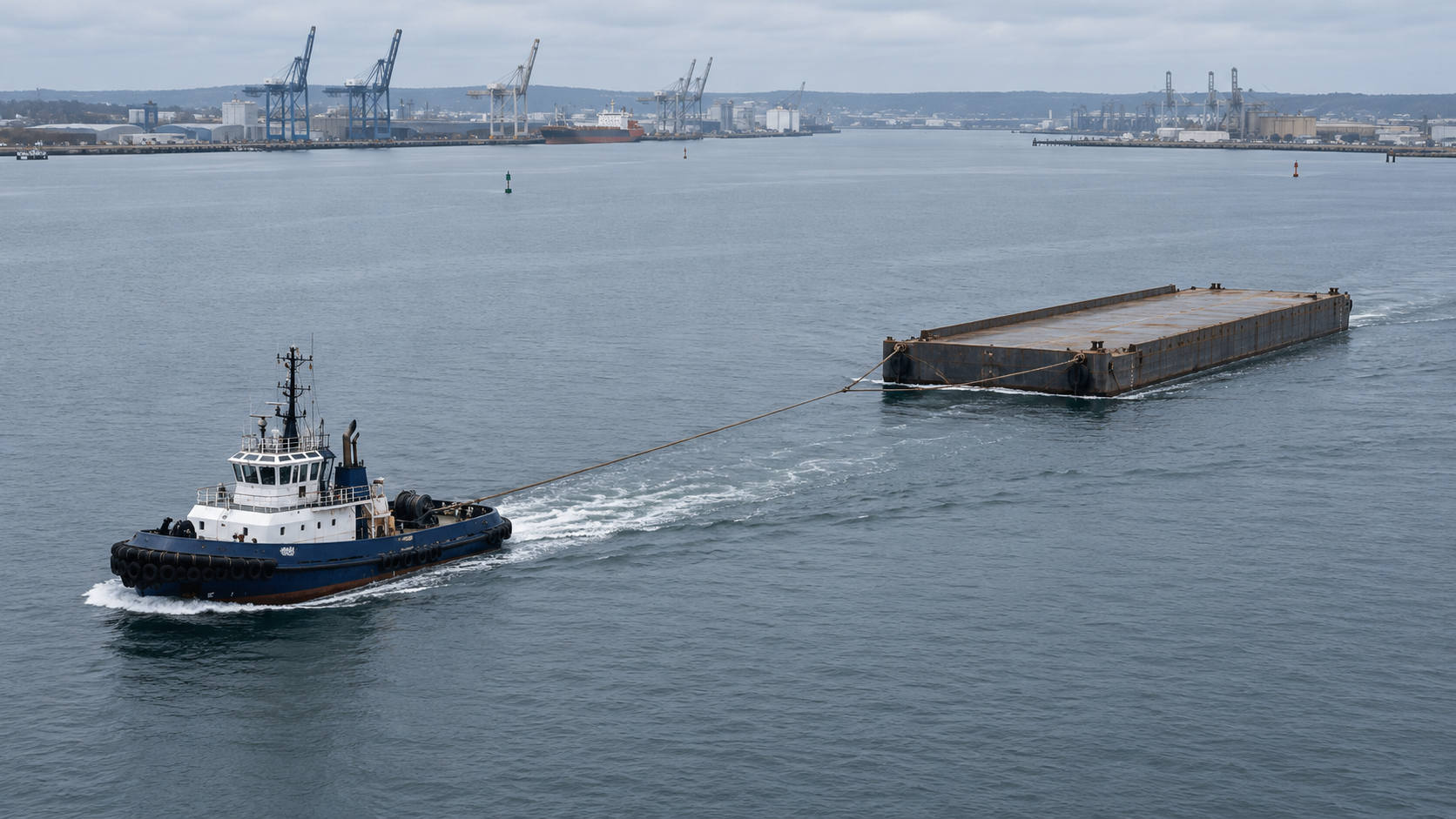
The lowest towage figure may leave the buyer paying separately to bring the tug to the barge, return it after the job or arrange local services. Even after those items are added, a different free-time allowance can change the comparison again. Put both quotations on the same movement and charging basis before choosing a barge delivery offer.
This article concerns a selected non-propelled barge and its proposed delivery movement. Our used deck-barge buyer’s guide covers asset selection and purchase checks. Here, the task is to establish which services each delivery quotation includes, when extra charges begin and what remains for the buyer to arrange.
1. Give both providers the same movement brief
Identify the barge, its declared condition and whether cargo or equipment will be aboard. Specify the connection point, proposed route, destination and disconnection point, together with the departure window. “Port to port” is insufficient if one offer ends at an outer anchorage and the other includes assistance to a receiving berth.
Separate the seller’s contractual handover from the transport provider’s service start and the buyer’s physical receipt. A sale can close before the tug is ready or before the barge reaches its worksite. Any onward move beyond the quoted endpoint needs its own scope. Refer to the ship sale and purchase process for the wider closing sequence.
Record who confirms the tow’s preparation, tug suitability, proposed movement and required permissions. Matching commercial endpoints does not establish that a route or towing arrangement is acceptable. Have the responsible professionals identify outstanding requirements and the services needed to satisfy them.
2. Read the price together with the service limits
BIMCO describes TOWCON 2021 as a lump-sum ocean towage agreement and TOWHIRE 2021 as daily hire; neither is intended for port towing. Establish which form, edition and amendments the offer proposes. A lump sum does not mean every movement-related expense is included.
The public TOWCON 2021 sample linked by the International Salvage Union treats free time, delay payments, bunker-price adjustment and additional charges separately. Delay-period fuel and lubricants are distinct from the stated delay rate. Use the actual agreement to allocate each item; do not assume the quotation heading overrides its terms.
Mark mobilisation and return positioning as included, separately priced or unresolved. Do the same for port agents, pilotage, assisting tugs, preparation, survey attendance, documentation and insurance arrangements. Identify the service provider, the party receiving the invoice and the party ultimately bearing the cost. Reimbursement by the buyer is still a buyer cost even when the tugowner initially pays.
3. Same-voyage example: normalise two lump-sum offers
Fictional purchasing exercise: both offers concern the same unladen non-propelled barge in the same declared ballast condition, the same connection point at Port P, the same P–Q route and departure window, and the same disconnection point at Port Q. These are hypothetical endpoints, not an assessed geographical passage. Assume the professionals have confirmed equivalent technical service requirements for this exercise.
All amounts are invented cost units (CU), with no currency conversion or link to supplier rates. Offer A includes tug mobilisation and return positioning. Offer B quotes them separately. The common buyer allowances below are assumptions, not confirmed invoices, premiums or proof of insurance cover.
| Compared cost item | Offer A, CU | Offer B, CU |
|---|---|---|
| Headline lump sum | 100 | 92 |
| Tug mobilisation | Included above | 10 |
| Return positioning | Included above | 8 |
| Port agency and local services allowance | 12 | 12 |
| Survey and document-support allowance | 8 | 8 |
| Movement-insurance allowance | 5 | 5 |
| Comparable base budget | 125 | 135 |
B’s headline is eight CU lower, but its separately priced positioning adds eighteen CU. On the aligned base scope, A is ten CU lower. This comparison includes normal voyage fuel at the assumed pricing basis, with no bunker-price movement. It includes no repair, diversion, additional destination time, tax change or onward movement beyond Q. Replace allowances with actual quotations before committing; these subtotals are not complete maximum liabilities.
4. Compare the charging clock, not just the daily rate
For origin time, confirm the start event, end event, free hours, excluded causes and treatment of partial days. TOWCON’s sample has separate free-time provisions for departure, destination, restricted waters and interim bunkering. Its departure provision excludes tug/tugowner-caused delay from counting. Do not pool unrelated allowances or assume every weather-related hour is automatically payable.
For the case only, let T be the total agreed countable origin time from the tug’s ready arrival within the agreed window until the last outward pilot disembarks. It includes connection and departure formalities, not just additional waiting. Exclude any non-counting periods. Assume A allows 24 free hours and then charges six CU per 24 hours; B allows 48 and then charges four. Both have an additional assumed fuel/lubricant allowance of two CU per chargeable 24 hours, calculated proportionately.
| Countable origin time T | A: paid hours / budget CU | B: paid hours / budget CU |
|---|---|---|
| 24 hours | 0 / 125 | 0 / 135 |
| 72 hours | 48 / 141 | 24 / 141 |
| 96 hours | 72 / 149 | 48 / 147 |
At 72 hours, A adds 48/24 × (6 + 2) = 16 CU and B adds 24/24 × (4 + 2) = 6 CU: both reach 141. At 96 hours, B is two CU lower. Other allowances are held constant to isolate this clock; actual prolonged attendance or port charges could change the result. These are sensitivity cases, not predicted waiting times or standard contract rates.
Keep timestamped readiness notices, connection and pilot records, reasons for interruptions and supporting consumption records. Reconcile the agreed counting rules with invoices. A fuel allowance in a budget does not replace the actual contract’s consumption and price evidence.
5. Resolve conditions before accepting the offer
A budget ranking is useful only if the service can proceed on the stated basis. Britannia’s non-harbour towing guidance describes individual review and possible insurer requirements for marine warranty survey. Obtain the actual requirements from the relevant flag, class, authorities and insurers; a generic class certificate or quoted survey fee does not approve this movement.
Ask who will commission each assessment, complete preparation and deal with additional findings or repeat attendance. Confirm quotation validity, payment milestones, cancellation provisions and any security requirements with the appropriate advisers. Unresolved items stay visible as conditions or unpriced exposure, not zero-cost rows.
Send Golden Shipyard the movement brief and competing offers, with their schedules and exclusions attached. Our sale and purchase team can coordinate the outstanding commercial questions with the providers and advisers. For the wider asset search, browse deck barges for sale.
Buying, or want a second opinion?
Our sale & purchase desk can help you find, value and inspect the right tonnage. Tell us what you’re looking for and we’ll revert within one working day.