


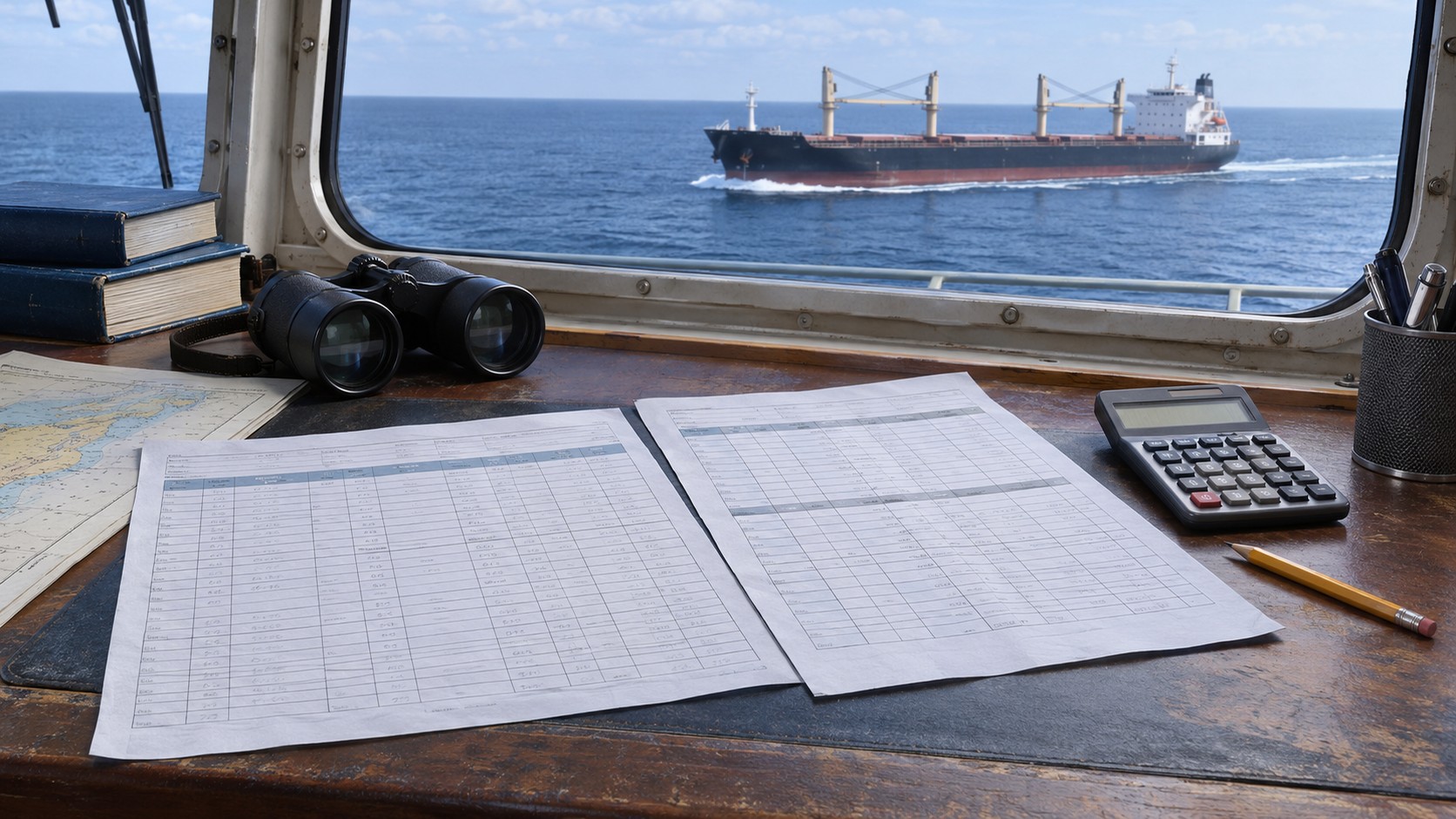
A ship is advertised at 12 knots on 18 tonnes of fuel per day. A recent report shows a higher figure. Before deciding that the vessel has deteriorated, establish what each number measures. A main-engine figure, a whole-ship total and a quantity consumed during a short reporting interval can all be accurate while remaining unsuitable for direct comparison.
This guide helps a used-ship buyer turn seller performance documents into a traceable set of budget inputs and unanswered questions. The ship acquisition due-diligence guide covers the wider purchase assessment. Here the output is a record-by-record comparability worksheet for one candidate vessel.
1. Write down the claim and the intended use
Copy the seller’s exact statement, its date and its document reference. Preserve qualifications such as laden or ballast condition, weather limits, engine setting and whether consumption is described as a daily rate. Request the source behind any summary figure. An unattributed number in a sales sheet remains a claim to clarify.
Then state the proposed budget case: intended passage speed, loading condition, sea-passage duration and which fuel consumers the estimate must include. Keep any expected port consumption separate. The document review should answer whether the evidence supports that case, rather than simply producing the lowest available consumption number.
For a feeder service, the route-fit checklist handles the port rotation and timetable. Carry an adequately supported performance assumption into that assessment after this review.
2. Give every source record a comparable basis
Ask for the original trial report where available, recent voyage and noon reports, relevant fuel-measurement records, and explanations of the reporting fields. Connect them to the vessel and dates. Retain the original entries alongside any conversions so another reviewer can reproduce the work.
| Worksheet field | What to reconcile |
|---|---|
| Time and operating phase | Start/end timestamps, timezone, elapsed hours, engine-running hours, and sea passage versus manoeuvring, waiting or berth time. |
| Fuel quantity and scope | Tonnes consumed in the interval or tonnes/day; main engine, auxiliary engines and boiler separately; fuel grades, measurement method and missing consumers. |
| Speed and distance | Speed over ground or through water, averaging interval, distance basis, engine power/RPM and any limitations stated in the records. |
| Loading and environment | Drafts, trim and displacement where available; wind, waves, current, water depth and how those observations were obtained. |
| Vessel condition and traceability | Record date, hull/propeller maintenance context, machinery changes, source reference and unresolved questions. |
Reporting definitions matter. For example, Toqua’s operational-data documentation distinguishes interval fuel amounts from daily rates, engine-running hours from report timestamps, and speed over ground from speed through water. Your seller’s reporting system may use different fields: request its definitions instead of assuming the labels mean the same thing.
3. Separate an arithmetic conversion from a performance assessment
For an interval quantity, a reporting-rate conversion is straightforward: fuel consumed in tonnes ÷ elapsed reporting hours × 24 = tonnes per 24 hours. Use the hours belonging to that quantity. If a source instead reports a rate per engine-running hour, preserve that denominator and establish how it relates to the proposed operating period. Do not convert a figure already expressed in tonnes/day a second time.
This arithmetic does not correct for weather, loading or speed. Speed over ground includes the effect of current; speed through water is a different measurement. Do not substitute one for the other when comparing records.
The 2024 ITTC speed/power trial procedure addresses trial ship condition, environmental conditions, measurements and analysis. A historical trial curve should be read with its reference conditions and analysis basis. It does not, by itself, demonstrate today’s whole-ship fuel consumption at the buyer’s intended service speed. Have a qualified performance specialist assess any corrections or extrapolation required.
The IMO-GloMEEP GIA performance-validation white paper explains the limits of daily averages and the importance of sufficient, accurately recorded data. A few selected noon reports may support a request for more evidence while remaining inadequate to establish a representative performance trend.
4. Worked case: three documents, three different meanings
Fictional illustration: all figures below are invented for a document-review exercise. They describe no real vessel and provide no market benchmark. A buyer receives a sales summary, an old trial report and one recent sea-passage report.
| Document | Review finding |
|---|---|
| Sales summary: 12 knots, 18 t/day | No loading condition, speed basis or fuel-consumer scope supplied. Hold the figure outside the supported budget inputs pending clarification. |
| Historical trial report: 14 knots at a stated shaft power | Retain as a dated speed/power reference under its documented conditions. It supplies no direct whole-ship consumption figure for the 12-knot case. |
| Recent report: 20 elapsed hours, 240 nautical miles over ground, 18 t main-engine fuel and 2 t auxiliary fuel | Assume continuous sea passage throughout those 20 hours and correctly measured quantities. Average SOG is 12 knots. Reporting-rate equivalents are 21.6 t/day main engine and 2.4 t/day auxiliary, totalling 24 t/day for those two consumers only. |
The 18 tonnes in the recent report is an interval quantity, whereas the sales summary labels 18 as a daily rate. They cannot be equated. Even after conversion, 21.6 t/day is an observed main-engine equivalent for that interval, not a corrected 12-knot performance guarantee. Boiler consumption and any other missing consumers remain unresolved. The file does not establish whether the sales figure is wrong or the ship has deteriorated.
To show why scope matters, create two explicitly provisional sensitivity cases for a separate assumed 600-nautical-mile passage at an assumed average SOG of 12 knots. Passage time is 50 hours. A main-engine-only input of 21.6 t/day gives 45 tonnes; including the assumed 2.4 t/day auxiliary input gives 50 tonnes. The five-tonne difference comes entirely from the included consumers.
These calculations hold rates constant purely to illustrate budget sensitivity. They exclude port time, boiler fuel, other consumers and reserves. The original 20-hour observation does not validate those rates for a future 50-hour passage. Before adopting a base case, obtain representative records and technical review of conditions, data quality and uncertainty.
5. Close the review with evidence decisions
Classify each record by what it actually supports:
- Provisional budget input: its scope and conditions have been reconciled to the intended case, with the technical review, assumptions and remaining uncertainty recorded.
- Background reference: useful context, such as an old trial curve, that does not directly support the proposed consumption assumption.
- Awaiting evidence: a missing denominator, consumer, condition or source prevents a usable comparison. Name the document or explanation required and assign follow-up.
Keep conflicting and excluded records in the file with reasons. Request a sufficiently representative consecutive reporting period, including inconvenient observations, rather than only the seller’s best days. Refer suspected machinery or hull issues to the condition-survey team. Questions about engine-power limitation and emissions documentation belong in the separate EEXI/CII review.
Send the candidate reference, original performance statement, available reports and intended operating case through our enquiry form. A clear evidence request helps the seller and the buyer’s technical advisers resolve the assumptions that matter before purchase.
Buying, or want a second opinion?
Our sale & purchase desk can help you find, value and inspect the right tonnage. Tell us what you’re looking for and we’ll revert within one working day.