


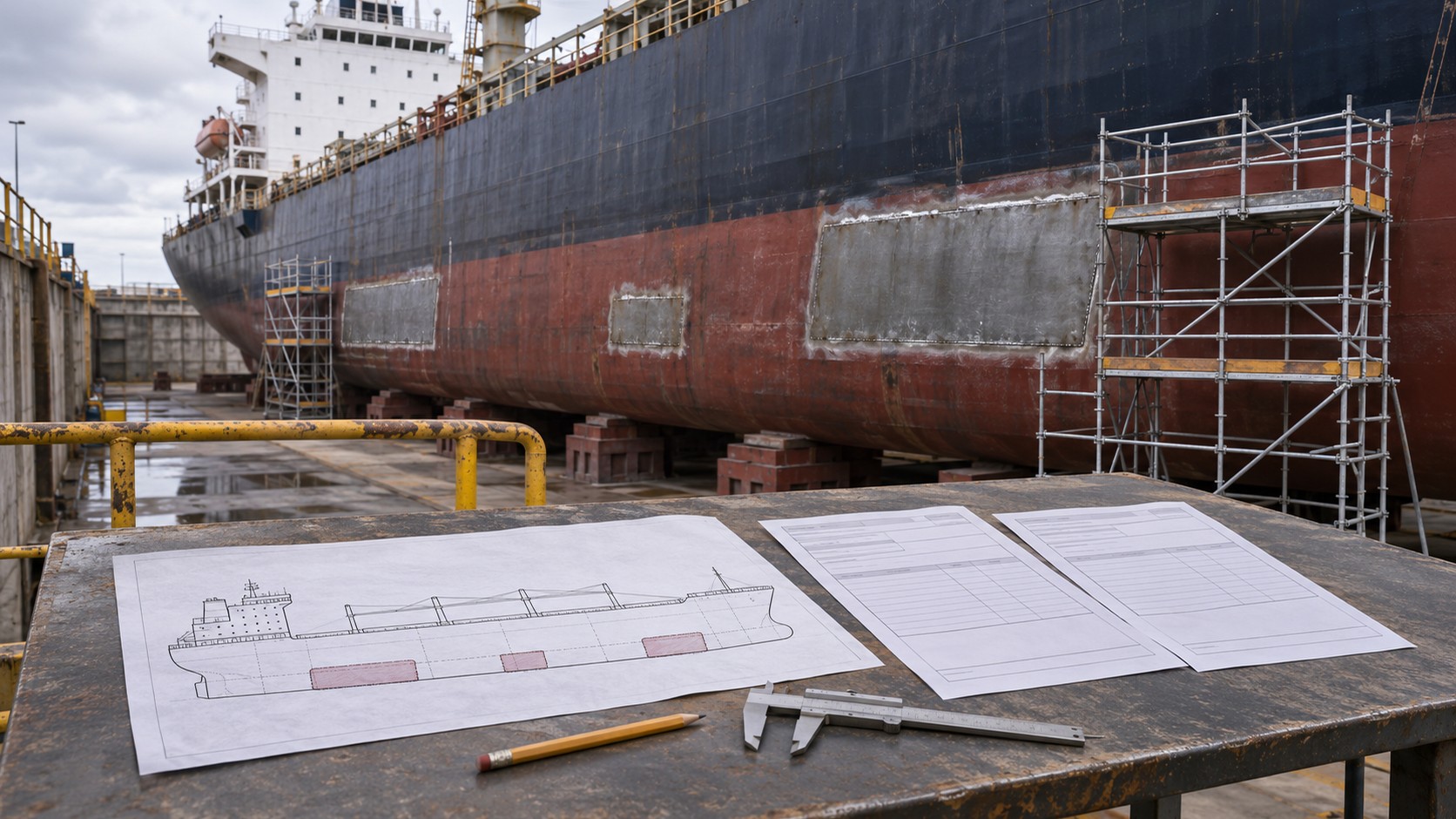
A seller provides a thickness-measurement report and says the ship needs “about two tonnes of steel”. One yard quotes purchased plate weight; another prices net steel installed. An adjacent frame still needs further measurements. Before comparing the totals, establish which repair locations are defined, which quantities are supported and which work remains unresolved.
This guide helps a used-ship buyer prepare a steel-renewal budget file from technical findings. The pre-purchase condition-survey guide covers the wider inspection. Here the deliverable is a location-based scope sheet that connects each budget line to evidence, a quantity basis and the yard’s stated inclusions.
1. Separate findings from an agreed repair extent
A low thickness reading identifies a question for technical assessment; it does not alone define how much structure will be removed. Obtain the measurement report with its location sketches, dates and references, the relevant structural drawings, and the attending surveyor’s findings. Ask the responsible technical team to identify the applicable vessel- and member-specific criteria and the status of the proposed repair.
IACS Procedural Requirement 19 describes the surveyor’s role in determining measurement locations and extent. It provides for additional measurements to delineate corrosion and identify members for repair or renewal. Keep those pending investigations separate from work whose boundaries have been established.
Record whether the repair arrangement is still a proposal, has been reviewed, or has the agreement required for the intended work. The repair provisions in IACS Recommendation 47, Part B (2025 corrigendum) address prior agreement and class-surveyor supervision of hull repairs covered by classification. Have the vessel’s class society confirm the requirements applying to the particular job. A buyer’s quantity worksheet does not approve a repair design.
Do not apply a universal percentage loss to every plate or treat the lowest spot reading as the thickness for an entire space. Likewise, an older report with no open item is not evidence of the current extent of corrosion. For the timing of the vessel’s next survey or docking, use the separate class-cycle guide.
2. Give each repair location its own budget record
Use identifiers that connect to the ship’s actual drawings and survey records. A line labelled only “ballast tank steel” is difficult to check against a quotation or completion report. Preserve the revision and date of the technical scope sent to each yard.
| Scope-sheet field | Evidence or budget question |
|---|---|
| Location and member | Space, side, frame range, plate or stiffener identification, drawing and measurement-report references. |
| Scope status | Defined renewal, additional investigation required, or claimed completed repair awaiting supporting records. |
| Quantity basis | Dimensions, replacement thickness, grade and quantity source; net installed steel versus procurement weight; units used for pricing. |
| Associated work | Access and preparation, removals and reinstatement, fabrication and welding, coating restoration, examinations and completion records: included, separate or unresolved? |
| Open question and owner | Specific missing evidence or price, responsible party, and the event that will allow the budget line to be revised. |
These fields organise a commercial request; the technical team determines what the repair actually requires. Ask yards to identify any assumptions about access, safe working conditions and the ship’s availability. Itemise tests, attendance and documentation where relevant, and distinguish their quoted costs from confirmation that the technical requirements have been satisfied.
3. Worked case: one defined plate item and two open locations
Fictional scope exercise: all locations, quantities and quotation descriptions below are invented. They represent no actual ship or yard. Assume the responsible technical team has supplied the repair boundaries and the replacement plate specification for Item R-01, with the required class agreement for that defined item. The dimensions are inputs, not repair recommendations.
| Location record | Budget treatment |
|---|---|
| R-01: defined plate renewal. Four rectangular inserts, each 2.0 m × 1.5 m × 16 mm; grade specified in the assumed technical package. | Prepare a net plate quantity for this item only. Ask each yard to connect its material and work prices to the same scope revision and explain its billing quantity. |
| R-02: adjacent frame. The available findings call for further measurements; the repair extent has not been established. | Obtain the investigation scope and its price. Keep any renewal allowance explicitly provisional. Do not add a guessed frame tonnage to R-01 and present the sum as a fixed repair scope. |
| R-03: seller-reported completed repair. A photograph and invoice are supplied, but the file has not yet been matched to the location and required completion records. | Request the relevant repair, inspection and class records. Do not automatically price a second renewal, or remove the item from review solely on the seller’s statement. |
For R-01, assume a steel density of 7,850 kg/m³ solely for this estimate. Convert 16 mm to 0.016 m. The net rectangular plate mass is:
4 × 2.0 × 1.5 × 0.016 × 7,850 = 1,507.2 kg, approximately 1.51 tonnes.
This is the calculated mass of the four inserts, before any procurement allowance. It excludes framing, weld metal and other materials. Use the actual agreed material data and geometry for a real take-off; the calculation does not establish the required grade, thickness or repair boundary.
Suppose Yard A’s material line uses 1,800 kg of purchased steel, including its stated cutting allowance, while Yard B’s line uses the 1,507.2 kg net installed plate quantity. Different quantities do not yet demonstrate different repair extents or a saving. Ask A to explain the procurement allowance and both yards to state which quantity their rates and final measurement will use. Procurement and installed weights may both be meaningful, but they are different denominators.
Then establish whether each offer includes steel removal, fabrication, welding, access, coating restoration and the required examinations or attendance. A material-only price cannot be ranked against an installed-work price without the missing scope and prices. This example deliberately has no cheapest-yard conclusion: the available documents are not yet a complete commercial comparison.
4. Present a budget with visible unresolved scope
Show the priced, defined work separately from investigation costs, provisional repair allowances and unpriced exclusions. Label the basis of each allowance and identify what will replace it with a firmer quantity or price. A blank quote line means unresolved cost, not zero cost.
Check currency, taxes, quotation validity, minimum charges and the stated unit of measurement. Keep shared access or attendance costs identifiable so they are not counted again under every location. Record the proposed method for measuring completed work, the supporting records and who must confirm any change to the scope or billing basis.
Also separate repair expenditure from the wider acquisition budget. Docking, positioning and time out of service may need their own allowances; a steel quantity alone does not determine them. The vessel-valuation guide covers the wider price assessment. This worksheet does not establish a discount, contractual entitlement or a complete drydock estimate.
When approaching our sale and purchase team, include the candidate reference, dated measurement and survey records, the defined repair scope and available yard offers. A file that distinguishes established work from unresolved locations gives the buyer and technical advisers a clearer basis for the next decision.
Buying, or want a second opinion?
Our sale & purchase desk can help you find, value and inspect the right tonnage. Tell us what you’re looking for and we’ll revert within one working day.