

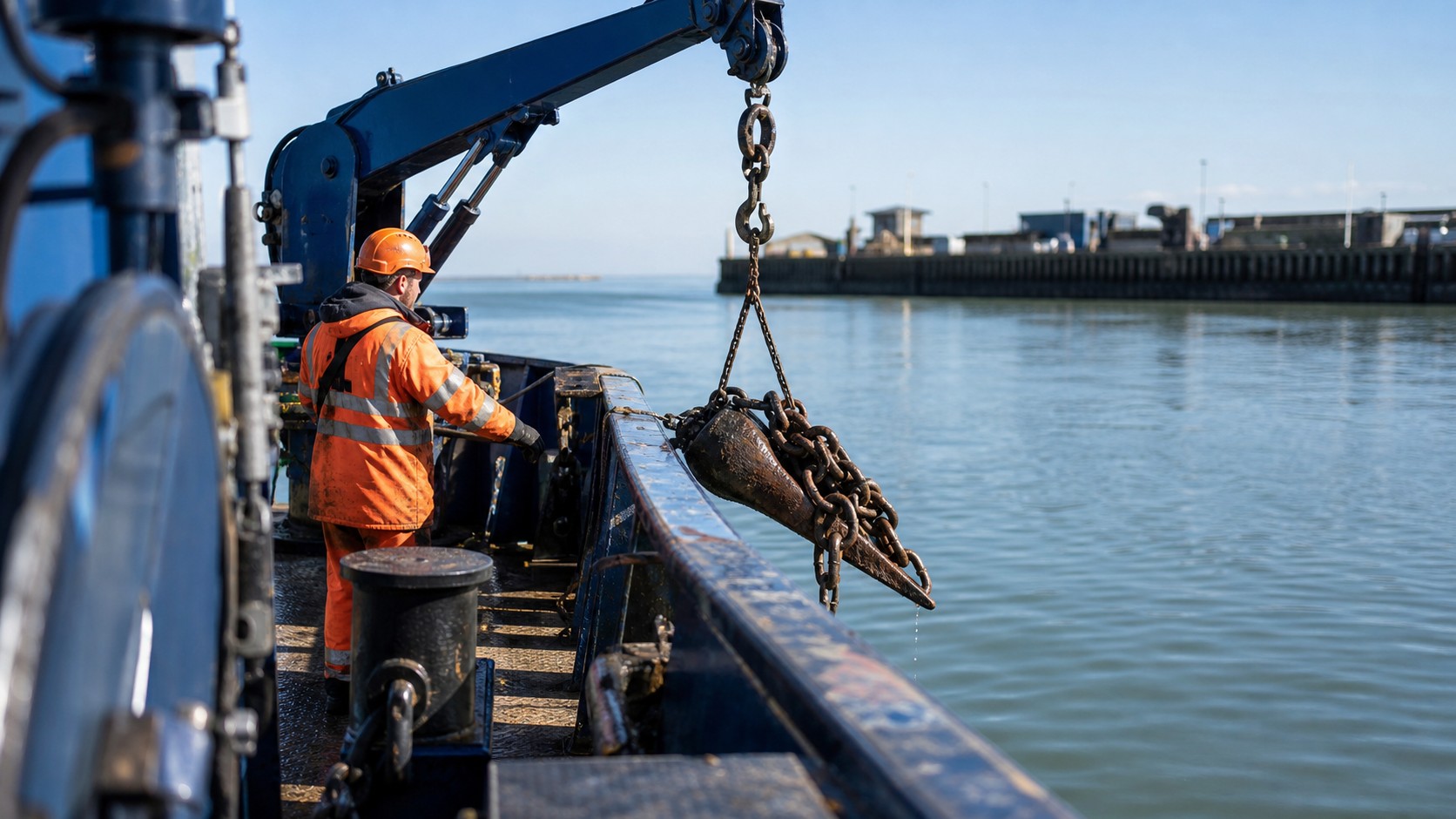
Small work boats are the quiet workhorses of every port and coastal project — laying and lifting anchors, running mooring lines, ferrying crew and stores, and handling light lifts with a deck crane. They’re inexpensive relative to offshore tonnage, quick to mobilise, and endlessly versatile, but the right boat is very specific to the job and the water it works in. This guide covers the small-craft basics and what to check before you buy.
What counts as a “small work boat”
The category covers compact, multi-role craft — often classed as special-purpose vessels — built for harbour and near-shore work rather than deep-sea service:
| Type | Built for | Key features |
|---|---|---|
| Anchor-handling boat | Laying/recovering anchors for barges, pontoons, and rigs | Deck winch or crane, towing gear, good bollard pull for size |
| Mooring boat / line boat | Running and handling mooring lines for ships and terminals | Manoeuvrability, low freeboard aft, push knee |
| Utility / work boat | General port and project support, light lifting, transport | Open work deck, deck crane, twin-screw handling |
| Crew / transport boat | Moving people and light stores | Speed, seating, light deck |
In-stock tonnage includes small coastal work boats around 25–30 m with a deck crane, twin-screw propulsion, and coastal service — flexible for anchor work, light lifting, and general harbour support.
See current availability on our special-purpose vessels for sale page. For larger, offshore-going support vessels, see our offshore support vessel (OSV) guide.
Deck gear: crane, winch, and what it can handle
On a small work boat the deck equipment is most of the value:
- Deck crane — its SWL and outreach set what you can lift over the side; for heavier or fixed lifting compare a floating crane.
- Anchor/tow winch — pull, wire capacity, and condition for anchor-handling.
- Clear work deck & deck strength (t/m²) — space and strength for gear, containers, or cargo.
- Towing gear / push knee — for towing pontoons or pushing barges.
Tip: Match the deck crane SWL and outreach — and the winch pull — to your actual anchors, moorings, and lifts. On a small boat, over-asking the deck gear is the most common mismatch.
Manoeuvrability and propulsion
Close-quarters harbour work lives or dies on handling:
- Twin screw / twin rudder — the norm for tight manoeuvring and redundancy.
- Bow thruster — for precise station-keeping alongside.
- Bollard pull — modest on a small boat, but the figure to check for any towing or anchor work.
- Shallow draft — access to shallow berths, slipways, and works.
Service area, stability, and accommodation
- Navigation/service area — coastal / near-coastal vs. sheltered water only. A small boat’s certificate defines where it can legally work — confirm it suits your area.
- Stability during lift/tow — small craft are sensitive to deck loads and side pulls; review the stability information.
- Accommodation & endurance — crew berths, fuel/water for your working pattern.
- Freeboard & sea state — realistic operating limits for your exposure.
Class, certificates, and due diligence
Before committing, confirm on paper and under NDA:
- Class & status — in class with a recognised society (e.g. CCS, ABS, DNV, BV, LR), no overdue surveys or outstanding Conditions of Class.
- Lifting-appliance certificate — the deck crane’s load-test and register.
- Statutory certificates — Load Line/Tonnage as applicable, Safety, and pollution/environmental certificates; note the certificate’s service-area restriction and expiry.
- GA, capacity/deck plan, and machinery particulars.
- Clean title — no liens, mortgages, or maritime claims.
Survey: deck gear and hull get the scrutiny
Commission an independent pre-purchase condition survey, and a slipway/drydock survey for any serious purchase. On a small work boat the surveyor focuses on:
- Deck crane & winches — load-test records, wires, hydraulics, and foundations.
- Work deck & hull — thickness gaugings, corrosion, and structure in way of deck loads.
- Propulsion & steering — twin-screw machinery, shafting, rudders, and any thruster.
- Safety & pollution systems — operational condition and certificate status.
Tip: A cheap work boat with an out-of-date crane load-test certificate or worn winches can cost more than a dearer, well-kept unit once you add overhaul and lost work days — survey the deck gear before the price tempts you.
Newbuilding vs. secondhand, and total cost
Small work boats are usually bought secondhand for immediate, low-cost mobilisation, or built new to an exact fit (deck crane, winch, draft, service area). For flat open-deck transport rather than lifting/anchor work, compare a small self-propelled deck cargo vessel. Budget beyond the price: survey and any class rectification, crane/winch overhaul reserve, delivery, flag and class transfer, insurance, and spares.
Quick pre-signing checklist
- ☐ Boat type (anchor-handling / mooring / utility / crew) matched to your work
- ☐ Deck crane SWL and outreach, and winch pull, suit your anchors/moorings/lifts
- ☐ Clear work deck and deck strength adequate
- ☐ Twin-screw handling, thruster, and shallow draft suit your harbour/berths
- ☐ Service/navigation area suits where you’ll work
- ☐ In class, no overdue surveys / Conditions of Class; certificate expiry checked
- ☐ Crane lifting-appliance certificate current
- ☐ Independent condition survey (+ slipway); deck gear and hull tested
- ☐ Full documents under NDA; clean title confirmed
- ☐ Total cost of ownership budgeted (crane/winch overhaul, delivery)
Frequently asked questions
What is a small work boat? A small work boat is a compact, multi-role craft — typically 20–35 m — built for harbour and coastal work such as anchor-handling, running mooring lines, light lifting with a deck crane, towing pontoons, and transporting crew and stores. They’re often classed as special-purpose vessels.
What’s the difference between a small work boat and an OSV? A small work boat is a compact coastal/harbour craft for near-shore support and light work. An offshore support vessel (OSV) — such as a PSV or AHTS — is a larger, offshore-going ship built to supply platforms and handle rig anchors far from shore. See our OSV guide for the larger offshore types.
What deck gear should a small work boat have? It depends on the job: a deck crane (with a load-test-certified SWL and outreach) for lifting, an anchor/tow winch for anchor-handling and towing, and a clear, strong work deck for gear and cargo. Match the equipment ratings to your actual anchors, moorings, and lifts.
Where can a small work boat legally operate? Its class and statutory certificates define a service/navigation area — sheltered water, coastal, or near-coastal. Always confirm the certificate’s area restriction (and expiry) suits where you intend to work before buying.
Should I buy secondhand or build new? Small work boats are usually bought secondhand for immediate, low-cost mobilisation; newbuildings suit buyers who need an exact fit (crane, winch, draft, service area) and a clean history. Either way, survey the deck gear and hull.
Looking for a small work boat now? Golden Shipyard carries in-stock and newbuilding special-purpose and work craft, including small coastal work boats around 25–30 m with deck cranes and twin-screw handling. Browse current availability on our special-purpose vessels for sale page, or learn about our ship sale & purchase brokerage services. To receive full particulars under NDA, email [email protected].
Buying, or want a second opinion?
Our sale & purchase desk can help you find, value and inspect the right tonnage. Tell us what you’re looking for and we’ll revert within one working day.