

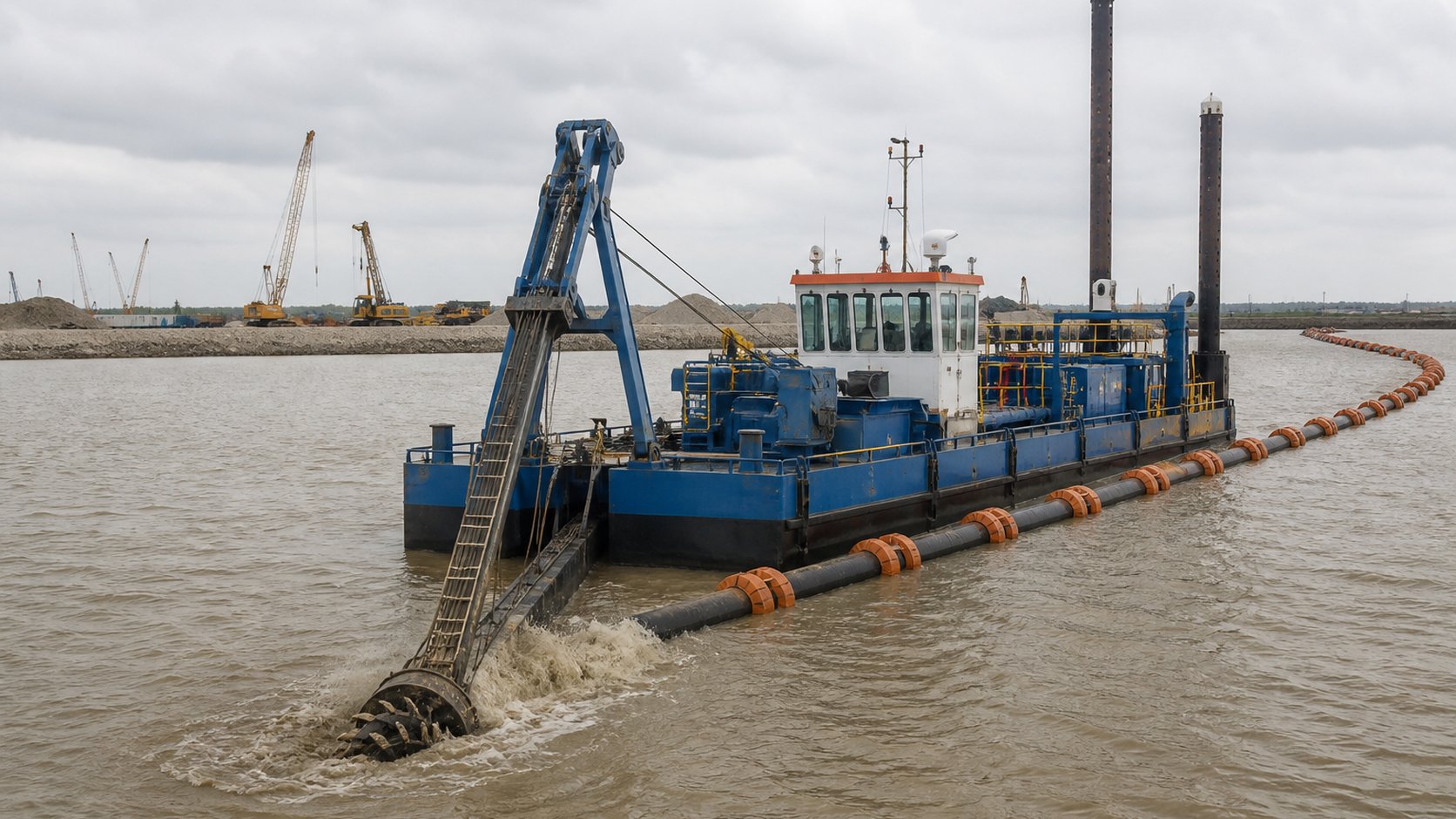
A cutter suction dredger and a trailing suction hopper dredger are both called “dredgers,” but they work in almost opposite ways. A TSHD is a self-propelled ship that drags a suction pipe along the seabed while under way and stores the spoil in its own hopper. A cutter suction dredger (CSD) stays in one place, anchored on spuds, while a rotating cutter head on a ladder breaks up the bed material and a suction pump sends it down a floating pipeline — usually straight to shore or a reclamation site, with no hopper in between. Buying the wrong type for the job means paying for capability you cannot use, which is why the first question is never size, it is which dredging method the project actually needs.
CSD vs TSHD: which method fits the job
| Factor | Cutter Suction Dredger (CSD) | Trailing Suction Hopper Dredger (TSHD) |
|---|---|---|
| Position while working | Stationary, held on spuds or anchors | Under way, trailing the suction pipe |
| Material handled | Hard and compacted material the cutter head can break up | Loose to medium sediment the drag head can lift directly |
| Discharge | Floating pipeline to shore, reclamation area or barge — continuous | Hopper fill-and-sail, discharged by bottom doors, rainbow or pump-ashore |
| Best suited to | Land reclamation, capital dredging in hard ground, close-to-shore fill | Maintenance dredging, channel deepening, disposal at a distant offshore site |
| Mobility | Usually non-propelled or limited self-propulsion; needs a tow between sites | Fully self-propelled; can transit between sites and disposal grounds independently |
See current stock under dredgers for sale, offered as newbuildings and surveyed resales.
What decides a CSD’s capability
- Cutter power (kW) and cutter head type — the headline figure for how hard the ground it can break up; heavier cutter heads and higher power reach denser and more compacted material.
- Dredging depth — the maximum ladder reach below the waterline, which sets the deepest cut the vessel can make in a single pass.
- Production rate (m³/hour) — the combination of cutter power, pump capacity and pipeline length that determines how fast the job actually gets done, not just the nameplate figures in isolation.
- Pump power and pipeline diameter — decide how far and how thick the discharge can be pumped before production drops off with distance.
- Spud and anchoring system — walking spuds, spud carriages or anchor-and-wire systems control how the dredger advances through the cut; the right system depends on the site’s ground conditions and swing width required.
- Ladder and swing winches — condition of the swing wire winches and ladder hoist directly affects how precisely and how fast the dredger can work its cut.
Sizing to the project
CSDs are sized and specified for a project far more tightly than most other commercial vessel types — a reclamation contract dictates the material, the depth, the required production rate and the pipeline distance to the discharge point, and the dredger has to match all four. Buying a CSD that is oversized on cutter power but undersized on pipeline capacity, or vice versa, leaves capacity stranded either way. If the project’s material is soft and the site is not close to shore, weigh a TSHD or a barge-based solution against the CSD route before committing.
Class, certificates and due diligence
- Class and status — in class with a recognised society, no overdue surveys or outstanding Conditions of Class; note any rebuild or re-engining history on the cutter drive and pumps.
- Dredge-plant specifications — cutter power curve, pump performance curve, and ladder/spud system particulars, not just headline numbers.
- GA and pipeline inventory — floating and shore pipeline lengths and diameters included in the sale, since a dredger without matching pipeline is not ready to work.
- Statutory certificates — Load Line (if applicable), tonnage, safety and pollution certification for the flag and trading area intended.
- Clean title — no liens, mortgages or maritime claims.
Survey: cutter, pumps and spuds get the scrutiny
Commission an independent pre-purchase condition survey alongside a specialist dredge-plant inspection. On a CSD the surveyor should focus on:
- Cutter head and drive — tooth wear, gearbox condition, and cutter drive motor hours.
- Ladder structure and hoist winches — wear at pivot points, wire condition, and hoist gear.
- Dredge pump and liners — wear on impellers and liners, which erode fast in abrasive material and are one of the biggest recurring cost items.
- Spud system — spud carriage rails, spud cylinders or walking mechanism, and wear at the guide points.
- Pipeline and floats — condition of floating pipeline sections, joints and floats included in the sale.
- Hull and machinery — general structural condition and the propulsion/generator plant powering the dredge equipment.
Tip: Pump and liner wear is the cost that catches buyers out. Ask for hours run in abrasive versus soft material, not just total hours, since a pump run hard in sand or coral wears out far faster than the same hours in silt.
Newbuilding vs secondhand
Golden Shipyard supplies both newbuilding CSDs to a project-specific spec and surveyed secondhand units for faster mobilisation — see newbuilding vessels for how the newbuild contracting process runs. A secondhand CSD trades sooner and cheaper but inherits pump and cutter wear from its dredging history; a newbuild is sized exactly to the project but carries the newbuild lead time.
Cutter suction dredger checklist
- ☐ Dredging method confirmed as the right fit for the material and site, not just available tonnage
- ☐ Cutter power, dredging depth and production rate matched to the project’s specification
- ☐ Pump and pipeline capacity checked against the actual discharge distance required
- ☐ Spud/anchoring system suited to the site’s ground conditions and swing width
- ☐ Pump and cutter wear history reviewed, not just total running hours
- ☐ Pipeline and float inventory included in the sale confirmed
- ☐ In class, no overdue surveys or outstanding Conditions of Class
- ☐ Independent condition survey plus specialist dredge-plant inspection completed
Frequently asked questions
What is a cutter suction dredger? A dredger that stays anchored on spuds while a rotating cutter head breaks up seabed material, which is then pumped through a floating pipeline to shore, a reclamation site or a barge — used mainly for land reclamation and capital dredging in harder ground.
What’s the difference between a CSD and a TSHD? A CSD is stationary and discharges continuously through a pipeline; a TSHD is self-propelled, drags a suction pipe while under way, and stores spoil in its own hopper before sailing to a disposal site. See the comparison table above for which fits which job.
How is a CSD’s capacity measured? By cutter power (kW), dredging depth, and production rate (m³/hour) — not deadweight or hopper volume, since a CSD has no cargo hold in the conventional sense.
What wears out fastest on a cutter suction dredger? Pump impellers and liners, and cutter teeth, both of which erode with abrasive material and need budgeting as a recurring cost rather than a one-off.
Should I buy new or secondhand? A secondhand CSD mobilises faster and costs less upfront but carries wear from its dredging history; a newbuild is sized exactly to your project’s cutter power, depth and pump requirements but takes longer to deliver.
Looking for a dredger? Golden Shipyard supplies cutter suction dredgers and TSHDs as newbuildings and surveyed resales, with dredge-plant specs and GA drawings released to qualified buyers under NDA. Browse current stock under dredgers for sale, or talk to us through our ship sale & purchase brokerage services. For a confidential discussion, email [email protected].
Buying, or want a second opinion?
Our sale & purchase desk can help you find, value and inspect the right tonnage. Tell us what you’re looking for and we’ll revert within one working day.