


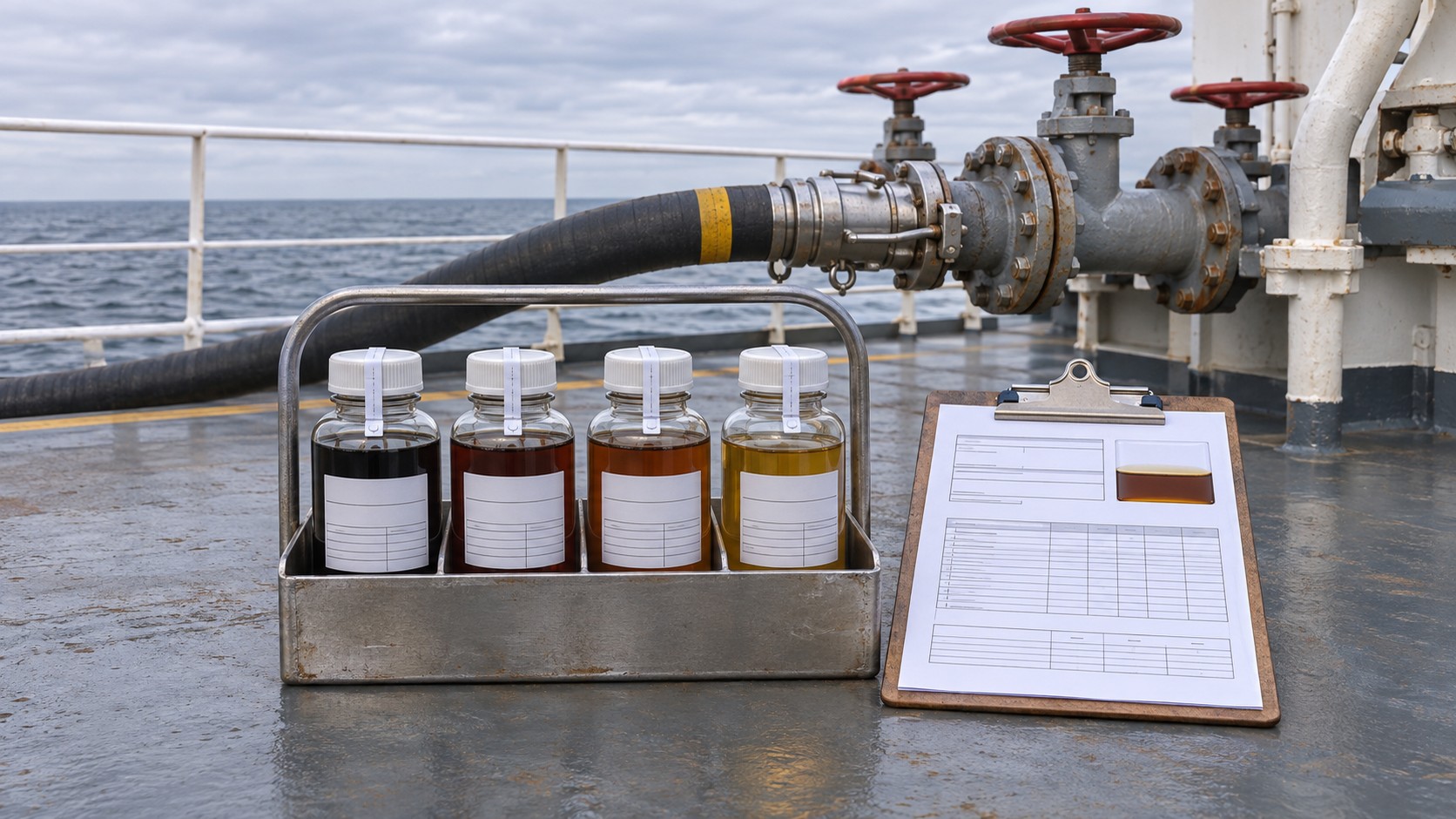
A delivery file can reconcile every tonne and still leave the buyer unable to say what quality of fuel is in the tanks. The bunker delivery note records a supply, a sample bottle represents a moment in that supply, and a laboratory report describes the bottle — not automatically the whole remaining-on-board (ROB) inventory.
This guide builds a quality-evidence file for a used-ship delivery. The ROB reconciliation guide covers quantities, grades and settlement; here the task is to connect each result to the fuel the buyer inherits and record what remains unproven.
1. Keep the two files separate
The quantity file answers how many tonnes are on board and how the contract treats them. The quality file answers which fuel those tonnes are, which sample represents them, which specification applies and whether the result supports acceptance.
Give every grade and tank its own record: grade and tank; delivery note; sample and seal or label; laboratory and report; parameter, method, result and limit; evidence gap; decision owner. Do not let one report stand for several parcels or tanks without checking the sample and tank mapping.
2. Reconstruct the sample chain
The bunker delivery note (BDN) records the ship and IMO number, port and date, supplier, product and quantity, density and sulphur content, plus the supplier’s declaration. It describes the fuel supplied, not the fuel remaining at a later delivery.
The representative sample is the next link. IMO resolution MEPC.182(59) calls for a sample drawn continuously at the manifold throughout delivery, sealed and labelled; ISO 13739 and the ship’s sampling procedure cover the practical handling. Several samples may exist — MARPOL, supplier, vessel-retained and commercial — and the supply contract may say which is binding.
Check the chain: do the labels match the BDN’s vessel, port, date and grade; are the seals intact and recorded; who witnessed the sampling; was the sample stored correctly; can the seller produce the retained MARPOL sample? A MARPOL sample is kept until the fuel is substantially consumed and for at least 12 months after delivery; commercial samples are often kept for less. A missing or mismatched sample means the report may describe some fuel, but not yet the fuel in the buyer’s tanks.
3. Read the report against the named specification
ISO 8217 is the marine fuel specification. The current edition is ISO 8217:2024, Edition 7, but a contract may still name an earlier edition. Check the edition and grade actually incorporated before applying a limit; a result without the grade, method, unit and limit is a number, not a conclusion.
Sulphur. Check the result, method and limit against the BDN declaration, and confirm whether the ship relies on compliant fuel or an approved equivalent method.
Water. Check the result against the grade limit and the method, and whether the sample came from the manifold or a tank. Elevated water can indicate contamination or handling problems.
Aluminium plus silicon (Al+Si). Check the result, method and grade limit. Catalyst fines are an abrasive risk associated with engine wear.
Viscosity and density. Check the reference temperature and method, and consistency with the grade. These properties define handling, heating and quantity conversion.
Flash point, cold flow, total acid number (TAN) and sediment. Check whether the parameter was tested, which method was used and whether the result is close to a limit.
Stability and compatibility. Check whether compatibility was assessed, between which fuels, and on what basis. A fuel can meet its table limits and still behave poorly when mixed with existing stock.
Sulphur depends on trading area: MARPOL Annex VI sets a 0.50% m/m global limit and 0.10% m/m in emission control areas, and the Mediterranean Sea limit took effect on 1 May 2025. A ship with an approved exhaust-gas cleaning system has a different compliance path, but that does not answer whether the inherited fuel meets the grade and contract specification.
Watch results close to a limit. Test methods have reproducibility, so a 0.49% result against 0.50% is not the same evidence as a result well inside the limit. Ask the laboratory or technical adviser how method uncertainty affects the conclusion.
4. Worked example: one intact chain and one broken link
Fictional illustration only. Assume two residual-fuel tanks and a contract naming ISO 8217:2024 and RMG 380 supplied as a 0.50% sulphur grade. Quantities, dates, sample numbers and results are invented; the limits shown are those relevant to this example, not a universal table.
S-01 — No.3 port and starboard
Delivery note and sample: BDN dated 12 October; bottle label and seal match the BDN record.
Sulphur: 0.47% m/m against a 0.50 limit. Water: 0.28% v/v against a 0.50 limit.
Al+Si: 18 mg/kg against a 60 limit. Viscosity at 50 °C: 372 cSt against a 380 limit.
Evidence status: chain intact; the result supports acceptance within the sample’s scope. Tank mapping needs confirmation if both tanks were not sampled.
S-02 — No.5
Delivery note and sample: BDN dated 14 October; bottle seal differs from the seal recorded on the BDN.
Sulphur: 0.48% m/m against a 0.50 limit, but the sample chain is unresolved. Water: 0.62% v/v against a 0.50 limit — 0.12 percentage points above.
Al+Si: 44 mg/kg against a 60 limit. Viscosity at 50 °C: 376 cSt against a 380 limit.
Evidence status: the report cannot be tied to the delivery note or No.5. Retest or tank sample and technical review required.
S-01 is a supported result, not a guarantee about every tonne. The sample came from one delivery at the manifold; if No.3 port and starboard have different histories, one sample may not represent both. The sulphur and viscosity margins are small enough that method reproducibility should be considered.
S-02 is the more common problem. Water is 0.12 percentage points above the limit — an off-spec result — but the seal mismatch means the report cannot yet be tied to No.5. Do not average the results, blend them into a “mostly compliant” conclusion or assume the report belongs to the other tank. Hold the acceptance decision, obtain a properly identified sample or tank sample and have the technical adviser review the result and the fuel system. The example does not establish engine damage, a claim amount or a legal position.
5. Record what the file does not prove
A laboratory report proves what the tested sample did under the named methods. It does not prove the sample represents every tank, that the fuel is compatible with previous stock, or that the ship can use it without technical review. Manifold, tank and in-use samples answer different questions; routine panels may miss contaminants outside their scope; on-board tests are screening, not final analysis. P&I guidance on contamination response adds: preserve samples and records, and notify the relevant parties promptly when quality is in doubt.
Classify each grade as supported for acceptance within a stated sample scope, retest required, unresolved because a document or sample is missing, or escalated for technical advice. Keep that classification separate from the quantity reconciliation.
6. Close the quality file before delivery
Assemble the BDN, sample labels and seal records, laboratory report with methods and limits, grade-to-tank mapping, sulphur compliance path and compatibility questions. Record which sample the contract treats as binding, who witnessed sampling, where samples were stored and what remains after delivery.
If a link is missing, request a replacement or properly witnessed tank sample, agree the laboratory and test scope, and record the reservation in the delivery file. Do not let quantity settlement absorb an unresolved quality question. The sale and purchase contract, supply terms and notification deadlines are for the buyer’s technical and legal advisers; this worksheet does not decide contractual rights.
For the wider sequence, see the ship sale and purchase process guide. When approaching our sale and purchase team, include the candidate reference, delivery notes, retained-sample records and laboratory reports. A file that shows the sample chain and the remaining gaps gives the buyer and advisers a clearer basis for acceptance.
Sources: ISO, ISO 8217:2024 marine fuel specification; IMO, IMO 2020 sulphur limit and 2019 guidelines on consistent implementation of the 0.50% sulphur limit; Skuld, analysis of fuel samples, sample storage and bunker disputes and shipboard fuel treatment.
Buying, or want a second opinion?
Our sale & purchase desk can help you find, value and inspect the right tonnage. Tell us what you’re looking for and we’ll revert within one working day.