


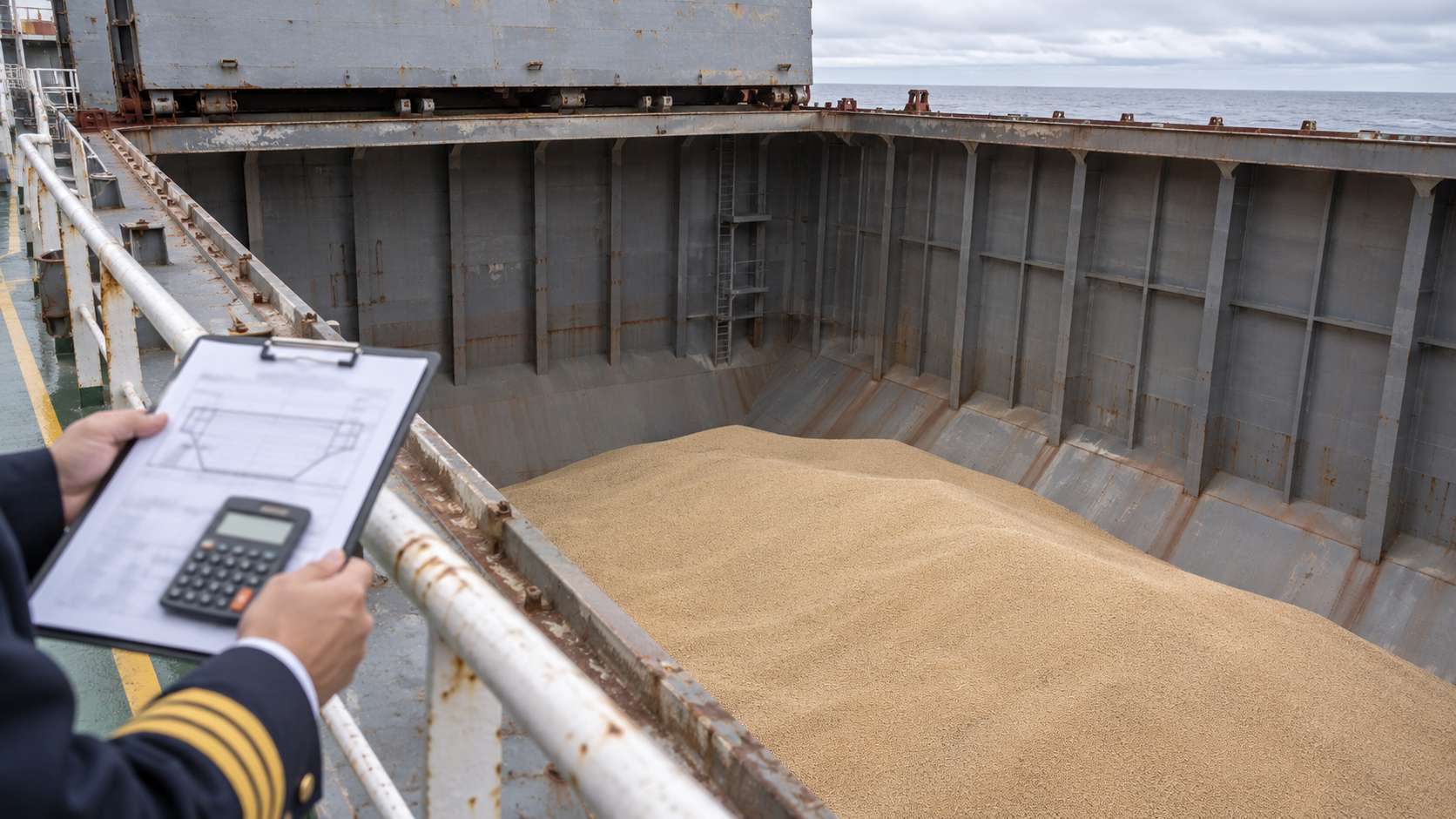
A bulk carrier is advertised at 63,000 DWT. Your intended cargo parcel is 55,000 tonnes. That comparison leaves two questions unanswered: how much deadweight remains for cargo in the proposed condition, and how much space will this cargo require? A ship can have enough weight capacity for the parcel while running short of usable hold volume.
This guide produces an initial quantity screen for a specified dry-bulk parcel. Use our ship specification guide for DWT and capacity terminology. Here, the useful result is a calculation showing which of two limits binds, whether the parcel clears them, and which uncertain input could change that decision.
1. Establish three inputs on a consistent basis
First obtain the deadweight applicable to the assumed operating condition. Have the vessel’s technical team establish the relevant draft and load-line basis rather than adopting the maximum advertised DWT automatically. Record the assumed timing of the condition, since consumables and ballast can change during a voyage.
Deduct the non-cargo deadweight included in that condition to obtain a cargo-weight budget. Keep fuel, water, ballast, stores, constants and any planning allowances identifiable, with each amount counted once. Lightweight is already excluded from deadweight; do not subtract it again. If the supplied figure is already a net cargo budget, establish its deductions before applying more.
Next obtain a usable cargo-space volume for the proposed bulk stowage. Wärtsilä’s capacity-plan description identifies cargo and tank capacity information alongside deadweight scales. Ask which cargo-capacity basis is quoted and how the screening volume was established; a headline cubic figure alone does not establish usable space for every cargo or loading arrangement.
The third input is the cargo’s stowage factor (SF). Wärtsilä defines stowage factor as the space required per unit cargo weight. Record the units and the basis supplied for the actual shipment. In this article all weights are metric tonnes and SF is in m³/t. Do not combine cubic feet with cubic metres, or an unspecified “ton” with a metric tonne.
| Input to retain | What must be clear |
|---|---|
| Cargo-weight budget, tonnes | Applicable operating condition, deadweight basis, non-cargo deductions and allowances already included. |
| Usable cargo volume, m³ | Capacity-plan reference, spaces included, cargo basis and adjustments already made. |
| Shipment SF, m³/t | Supplier or cargo-information source, units, assumed range and any stowage allowances contained in that figure. |
| Parcel requirement, tonnes | Quantity to screen and the agreed basis for any tolerance; do not silently reduce the requirement to make a candidate fit. |
Reconcile volume adjustments with the SF basis. Applying the same space allowance to both can double-count it. Keep any unresolved assumptions visible rather than hiding them in a conservative-looking total.
2. Calculate both limits before choosing the smaller
Volume-based quantity = usable cargo volume ÷ stowage factor. With m³ divided by m³/t, the result is tonnes. Compare that quantity with the cargo-weight budget. The lower value is the ceiling under these two assumptions.
For example, if the weight budget is 60,000 tonnes but volume supports only 50,000 tonnes, unused deadweight cannot create more hold space. If volume supports 62,500 tonnes but the weight budget is 60,000 tonnes, the extra cubic capacity cannot increase that budget.
Veson’s Max Lift documentation treats available deadweight, cubic restrictions and draft restrictions as distinct constraints. This article’s two-limit comparison is a preliminary screen: other limits can reduce the permissible quantity further. A positive arithmetic result is a reason to request a vessel-specific loading assessment.
3. Worked example: screen a 55,000-tonne parcel
Fictional example: assume a technical team has supplied 63,000 tonnes of deadweight for the selected operating condition and 3,000 tonnes of total non-cargo deductions, including all allowances used here. The resulting cargo-weight budget is 60,000 tonnes. Assume 75,000 m³ is the usable volume established for this screening exercise, after the relevant space adjustments.
The buyer needs to screen a 55,000-tonne parcel. Cargo A and Cargo B are hypothetical alternatives with assumed SF values; they are not guaranteed figures for named commodities or actual inventory. Hold the vessel, weight budget and usable-volume assumptions constant.
| Cargo case and calculation | Initial parcel decision |
|---|---|
| A: SF 1.20 m³/t
75,000 ÷ 1.20 = 62,500 t by volume. Lower of 62,500 and 60,000 = 60,000 t; weight binds. |
55,000 t clears both arithmetic limits, leaving 5,000 t below the two-constraint ceiling. Advance for technical verification. |
| B: SF 1.50 m³/t
75,000 ÷ 1.50 = 50,000 t by volume. Lower of 50,000 and 60,000 = 50,000 t; volume binds. |
55,000 t exceeds the volume-based ceiling by 5,000 t. The parcel does not clear this screen. |
Two different thresholds help interpret the result. The constraint switches at 75,000 ÷ 60,000 = 1.25 m³/t: below that assumed SF, weight binds; above it, volume binds. Separately, a 55,000-tonne parcel requires SF ≤ 75,000 ÷ 55,000, approximately 1.364 m³/t, provided the weight budget remains sufficient. The rounded value is explanatory, not an operational acceptance limit.
Test an uncertain SF range before advancing a candidate. At 1.30 m³/t, volume supports approximately 57,692 tonnes; at 1.40, approximately 53,571 tonnes. The same 55,000-tonne parcel clears one assumption and fails the other. Obtain better shipment-specific information instead of presenting the favourable end of the range as confirmed intake.
4. Turn the screen into a specific technical request
Send the input sheet, parcel quantity, calculations and sensitivity range to the vessel’s technical team. Ask them to verify the condition-specific weight budget and space basis, and assess hold distribution, stability, strength, draft and load-line restrictions, and applicable cargo requirements. Total volume cannot establish whether an individual hold can accept its proposed share.
Keep a missing input separate from a demonstrated mismatch. Cargo B fails under the stated assumptions; a candidate with an unverified cubic figure remains unevaluated. Cargo A clears the two arithmetic limits but still requires the further checks. This distinction makes the screen useful before commissioning detailed work.
When comparing bulk carriers for sale, send the intended parcel and its SF basis with your enquiry. They help identify which particulars and loading information are needed to assess the candidate.
Buying, or want a second opinion?
Our sale & purchase desk can help you find, value and inspect the right tonnage. Tell us what you’re looking for and we’ll revert within one working day.