

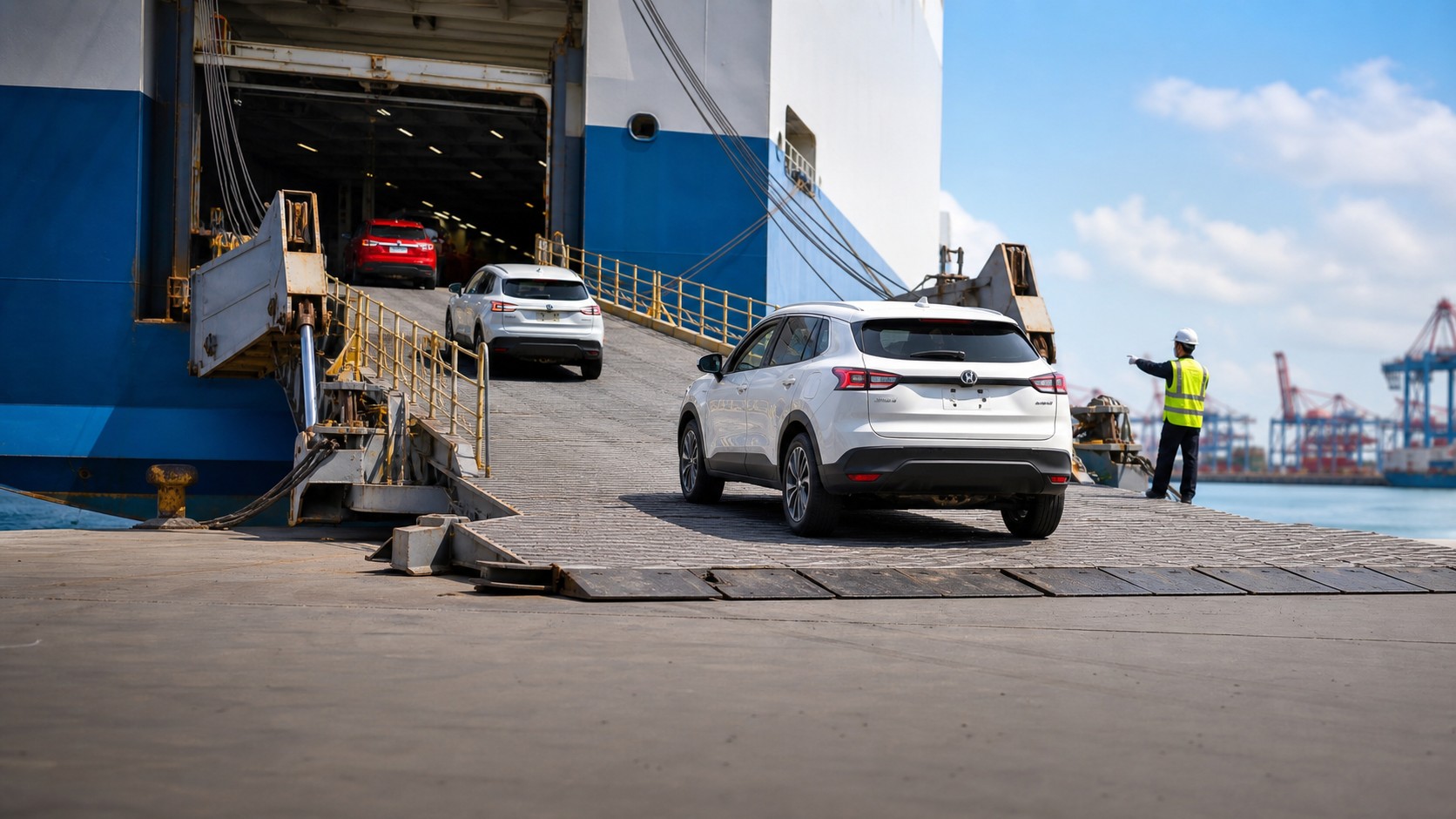
A Ro-Ro (roll-on/roll-off) vessel earns its money on how quickly wheeled cargo drives on and off — no cranes, no lift, just ramps and decks. But “Ro-Ro” spans pure car carriers, high-and-heavy carriers, cargo Ro-Ros, and passenger RoPax ferries, and the spec sheet hides what actually decides the deal: the ramps your ports can take, the deck heights your cargo needs, and how capacity is really measured. This guide covers what to check before you buy.
FRVous préférez le français ? Consultez notre sélection de navires RoRo et porte-voitures à vendre.
Ro-Ro family: PCTC vs. ConRo vs. RoPax vs. Ro-Ro cargo
Match the type to your trade first:
| Type | Carries | Best for |
|---|---|---|
| PCTC (Pure Car & Truck Carrier) | Cars, vans, and high-and-heavy on multiple decks | Deep-sea and regional vehicle logistics |
| Ro-Ro cargo | Trailers, machinery, project units, some cars | Trailer/unaccompanied freight and mixed rolling cargo |
| ConRo | Containers + rolling cargo | Trades mixing boxes and vehicles |
| RoPax / Ro-Ro ferry | Vehicles + passengers | Short-sea ferry routes |
A typical modern PCTC has multiple vehicle decks (e.g. 6+), a stern ramp, and ocean-going class — designed to load and unload thousands of cars fast. In-stock tonnage includes units around 2,200 car spaces with several decks and stern-ramp access.
See current availability on our Ro-Ro & car carriers for sale page.
Ramps: the feature that decides which ports you can serve
The ramp is a Ro-Ro’s front door — and it must match the quays you’ll use:
- Stern ramp — the workhorse; straight-in loading. Check its SWL (safe working load) and width for your heaviest unit.
- Quarter (stern-quarter) ramp — angled, lets the ship berth alongside and still load — more port flexibility, higher value.
- Side ramp — for simultaneous operations and certain terminals.
- Internal ramps / hoistable ramps — how vehicles move between decks; ramp vs. lift affects loading speed.
Tip: Confirm ramp SWL, width, and angle against the heaviest and largest units you’ll carry and the tidal range at your ports. A stern-only ramp limits you to end-on berths; a quarter ramp opens far more terminals.
Deck height and hoistable decks — cars vs. high-and-heavy
Capacity isn’t just floor area; it’s clearance:
- Fixed vs. hoistable (liftable) decks — hoistable panels let you raise clearance for trucks, buses, and high-and-heavy, or lower them to pack in more cars. The more adjustable decks, the more flexible the cargo mix.
- Deck clearance (height) — the free height on each deck sets what fits (a car deck ≈ 1.7–2.2 m; high-and-heavy needs much more).
- Deck strength (axle/point load) — for trucks, buses, and heavy machinery, not just cars.
- Ramp gradients inside — steep internal ramps limit low-clearance or heavy units.
Capacity: lane metres, CEU, and what the numbers mean
Ro-Ro capacity is quoted differently by segment — know which you’re buying:
| Metric | Meaning |
|---|---|
| CEU (Car Equivalent Unit) | Standard car spaces — the PCTC headline (e.g. ~2,200 cars) |
| Lane metres (LIM) | Metres of lane at standard width — used for trailers/Ro-Ro cargo |
| RT / high-and-heavy capacity | How much of the deck can take trucks/machinery vs. cars |
Nominal car capacity assumes a standard vehicle size; real intake drops with larger vehicles or high-and-heavy mix. Match the metric to your actual cargo.
Ventilation, fire safety, and lashing
Vehicle decks are demanding spaces — check the systems that keep them safe:
- Ventilation — high air-change rates for exhaust fumes on enclosed decks.
- Fire detection & fixed fire-fighting — vehicle-deck fires (increasingly an EV concern) make detection, drencher/CO₂ systems, and boundary cooling critical; review certification and condition.
- Lashing points & equipment — deck-securing for cars and heavy units in a seaway.
- Watertight ramp doors & stability — Ro-Ro stability and the integrity of bow/stern doors are safety-critical; confirm survey status.
Class, certificates, and emissions
Before any inspection, confirm:
- Class & status — in class with a recognised society, no overdue surveys or outstanding Conditions of Class.
- Ro-Ro / vehicle-deck notations, ice class, and service area (coastal vs. ocean-going).
- Statutory certificates — Load Line, Tonnage, Safety, pollution; ramp/door and fire-system certificates.
- Air draft & main dimensions — for the bridges, berths, and terminals on your route.
- Emissions standing — for international voyages, review the vessel’s EEXI and CII rating.
Survey: ramps, doors, and decks get the scrutiny
Commission an independent pre-purchase condition survey, and a drydock survey for any serious purchase. On a Ro-Ro/PCTC the surveyor focuses on:
- Stern/quarter/side ramps & doors — structure, hydraulics, hinges, seals, and load-test records.
- Hoistable decks & internal ramps — panels, lifting systems, and securing.
- Vehicle decks — coating, corrosion, drainage, and deck strength.
- Ventilation & fire systems — operational tests, not just paperwork.
- Watertight integrity — bow/stern doors and ramp seals (safety-critical on Ro-Ros).
- Hull, machinery & steering — thickness gaugings and propulsion.
Tip: On a Ro-Ro, tired ramp hydraulics, worn hoistable-deck systems, or ageing fire/ventilation plant can cost more than a dearer, well-maintained sister once you add repairs and off-hire. Survey the ramps, doors, and deck systems before the price tempts you.
Due diligence and total cost of ownership
Reputable sellers release full particulars to qualified buyers under an NDA. Insist on the GA (deck plans), capacity/lane-metre and CEU figures, ramp and hoistable-deck specifications, class and survey status, maintenance and drydock history, and a clean title free of liens. Then budget beyond the price: survey and any class rectification, ramp/deck/fire-system overhaul reserve, delivery, flag and class transfer, insurance, and modifications for your cargo mix. For rolling project cargo without car-deck needs, compare an MPP or a self-propelled deck cargo vessel.
Quick pre-signing checklist
- ☐ Ro-Ro type (PCTC / Ro-Ro cargo / ConRo / RoPax) matched to your trade
- ☐ Ramp type(s), SWL, width, and angle suit your ports and heaviest units
- ☐ Deck clearances and hoistable decks fit your cars vs. high-and-heavy mix
- ☐ Capacity confirmed in the right metric (CEU and/or lane metres) for your cargo
- ☐ Deck strength adequate for trucks/machinery, not just cars
- ☐ Ventilation and fixed fire-fighting adequate and certified (EV considerations)
- ☐ Air draft and dimensions suit your route’s berths and bridges
- ☐ In class, no overdue surveys / Conditions of Class; special survey priced in
- ☐ Independent condition survey (+ drydock); ramps, doors, decks tested
- ☐ Full documents under NDA; clean title confirmed
- ☐ Total cost of ownership budgeted (ramp/deck/fire overhaul reserve)
Frequently asked questions
What is the difference between a Ro-Ro and a PCTC? Ro-Ro (roll-on/roll-off) is the broad category of ships where cargo drives on and off via ramps. A PCTC (Pure Car & Truck Carrier) is a Ro-Ro specialised for cars and high-and-heavy vehicles on multiple decks. Other Ro-Ro types include Ro-Ro cargo (trailers), ConRo (containers + rolling cargo), and RoPax ferries (vehicles + passengers).
What are lane metres and CEU? CEU (Car Equivalent Unit) counts standard car spaces — the headline for car carriers. Lane metres (LIM) measure metres of lane at a standard width — used for trailers and Ro-Ro freight. Match the metric to your cargo; nominal capacity assumes standard vehicle sizes.
Why do ramp type and SWL matter so much? The ramp determines which ports and berths you can serve and how heavy a unit you can load. A stern-only ramp needs end-on berths; a quarter ramp lets you berth alongside and load, opening far more terminals. Always match ramp SWL, width, and angle to your cargo and ports.
What are hoistable decks? Hoistable (liftable) decks are movable deck panels that let you raise clearance for trucks and high-and-heavy cargo or lower it to pack in more cars. The more adjustable decks a car carrier has, the more flexible its cargo mix.
What are the key safety systems on a Ro-Ro? Vehicle-deck ventilation, fire detection and fixed fire-fighting (increasingly important with electric vehicles), lashing/securing points, and the watertight integrity of bow/stern doors and ramps. These are safety-critical — always confirm their condition and survey status.
Looking for a Ro-Ro or car carrier now? Golden Shipyard carries in-stock and newbuilding Ro-Ro and PCTC tonnage, including modern ocean-going car carriers around 2,200 car spaces with multiple vehicle decks and stern-ramp access. Browse current availability on our Ro-Ro & car carriers for sale page, or learn about our ship sale & purchase brokerage services. To receive full particulars under NDA, email [email protected].
Buying, or want a second opinion?
Our sale & purchase desk can help you find, value and inspect the right tonnage. Tell us what you’re looking for and we’ll revert within one working day.