


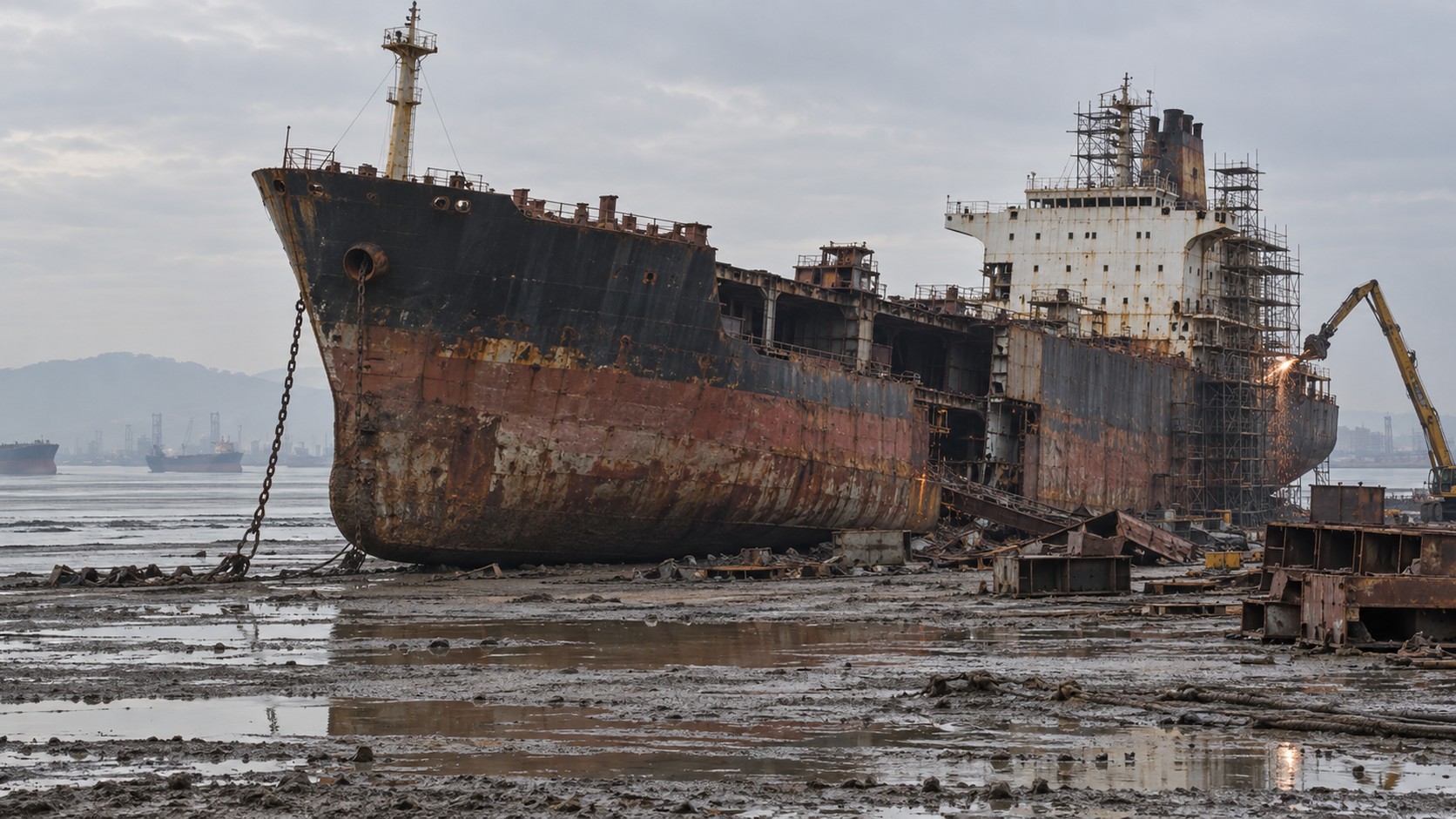
The ship recycling market in 2026 is defined by a contradiction: the yards are ready, the prices are firm, and there is almost nothing to buy. Global demolition volumes fell 4% year-on-year in the first half to roughly 1.01 million light displacement tonnes (LDT), with May 2026 marking the lowest monthly demolition sales in a year. South Asian yards describe an “acute tonnage shortage” — a market with willing buyers and a thinning pipeline of candidates. This is a read on why, what it means for prices, and what would actually change it. For the owner-side decision of whether to scrap or keep trading, see our ship demolition vs trading on guide.
FRVous préférez le français ? Lisez notre guide d’achat du navire vraquier.
The headline: firm prices on almost no volume
What makes 2026 unusual is that the two halves of the market are pointing in opposite directions. Prices are strong and getting stronger — Pakistan led an aggressive August surge, with container tonnage jumping 6.25% in a single week to around USD 520 per LDT, tankers to USD 510 and bulkers to USD 500, and an actual 6,140 LDT bulker (the MARIA) changing hands at Gadani at USD 532 per LDT. Yet volume is scarce: March 2026 opened with Turkey at USD 280/LT for bulkers, Pakistan at USD 420–425, India around USD 420 and Bangladesh at USD 430, and through the year the yards have been bidding against each other for a supply of ships that simply isn’t arriving.
The wider price trend is worth reading carefully, because the August surge sits inside a softer year. By mid-2026, prices had cooled roughly 5% below May 2025 levels and about 19% below May 2023 — a reminder that the recycling market’s headline rates swing hard year to year, and that a strong month is not the same as a strong cycle.
Why owners are not selling: freight rates beat scrap prices
The tonnage shortage is not a mystery. Recycling is fundamentally an arbitrage between what a ship earns in trade and what its steel is worth on the beach, and through 2026 the trading side has won almost every time. Firm freight markets across most size bands, compounded by Red Sea and Middle East routing disruption that has absorbed effective vessel capacity, mean an ageing ship still generates a reasonable return. Add the cost and administrative burden of getting an Inventory of Hazardous Materials in order before a compliant yard can legally accept the vessel, and the bar for scrapping rises further.
Tip: When both freight and scrap prices are firm, tonnage does not leave the fleet — it circulates. Expect more of it in the secondhand market, trading longer than the age profile alone would suggest you.
A two-speed recycling market: bulkers out, tankers held back
What little is being scrapped is concentrated in a few segments. In the first four months of 2026, 30 dry bulk carriers (around 1.51 million DWT) were recycled against only 19 tankers. Bulk carriers were the largest scrap-sale category overall in 2025, at 72 vessels and about 2.5 million GT — roughly 32% of all tonnage recycled — and in H1 2026 they again led South Asian intakes at about 27% of tonnage, followed by containers at around 17%.
The tanker figure is the more interesting one, because it is not a story about ships being too young to scrap. It is a sanctions story. Roughly 927 tankers — around 11.6% of the global tanker fleet — are under sanctions, against just 65 bulkers, about 0.4% of that fleet. Nearly 93% of those sanctioned tankers are over 16 years old, well past the age at which they would normally be recycled. Shadow-fleet employment has artificially extended their working lives, and because those vessels are difficult to sell, insure and clear through compliant yards, an entire generation of elderly tanker tonnage is being held out of the demolition market rather than flowing into it.
Where the ships go: India pulls ahead
The regional balance has shifted decisively toward India. Indian yards grew 16% year-on-year in H1 2026 to around 569,000 LDT, taking 35.4% of global recycling volume — supported by more than 115 Hong Kong Convention-compliant yards, the highest certified capacity of any recycling nation, plus stronger financing and infrastructure investment, with capacity being expanded from 4.5 to 9 million tonnes a year. Alang beached 119 ships in FY26 totalling 1,087,447 LDT, of which 24 were sanctioned or “dark fleet” vessels accounting for 31.72% of the tonnage.
Bangladesh meanwhile fell 21% to 392,000 LDT, caught between regulatory uncertainty as it implements Basel Convention and HKC requirements simultaneously, weaker domestic steel demand and banking constraints. Pakistan dropped 15% to roughly 51,000 LDT even as it modernised Gadani and led the market on price. Turkey stayed structurally uncompetitive on price — around USD 285 per LDT for containers in August against Pakistan’s USD 520 — reflecting stricter EU-linked environmental standards and higher local compliance costs, but it remains the default destination for tonnage that cannot leave European waters under waste-shipment rules.
The 2025 comparison: fewer ships, much bigger ones
It helps to set 2026 against a genuinely strong 2025, when global recycling rose 65% year-on-year to 7.9 million gross tonnes — the highest since 2021 — while the number of vessels scrapped actually fell to 298 from 322. Fewer ships, far more tonnage: the market shifted decisively toward larger units. A record 17 steam-turbine LNG carriers were recycled, a reflection of that older propulsion technology reaching end of life, alongside shadow-fleet tankers. Containership scrapping, by contrast, fell to a near two-decade low of just 10 ships — the segment that has most consistently stayed in service.
Outlook: the pipeline refills slowly
Recycling activity is expected to pick up through 2026 and into 2027, but the timing depends on a balance of forces that currently all point the same way — toward holding tonnage. Four things would change it: a softening in freight earnings that makes trading on unprofitable; the progressive exit of ageing shadow-fleet tankers as sanctions enforcement tightens; the scheduled obsolescence of elderly steam-turbine tonnage; and continued fleet renewal, as newbuild deliveries displace less efficient ships from their trades.
What is unlikely is a return to the 2015–2016 pattern of mass scrapping. That was driven by a freight market so weak that owners had no choice. In 2026 the tonnage is ageing — the bulk carrier fleet averages roughly 13 years, against 8.6 in 2018 — but it still earns. An ageing fleet plus firm rates plus a sanctions overhang is a recipe for a slow, thin recycling market, not a flood of ships onto the beaches.
What it means for buyers and sellers
If you are buying older tonnage, the recycling market matters to you in two directions. Upward: a firm scrap price puts a meaningful floor under what a ship is worth even at end of life, which is a real part of the value case for an older vessel — see our ship age buyer’s guide and secondhand value drivers. Downward: the same firm prices are a signal that tonnage is staying in the fleet longer than age alone would predict, so the secondhand market will keep offering older candidates, and the condition and survey position of a vessel matter more than its build year. If you are selling, the HKC compliance status of your ship is now an exit-value driver in its own right — not paperwork to arrange at the last minute.
Either way, the recycling market is worth watching as a leading indicator for the secondhand market as a whole: it is where value goes when trading stops being worth it, and how strongly it is bidding tells you how much the rest of the fleet is still earning.
Buying, or want a second opinion?
Our sale & purchase desk can help you find, value and inspect the right tonnage. Tell us what you’re looking for and we’ll revert within one working day.