


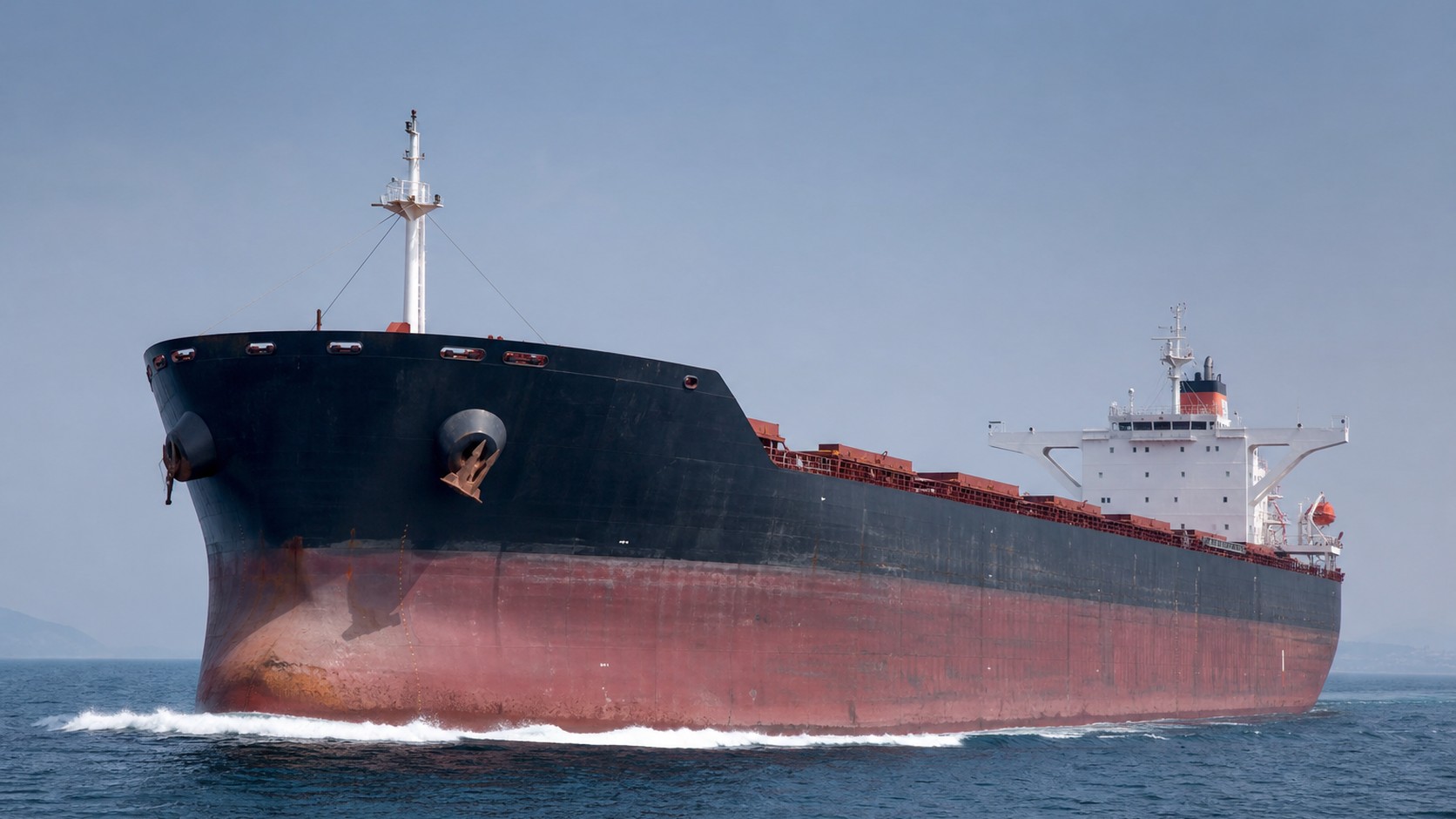
Ask why a Kamsarmax is 82,000 DWT and not a round number, and the honest answer is: it isn’t sized off a round number at all — it’s sized off two physical constraints that have nothing to do with each other, and Kamsarmax is what you get when a naval architect maximises deadweight against both at once. It has become the default large-Panamax newbuild size, and understanding why tells you something real about what you’re buying. See our bulk carrier size classes explainer for how Kamsarmax fits against Handysize through Capesize.
FRVous préférez le français ? Lisez notre guide d’achat du navire vraquier.
Two constraints, one hull
A Kamsarmax’s dimensions come from stacking two separate limits on top of each other:
- Beam ~32.25 m — the beam limit of the Panama Canal’s original locks. A classic Panamax was built to the same beam limit.
- Length ~229 m — the quay and turning-basin length restriction at the port of Kamsar, Guinea, a major bauxite export terminal that gives the class its name.
A classic Panamax tops out around 75,000 DWT at roughly 225 m length. Stretch the hull to 229 m at the same beam — the longest a vessel can be and still work Kamsar’s berths — and deadweight climbs to around 82,000 DWT. That extra 4 metres of length is worth roughly 7,000 tonnes of additional cargo-carrying capacity on the same beam, which is why owners standardised on it.
Why the canal expansion didn’t kill Kamsarmax
The Panama Canal’s 2016 expansion opened new, wider locks (beam limit roughly 51 m), enabling genuinely larger dry bulk tonnage — Newcastlemax and other post-Panamax classes now transit loaded where a Kamsarmax once represented the practical ceiling. That could have made Kamsarmax obsolete. It didn’t, for a simple reason: the canal was never the only constraint. Kamsar and plenty of other bulk terminals worldwide still have berth and turning-basin lengths built around the pre-expansion generation of ships. A Newcastlemax that can transit the new locks still can’t necessarily call the ports that made Kamsarmax’s dimensions the target in the first place. Newbuild ordering has stayed heavily weighted toward Kamsarmax and Supramax for exactly this reason — see our read on the 2026 bulk carrier market, where Panamax accounts for the largest single share of this year’s delivery wave.
Tip: When you see “Kamsarmax” on a spec sheet, check both numbers independently — beam against the ports and canals you actually transit, length against the specific berths you actually call. A vessel built to Kamsarmax dimensions is optimised for Kamsar and canal transit, not automatically for every port that happens to take an 82,000 DWT ship.
Kamsarmax vs. the rest of the Panamax family
| Class | Indicative DWT | Defining limit |
|---|---|---|
| Classic Panamax | ~65,000–75,000 DWT | Original Panama Canal locks — beam and length |
| Kamsarmax | ~82,000 DWT | Original canal beam + Kamsar port length (229 m) |
| Post-Panamax / Newcastlemax | ~180,000–210,000 DWT | Expanded canal locks (2016) and Newcastle, Australia port limits |
What a Kamsarmax actually carries
The class exists because of a bauxite terminal, but bauxite is now a minority of what Kamsarmax tonnage actually trades. In practice the fleet works across the full range of major dry bulk commodities:
- Grain — Kamsarmax is a mainstay size on US Gulf, South American and Black Sea grain export routes, where cargo is light and stows on volume (grain cubic) rather than deadweight, so hold geometry matters as much as the DWT figure.
- Coal — thermal and coking coal moving from major exporters into Asia and Europe, where the 82,000 DWT band sits comfortably within most receiving terminals’ draft and parcel-size limits.
- Iron ore — a smaller share than Capesize and Panamax carry on the headline Brazil–China and Australia–China routes, but Kamsarmax picks up ore parcels into terminals that can’t take a Capesize.
- Bauxite — still a real trade, and still the one the class is named for; Kamsar itself remains one of the world’s largest bauxite export terminals.
That commodity spread is part of the class’s appeal: a Kamsarmax isn’t built around one cargo the way a specialised vessel is, so an owner can redeploy it across grain, coal, ore or bauxite fixtures as freight rates and seasonal demand shift, without being locked into a single trade lane.
What to check beyond the headline DWT
Once you’re comparing specific Kamsarmax candidates, the deadweight figure stops doing much work — every unit in the class is close to 82,000 DWT by definition, so the real differentiators are elsewhere:
- Grain and bale cubic — two Kamsarmax hulls at the same DWT can have meaningfully different cubic capacity, which decides what you can actually load on a light, high-stow cargo like grain.
- Geared vs. gearless — most Kamsarmax newbuilds are gearless, built for major terminals with shore cranes; a geared unit costs more but opens up ports without discharge equipment, closer to the flexibility of a Supramax.
- Hold configuration and tank-top strength — decisive for heavy ore cargoes, where a hold rated for grain alone limits which fixtures you can actually take.
- Build yard and age — Kamsarmax is a high-volume newbuild class at several major yards; build quality and age drive resale value as much as class and flag do.
What this means for a Kamsarmax buyer
Kamsarmax has become the default large-Panamax newbuild size because it’s the single hull that clears the most constraints at once — the original canal beam, Kamsar’s berths, and (in practice) most of the other dry bulk terminals worldwide still built around that generation of ship. That broad compatibility is also its resale case: a Kamsarmax is a more liquid, more widely tradeable asset than a class built around a narrower set of ports. Before buying, weigh a Kamsarmax against both secondhand and newbuild options, check what actually drives resale value on the class, and browse current bulk carriers for sale — or talk to a broker about a specific opportunity.
Buying, or want a second opinion?
Our sale & purchase desk can help you find, value and inspect the right tonnage. Tell us what you’re looking for and we’ll revert within one working day.