


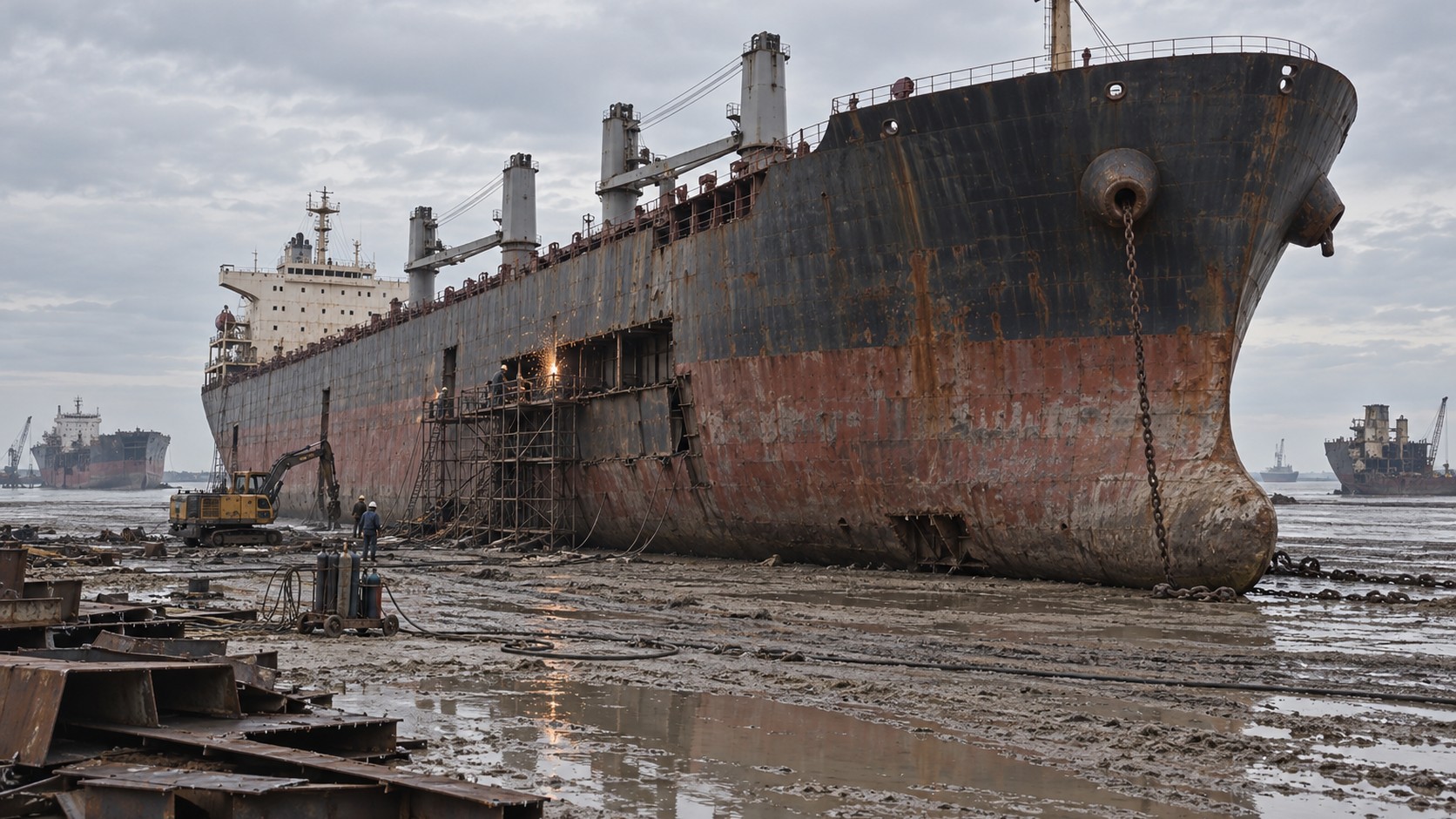
Every ageing ship eventually forces the same decision on its owner: keep trading it, or sell it for scrap. In 2026 that decision is more complicated than a simple age cut-off, because the demolition market itself has changed — the Hong Kong Convention has reshaped which yards can legally take a ship, and where a ship gets recycled now moves its scrap value by tens of dollars per tonne. This is a look at what a ship is actually worth at end of life, why owners are holding on to ageing tonnage rather than scrapping it, and when trading on genuinely stops making sense. See our how old is too old guide for the buyer’s side of this question.
FRVous préférez le français ? Lisez notre guide d’achat du navire vraquier.
What a ship is actually worth at end of life
Scrap value is priced per LDT (light displacement tonnage — the ship’s steel weight, not its cargo capacity), and that price varies sharply by where the ship is recycled. Current 2026 regional indications: Pakistan’s Gadani yards are paying the most, around USD 525–530 per LDT; Alang in India runs roughly USD 405–450 per LDT depending on ship type (container tonnage highest, bulk carriers lowest); Chattogram in Bangladesh sits close behind at USD 410–440 per LDT; and Turkey’s Aliağa yards pay far less, around USD 260–280 per LDT, reflecting stricter EU-linked environmental standards and higher local compliance costs. The underlying scrap steel price (HMS 1&2, 80:20 grade) is far more uniform — USD 375–390 a tonne across all four markets — so the LDT price gap is really a gap in yard compliance cost and labour, not in the steel itself.
The Hong Kong Convention has reshaped where a ship can even go
The Hong Kong International Convention for the Safe and Environmentally Sound Recycling of Ships entered into force on 26 June 2025, and its effect on the market is now measurable rather than theoretical. Yards in contracting states must operate as authorised facilities with an approved Ship Recycling Facility Plan, and shipowners must hold an Inventory of Hazardous Materials (IHM) certificate to sell into a compliant yard. The compliance burden has landed unevenly: in Alang, 115 of 128 plots are now HKC-compliant, backed by a INR 1,224 crore capital programme to double capacity, while Bangladesh’s shipbreaking volumes dropped sharply — 57 ships recycled in the first half of 2025 versus 89 in the same period of 2024 — as yards there adjust to the new requirements. Pakistan brought its first HKC-certified yards online only in early 2026. The practical result: a ship without a clean IHM, or one whose owner hasn’t budgeted for it, has fewer legal buyers for its steel than it did two years ago, regardless of the LDT price on offer.
Tip: Get an Inventory of Hazardous Materials survey done well before you plan to sell for scrap, not after. Without a current IHM, a growing share of the highest-paying yards simply can’t take the ship, which shows up as a lower effective sale price even when the headline LDT rate looks attractive.
Why owners are trading on instead of scrapping
The bulk carrier fleet is a useful case study: average age has climbed from around 8.6 years in 2018 to roughly 13 now, yet annual demolition volumes have stayed at a fraction of the levels seen during the 2015–2016 downturn — recent scrapping runs closer to 2–3.5 million DWT a year against more than 10 million DWT during that earlier slump. Two forces are holding tonnage in trade rather than sending it to the beach. First, freight rates across most size bands have been strong enough that an ageing ship still earns a reasonable return, so there’s no cash-flow pressure forcing a sale. Second, HKC compliance costs — the IHM survey, and in some cases retrofit work to remove materials a compliant yard won’t accept — have made scrapping itself more expensive and administratively heavier than it used to be, which raises the bar for when scrapping beats one more trading cycle.
When trading on stops making sense
The calculation flips once the cost of keeping a ship in class exceeds what it can still earn before the next one. The trigger is almost always the next special survey or drydocking — a docking bill that can run into seven figures on a mid-size ship is only worth paying if the earnings on the other side clearly cover it. Layer on rising EEXI and CII compliance costs, which fall hardest on older, less efficient tonnage, and the scrap value on offer starts looking less like a bargain-basement exit and more like a floor that’s simply catching up with the ship’s real remaining earning power. A vessel with a clean IHM and access to the higher-paying Pakistani or Indian yards has a materially better exit than one without — which is itself now a value driver worth checking before you buy secondhand tonnage, alongside the factors in our secondhand value drivers guide.
What this means in 2026
For an owner: don’t wait until the next survey bill lands to think about scrapping — get the IHM done early, and treat it as a real exit-value driver rather than paperwork. For a buyer of older tonnage: ask for the vessel’s IHM status as part of due diligence, because it affects what the ship is worth to you on the day you eventually want out, not just what it costs to keep trading. Across the fleet, expect low demolition volumes to persist as long as freight rates hold and HKC compliance keeps raising the cost of scrapping — which means older tonnage will keep circulating in the secondhand market longer than the raw age numbers suggest. See our ship age buyer’s guide for how to weigh age against condition on a specific candidate, or talk to a broker about a specific opportunity.
Buying, or want a second opinion?
Our sale & purchase desk can help you find, value and inspect the right tonnage. Tell us what you’re looking for and we’ll revert within one working day.