

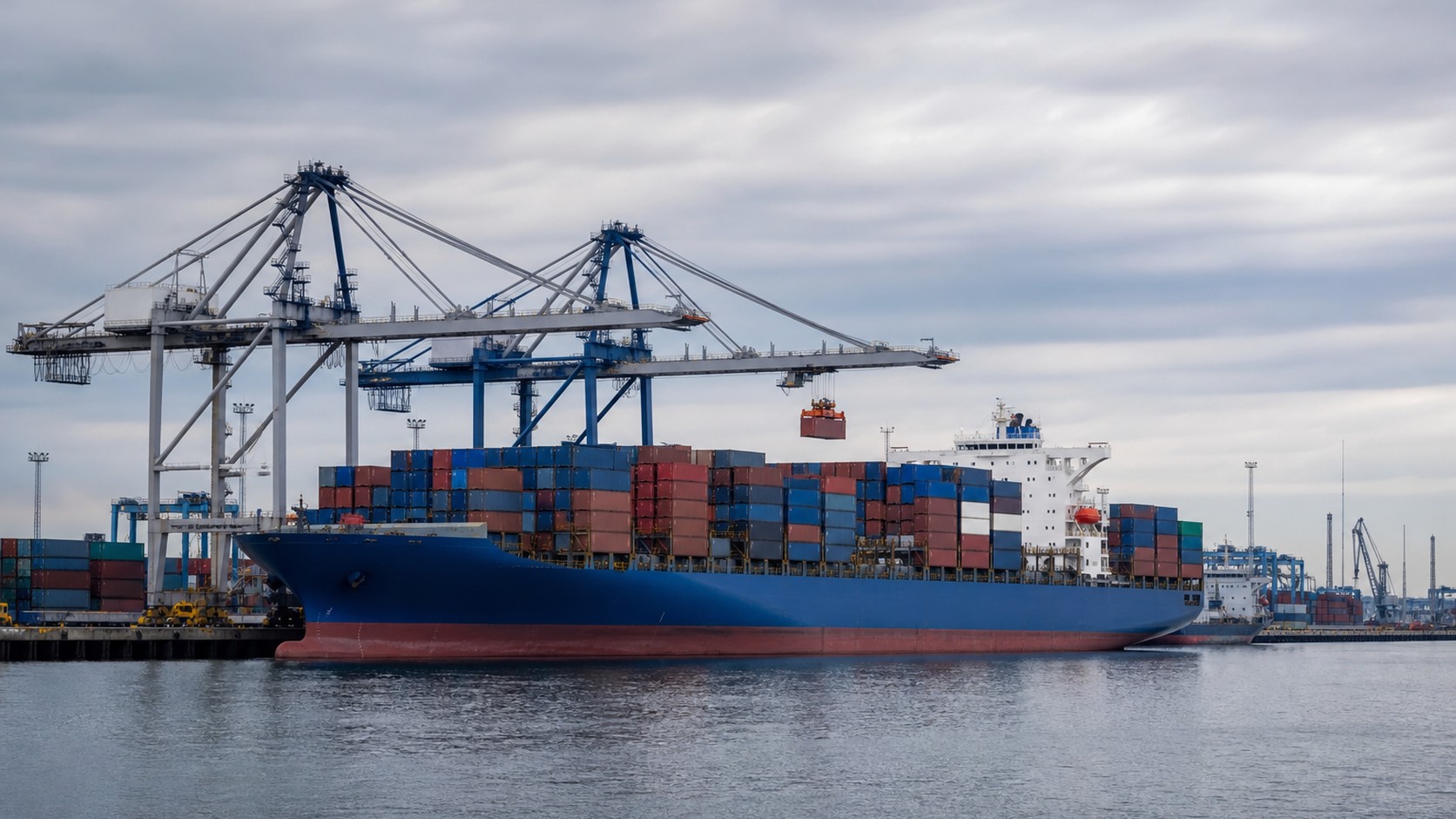
From a short-sea 816 TEU feeder to a 4,350 TEU newbuilding, Golden Shipyard carries a range of container ships for sale spanning the small and mid-size segments that actually trade day to day — not just the headline ultra-large ships that dominate the news. This page is your starting point: current inventory, what’s in stock versus available to order, and what to check before you buy.
Container ships for sale — current inventory
Our current range runs 816 to 4,350 TEU, split between in-stock and newbuilding tonnage:
| Reference | Capacity | LOA | Status |
|---|---|---|---|
| GS-CT-816 / GS-CT-816-2 | 816 TEU | 129.8 m | In-stock (built 2018 / 2019) |
| GS-CT-1056 | 1,056 TEU | 136.8 m | Newbuilding, 2026 delivery |
| GS-CT-2103 | 1,246 TEU | 149.8 m | In-stock, built 2022 |
| GS-CT-1364 | 1,364 TEU | 153.8 m | In-stock, built 2023 |
| GS-CT-1500 / GS-CT-1500-2 | 1,500 TEU | 156.3 m | In-stock (2025) / newbuilding (2026) |
| GS-CT-2700 | 2,700 TEU | 188.8 m | Newbuilding, available to order |
| GS-CT-4200 | 4,222 TEU | 213.0 m | Newbuilding, 2026 delivery |
| GS-CT-4350 | 4,350 TEU | 215.0 m | Newbuilding, 2027 delivery |
See the full, up-to-date list on our container ships for sale page — availability and particulars change as ships are sold and added. For the 1,000–2,700 TEU feeder segment specifically, with feeder-focused buying considerations, see our dedicated feeder container ships for sale page — this page covers the full current range, including the larger 4,000 TEU+ newbuildings that sit above typical feeder scale.
In stock vs. newbuilding
The range includes both:
- In-stock (available for inspection now) — completed vessels from 816 to 1,500 TEU, built 2018 to 2025, available for inspection now.
- Newbuilding (available to order) — from 1,056 TEU up to the 4,350 TEU top of the range, with 2026 and 2027 delivery slots.
The larger 4,000 TEU+ newbuildings sit closer to Panamax-feeder scale than typical feeder tonnage — for the general economics of ordering new versus buying secondhand, see our container ship cost guide.
What to look for in a container ship
When you compare container ships for sale, the value drivers are:
- Nominal vs. homogeneous TEU — the headline capacity figure assumes a mix of empty and loaded boxes; homogeneous TEU (all boxes at a standard weight) is the number that tells you what you can actually lift on a heavy cargo mix. See our container ship sizes explainer.
- Geared vs. gearless — geared tonnage can self-discharge at ports without shore cranes, which matters most on the smaller feeder sizes serving developing-port trades.
- Reefer plug count — decisive for perishable and reefer-heavy trades, and expensive to add after delivery.
- Main engine and consumption — fuel burn at service speed is the largest single operating cost line on a container ship.
- Class and flag continuity — no gaps in class, first-tier IACS society, matched to the flag states your charterers accept.
Tip: Don’t compare ships on nominal TEU alone. Two ships quoted at the same capacity can have very different homogeneous TEU and reefer plug counts — the numbers that actually decide what cargo mix a ship can carry on your specific trade.
How much does a container ship cost?
Every container ship for sale here is offered on the same basis: full particulars to qualified buyers, price on application. Prices move with capacity, gear, age and specification, so vessels are offered on a P.O.A. (price on application) basis. Full particulars — including indicative pricing — are released to qualified buyers under an NDA. See our container ship cost guide for indicative 2026 price ranges by size band, or tell us the capacity and trade you have in mind and we’ll match you to what’s available.
How to view and buy
1. Browse the container ships for sale list and shortlist by TEU and in-stock/newbuilding. 2. Request full particulars under NDA — GA drawing, capacity plan, and full certificate set. 3. Inspect — arrange a pre-purchase condition survey for a secondhand ship, or site supervision for a newbuilding. 4. Close through a standard MOA with our brokerage support.
Quick buying checklist
- ☐ TEU band matched to your trade and port draft/crane access
- ☐ In-stock (inspect now) vs. newbuilding (order) decided
- ☐ Nominal vs. homogeneous TEU checked against your typical cargo mix
- ☐ Geared vs. gearless suited to your discharge ports
- ☐ Reefer plug count matched to your cargo needs
- ☐ Class (IACS), age, and flag history reviewed
- ☐ Full particulars requested under NDA
Frequently asked questions
What container ships do you have for sale? Golden Shipyard offers container ships for sale from 816 to 4,350 TEU — in-stock tonnage built 2018–2025 and newbuildings with 2026–2027 delivery. See the current list on our container ships for sale page, as availability changes.
How much does a container ship cost? Prices depend on capacity, gear, age and specification, so ships are offered P.O.A. (price on application). See our container ship cost guide for indicative 2026 ranges by size, and contact us with your target capacity for current terms.
Do you have feeder container ships specifically? Yes — for the 1,000–2,700 TEU feeder segment with feeder-focused buying guidance, see our dedicated feeder container ships for sale page. This page covers the full current range, feeder through 4,350 TEU.
What’s the difference between nominal and homogeneous TEU? Nominal TEU assumes a standard mix of loaded and empty containers; homogeneous TEU is the capacity if every box were loaded at a standard weight. Homogeneous TEU is the more conservative, more useful figure for planning a heavy cargo mix.
Looking for a container ship? Golden Shipyard has container ships for sale from 816 to 4,350 TEU, in-stock and newbuilding. Browse current availability on our container ships for sale page, or email [email protected] with your target capacity and trade to receive full particulars under NDA.
See what’s available now
Browse the current inventory in this segment, or tell our sale & purchase desk exactly what you need — size, deadweight, flag, delivery window — and we’ll revert within one working day.