

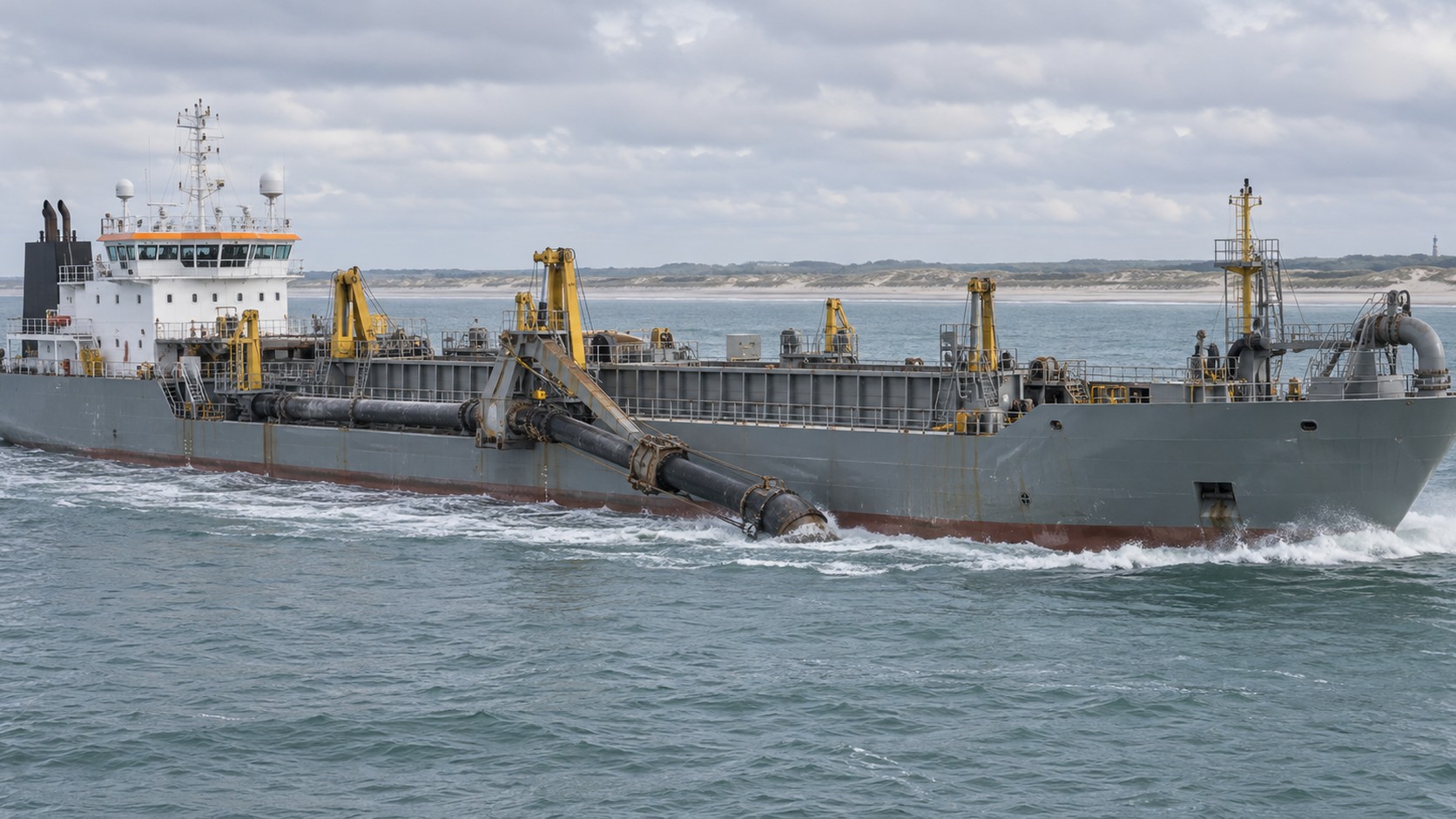
A dredger is the most specialised asset in the commercial fleet, and the least often bought off the shelf: it is engineered around a specific dredging depth, soil type and discharge method, not around a cargo. That shapes how the market works. Some dredgers are available now, some are built to order against your project, and the difference between a 9,000 m³ trailing suction hopper dredger and a cutter suction dredger is not a size step — it is a different job entirely. This page covers what is available, the sub-types worth knowing about, and what actually drives a dredger’s price.
Dredgers for sale — current availability
| Reference | Type | Capacity | Status |
|---|---|---|---|
| GS-DR-9000 | Trailing suction hopper dredger | 9,000 m³ hopper, LOA 128.6 m | Newbuilding, delivery 2026 |
Dredger availability is genuinely thin market-wide in 2026 — good units are held, and the strongest are ordered new rather than resold. If you are looking for a specific configuration, tell us the depth, soil and discharge method and we will source against it rather than wait for something suitable to appear. See the full list on our dredgers for sale page.
The sub-types: what each dredger actually is
| Type | How it works | Best for |
|---|---|---|
| TSHD | Self-propelled; drags suction pipe along the seabed and loads its own hopper under way | Maintenance and capital dredging, land reclamation, sand and aggregate recovery in open water |
| CSD | Stationary; rotating cutter head breaks the soil, pumped ashore through a floating pipeline | Hard or compacted soil and rock, sheltered water, continuous pumping to shore |
| WID | Water injection; low-pressure jets fluidise sediment, which then flows away on the current | Maintenance of navigation channels and berths where the material can be moved, not removed |
| Mechanical (backhoe / grab / bucket) |
Excavator or grab mounted on a pontoon | Confined areas, quays and berths, hard or mixed material, precise work |
Water injection dredgers are the sub-type most often searched for and least often stocked — they are a specialist maintenance tool, usually purpose-built, and rarely come to the open resale market. If your work is channel maintenance in soft sediment rather than capital excavation, a WID can be dramatically cheaper to run than a TSHD, but it moves material rather than removing it, so it is not a substitute where spoil has to leave the site.
Aggregate and gold recovery: the same hull, a different job
A significant share of the searches in this category are not for navigation dredging at all but for aggregate recovery and, further down the scale, gold and mineral dredging. These use the same underlying principle — a suction head lifting material off the seabed — but the economics are inverted: the specification that matters is the ability to process and grade what you lift, not the speed at which you can move it. Aggregate dredgers are typically TSHD-derived with onboard screening and a defined licence area; small-scale gold and placer dredgers sit in an entirely different size class, often barge- or pontoon-mounted and built to a much lower tonnage. Be clear about which of these you are buying for, because a unit specified for navigation dredging is not automatically suited to a recovery licence, and the consenting and licensing regime differs completely from a civil dredging contract.
What a dredger costs
Dredgers are almost always offered P.O.A. (price on application), and that is not salesmanship — the spread is genuinely enormous. Price is driven by four things: hopper capacity, which sets the headline productivity; dredging depth, since deeper capability means longer drag arms, stronger pumps and a heavier hull; pump power and configuration, the single most expensive part of the vessel and the one that decides what soil it can lift at depth; and discharge capability, where a unit with both bottom doors and a bow coupling for rainbowing or pump-ashore commands materially more than one that can only dump. Age and class status move the number again, and a unit due for special survey is priced with that bill already deducted.
Tip: Do not compare dredgers on hopper size. Two 9,000 m³ units can differ by millions depending on dredging depth, pump power and discharge method — and the cheaper one is often cheaper precisely because it cannot do the job you have in mind.
Available now, or built to order
Because a dredger is engineered around a project, most serious buyers either take a unit that happens to fit — accepting its depth, pump and discharge configuration — or order new against an exact specification. A newbuilding gives you the depth rating, drag-arm arrangement and discharge method your project actually needs, with a full class cycle ahead of it; the trade-off is lead time, typically measured in quarters rather than months. A secondhand unit mobilises immediately and costs less, but you are buying someone else’s configuration and inheriting its survey position. If the project is time-critical, secondhand is usually the answer; if the specification is unusual, ordering new is often the only route.
What to check before you commit
- ☐ Type matched to soil and site, not just to budget (TSHD / CSD / WID / mechanical)
- ☐ Dredging depth confirmed per arm, not as a single headline figure
- ☐ Dredge pump condition and wear history reviewed — the most expensive item on the vessel
- ☐ Drag head type confirmed as suited to your material
- ☐ Discharge method verified against your disposal or reclamation plan
- ☐ Class and dredging notations read in full, including any area restriction
- ☐ Next special survey dated and its cost priced in
- ☐ Licensing or consent regime checked if the work is aggregate or mineral recovery
Frequently asked questions
What dredgers do you have for sale? Our current dredger list carries a 9,000 m³ trailing suction hopper dredger newbuilding (ref GS-DR-9000) with delivery in 2026. Because the market is thin, we also source against specification — give us the depth, soil type and discharge method and we will revert with what is available.
How much does a dredger cost? There is no meaningful headline figure, which is why dredgers are sold P.O.A. Hopper capacity, dredging depth, pump power and discharge configuration together move the price by an order of magnitude, and two units of the same hopper size can be millions apart.
What is the difference between a TSHD and a cutter suction dredger? A TSHD is self-propelled and loads its own hopper while under way, which suits open and exposed water. A CSD is stationary, breaks hard soil with a rotating cutter head and pumps it ashore through a pipeline, which suits hard material and sheltered conditions.
Should I buy new or secondhand? If your specification is standard and your schedule tight, secondhand mobilises faster and costs less. If the depth, pump or discharge configuration has to match a specific project, ordering new is usually the only route — dredgers are rarely resold in the exact configuration a given job needs.
Looking for a dredger
Tell us the job rather than the vessel: depth, soil, volume, disposal method and timeline. We will tell you which type fits, what is available now, and what a newbuild would cost and take to deliver. See our dredgers for sale page, read the full TSHD buying guide for how to evaluate a unit, or contact a broker.
See what is available now
Browse dredgers in stock and on order, or tell our sale & purchase desk exactly what your project needs — depth, soil, volume and timeline — and we will revert within one working day.