


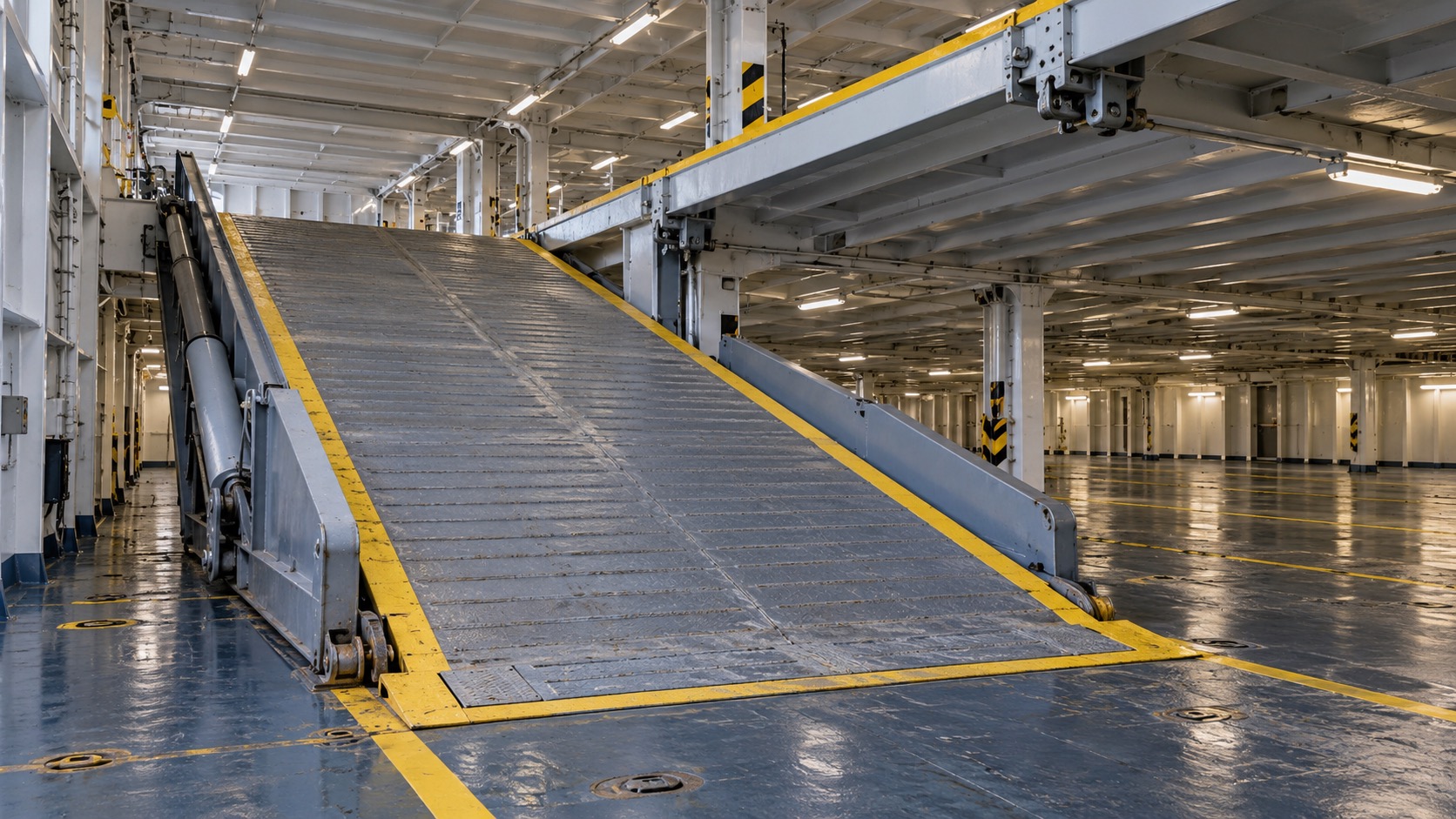
A ramp that opens during a viewing has demonstrated movement. It has not, by that action alone, established the condition of its structure, the reliability of its securing devices or its ability to operate under the documented load conditions. The same distinction matters when a used car carrier’s hoistable decks move smoothly but their maintenance history is incomplete.
This guide helps buyers scope a RoRo ramp and hoistable deck inspection: which defects to investigate, which records support the equipment’s condition, and how unresolved findings affect the repair budget. For vessel type, ramp configuration, deck clearance and cargo-capacity selection, use our RoRo and PCTC buying guide. The checks below form a specialist part of a wider pre-purchase condition survey.
1. Identify the equipment before assessing its condition
Build a register of the external ramps, internal ramps and movable deck panels included in the inspection. Record the maker, equipment reference, location, operating arrangement and any restrictions. Reconcile this register with the drawings and manuals on board: a service report for one ramp says little about another, and a deck level may contain several independently operated panels.
Hoistable decks do not all use the same lifting arrangement. MacGregor’s car deck equipment overview, for example, describes different hydraulic and electric winch arrangements. The inspection scope should follow the installed system, including its supports and securing devices.
Establish whether each panel or ramp is designed to move empty or with cargo. Do not infer this from the weight it can support in its working position. Ask the technical adviser to confirm the applicable examination and certification regime with class and flag as needed. DNV’s guidance on the 2026 lifting-appliance requirements specifically includes movable decks and ramps lifted with cargo; a single blanket testing rule should not be applied to every RoRo installation.
2. Request records that can be traced to each ramp or panel
Obtain the document pack before boarding. An equipment specialist can then target missing evidence instead of spending the visit identifying the installation.
- Design and operating documents: current arrangement drawings, maker’s operating and maintenance manuals, load information and records of modifications.
- Inspection and test records: equipment identification, date, scope, method, operating or loading configuration, results, attending parties and outstanding findings.
- Maintenance history: hydraulic repairs, hose replacements, pin and bush work, wire or chain renewals where fitted, lubrication and control-system faults.
- Damage and repair history: impact incidents, overload reports, structural repairs, supporting engineering documents and follow-up examinations where applicable.
- Serviceability: unavailable panels, restricted operation, temporary arrangements and unresolved class or service recommendations.
Match the paperwork to equipment markings and observed condition. A load-test certificate predating a substantial repair needs to be read alongside the repair and subsequent acceptance records. Missing paperwork is an uncertainty to resolve, not proof that the equipment has failed.
3. Look beyond paint when examining structure and connections
Ask the surveyor to map accessible corrosion, deformation, cracking indications and previous repairs on ramp plating, stiffeners, hinges, foundations and deck-panel supports. Pay attention to areas around connections and places where water or debris collects. Photographs should identify the component and location so a repair contractor can understand the finding.
Fresh coating can improve appearance while limiting what is visible. Where condition or repair history warrants it, agree further cleaning, thickness measurement or non-destructive examination by competent personnel. The extent and acceptance criteria should follow the equipment’s design, maker’s advice and applicable class requirements; there is no useful universal wear allowance for every ramp hinge or deck support.
Keep inaccessible undersides, enclosed sections and concealed connections visible in the report as inspection limitations. Arrange safe access, isolation and appropriate mechanical support before close examination. Personnel should not work beneath equipment supported only by hydraulic pressure.
4. Check hydraulics, lifting components and securing arrangements together
Review accessible cylinders, rods, hoses, pipework and power units for leakage, corrosion, damage and recurring repairs. Compare reported faults with maintenance entries. Repeated seal replacement deserves an explanation of the underlying cause and evidence that the corrective work was effective.
For winch-operated equipment, include the fitted wires or chains, sheaves, drums, brakes and terminations in the specialist’s scope. Check replacement and inspection records against the maker’s requirements. A record of new wire does not establish the condition of its sheaves or anchorages.
Inspect the designed support and securing arrangement in the working and stowed positions. Have the specialist assess accessible pins, bushes, locking devices, support seats and their engagement. A position indication should be reconciled with the actual mechanism rather than accepted as standalone evidence that the equipment is secured.
Where a ramp also forms part of a ship’s closing arrangement, extend the review to the relevant seals, securing devices and closing indications. Agree any required tightness checks separately. Internal ramps and external closing appliances should not be assumed to have identical sealing duties.
5. Agree a demonstration that answers specific questions
Plan demonstrations with the master, operator and attending specialist, using the installed equipment’s procedures and a controlled working area. Identify which units will run, their loading condition, the functions to be observed and any restrictions before starting.
During the agreed operating cycle, the specialist should record uneven movement, abnormal noise, leakage, alignment, seating and securing behaviour. Controls, indications, alarms, interlocks and emergency functions should be checked only under an appropriate procedure. Do not bypass a safeguard to obtain a demonstration.
An empty operating cycle is not a load test. It provides evidence about the functions observed under those conditions. Any load test needs a separate competent plan, a suitable configuration and the approvals or attendance required for that equipment. Do not improvise a proof test by driving the heaviest available vehicle onto a ramp.
If operational constraints prevent a demonstration, record the equipment, reason and outstanding work. A seller’s video may supplement the history, but does not replace an agreed inspection of current condition.
6. Turn findings into an actionable repair schedule
Separate confirmed defects from missing evidence and recommended further checks. The buyer needs to know what is established, what remains uncertain and what it will take to close each item.
| Finding | Evidence to request | Budget consequence to investigate |
|---|---|---|
| Recurring cylinder leakage | Repair history and specialist diagnosis | Removal, workshop work, parts and repeat demonstration |
| Deformation near a hinge or support | Measurements, repair history and engineering assessment | Access, structural repair, approvals and verification |
| A deck panel is unavailable | Fault report, service proposal and parts availability | Repair lead time and operational restrictions while unavailable |
| Test record does not match current equipment | Equipment identity, modification history and required verification scope | Specialist attendance, further examination and testing if required |
Request quotations against defined work, including access equipment, removal and refitting, engineering, parts, attendance and post-repair verification. Confirm lead times and whether the proposed location can accommodate the repair. A small component can still create a long interruption if it is obsolete or requires custom manufacture.
Compare the full repair-and-downtime exposure when evaluating vessels. Do not assign an arbitrary percentage discount to an unresolved structural or securing defect. First establish whether a technically acceptable repair is available, what restrictions apply meanwhile and how completion will be verified.
7. Define what closes each outstanding item
An inspection finding does not itself change the sale terms. Have the buyer’s advisers address material items in the transaction documents, with a clear scope, responsibility, timing and evidence of completion. Where seller repairs are agreed, define who verifies them and what records accompany delivery.
For each ramp or deck group, the handover file should distinguish inspected, demonstrated, restricted and not verified. Retain photographs, equipment references, findings and follow-up reports together. This gives the incoming operator a usable maintenance baseline as well as a record of the purchase assessment.
Questions buyers ask
Does a successful opening and closing cycle prove the ramp is fit for service?
It establishes only the functions observed under the recorded conditions. Structural condition, load limitations, securing arrangements and the applicable examination records still need review.
Should every hoistable deck be moved with vehicles on it during inspection?
No. Establish the permitted operating condition from the equipment documents first. Some installations are intended to be repositioned empty. Demonstrations and tests must follow the procedure appropriate to the actual installation.
What if only some panels can be inspected?
Identify the panels examined and the limitations on the remainder. Agree follow-up access or further specialist work where needed; do not report an entire deck system as verified from a limited sample.
Should I reject a ship because ramp records are incomplete?
Incomplete records call for investigation. The decision depends on the condition found, the evidence that can be recovered, the additional verification required and the commercial consequences. Keep that uncertainty separate from confirmed repair work.
When a candidate vessel is shortlisted, share its ramp and deck equipment list, available service records and known restrictions with our brokerage team. We can help coordinate the document request and specialist inspection scope. For initial vessel selection, return to the RoRo and car carrier buying guide; for current candidates, browse RoRo and car carriers for sale.
Buying, or want a second opinion?
Our sale & purchase desk can help you find, value and inspect the right tonnage. Tell us what you’re looking for and we’ll revert within one working day.