

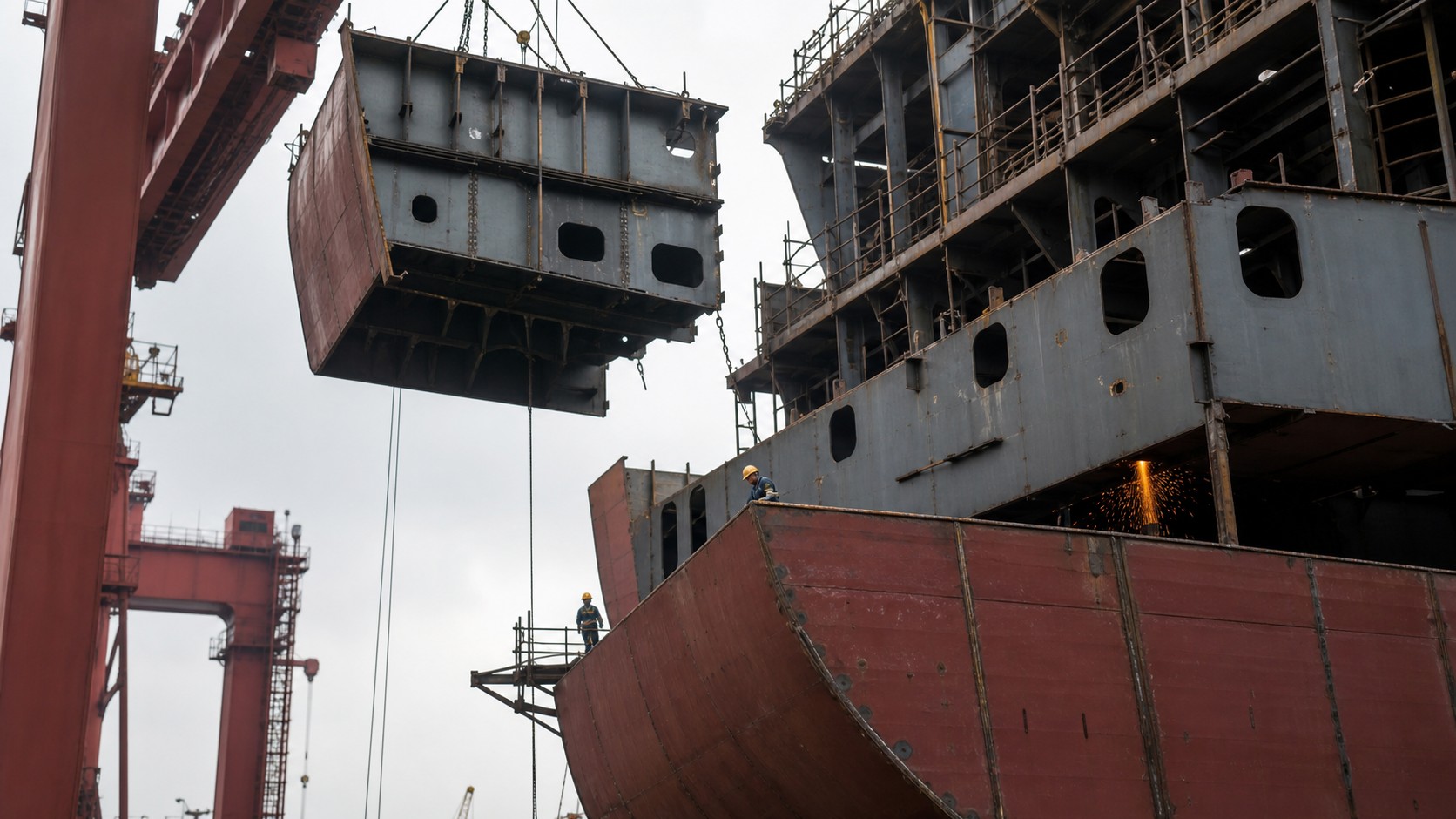
China builds more ships than any other country, across nearly every type — bulk carriers, container ships, tankers, chemical tankers, multipurpose and heavy-lift vessels, dredgers, and more. For buyers, that means competitive prices, short lead times, and a deep pool of both newbuildings and modern secondhand tonnage. It also raises fair questions: is the class recognised, how does a newbuilding contract protect me, and what should I check before I pay? This guide answers them.
Why buy from a Chinese shipyard
Three things draw buyers to Chinese yards:
- Price and value — competitive newbuilding prices and a wide range of proven, series-built designs.
- Capacity and choice — from small coastal vessels to large ocean-going tonnage, often available as either a newbuilding slot or a recently delivered secondhand ship. Browse the full range of vessels for sale.
- Modern tonnage — much of the fleet is young, double-hull where required, and built to current rules. See, for example, bulk carriers, container ships, and chemical tankers.
Newbuilding vs. secondhand
The first decision is whether to order new or buy an existing ship:
| Newbuilding | Secondhand | |
|---|---|---|
| Specification | Built to your exact spec (size, class, equipment) | As-built; take it as it is |
| Lead time | Months to a couple of years | Available now / on delivery |
| Price | Set by contract, paid in stages | One price, immediate |
| History | Clean, no prior wear | Needs a condition survey |
Newbuilding suits highly-engineered assets (chemical tankers, dredgers, heavy-lift) where tank material, pumps, or cranes must be exact; secondhand suits buyers who need tonnage trading sooner and cheaper. Whichever you choose, the diligence below applies.
Is CCS class recognised?
The most common question from overseas buyers: is China Classification Society (CCS) accepted internationally?
- CCS is a full member of IACS (the International Association of Classification Societies) — the same body whose members include ABS, DNV, LR, BV, and others. CCS-classed ships are certified to IACS unified requirements.
- Flag and port acceptance — CCS is a recognised organisation for many flag states; confirm your intended flag accepts CCS (most do).
- Insurer and charterer acceptance — check that your P&I club, H&M insurer, and target charterers accept CCS class for your trade.
- Dual class — if a specific market or financier requires it, a ship can be built or transferred to dual class (CCS plus another IACS society), or to a different IACS society entirely.
Tip: Class acceptance is rarely a problem, but it’s specific to your flag, insurer, and charterers — confirm all three for CCS (or arrange dual/alternative class) before you sign, not after.
The newbuilding process and payment milestones
A newbuilding is bought against a shipbuilding contract with staged payments tied to construction milestones — not paid up front:
1. Contract signing / down payment 2. Steel cutting 3. Keel laying 4. Launching 5. Sea trial 6. Delivery (final payment on acceptance)
Key protections to insist on:
- Refund guarantee (RG) — a bank guarantee that returns your instalments if the yard fails to deliver. Non-negotiable on a newbuilding.
- Clear specification & maker’s list — exactly which equipment, class, and notations you’re buying.
- Milestone inspection rights — your right to inspect and approve at each stage.
- Delivery date, liquidated damages, and warranty — remedies for delay or defects after delivery.
Site supervision and third-party inspection
You don’t have to take the yard’s word for quality — and you shouldn’t:
- Plan approval — the classification society approves drawings before build.
- Class survey during construction — the society surveys at defined stages and issues the certificates at delivery.
- Owner’s site team / third-party supervision — independent supervisors at the yard check workmanship, welding, coatings (PSPC), and equipment against the spec throughout the build.
- Sea trial attendance — verify speed, consumption, machinery, and equipment perform to contract.
For secondhand Chinese-built tonnage, replace build supervision with an independent pre-purchase condition survey and a review of the class and survey status.
Class, certificates, and emissions
Whether new or secondhand, confirm:
- Class notation — that the ship carries the notations your trade needs (e.g. ice class, DP, PSPC, AUT, in-water survey, cargo-specific notations).
- Statutory certificates — Load Line, Tonnage, Safety, pollution, and cargo-specific certificates.
- Emissions standing — modern Chinese-built tonnage generally rates well, but for international voyages review the vessel’s EEXI and CII position.
- Clean title — no liens, mortgages, or maritime claims (for secondhand).
Delivery, warranty, and total cost
At delivery you receive the vessel with its class and statutory certificates and (for a newbuilding) a builder’s warranty period covering defects. Budget beyond the contract or purchase price: site supervision, delivery voyage, flag registration and any class transfer, insurance, initial stores and spares, and — for secondhand — survey and any rectification.
Quick pre-signing checklist
- ☐ Newbuilding vs. secondhand decided for your lead-time and budget
- ☐ CCS (or chosen class) accepted by your flag, insurer, and charterers — or dual class arranged
- ☐ Newbuilding: shipbuilding contract with refund guarantee, spec, maker’s list, and milestone inspection rights
- ☐ Payment tied to construction milestones (not paid up front)
- ☐ Delivery date, liquidated damages, and warranty defined
- ☐ Site supervision / third-party inspection arranged (newbuilding)
- ☐ Independent condition survey completed (secondhand)
- ☐ Class notations, statutory certificates, and EEXI/CII confirmed
- ☐ Clean title verified (secondhand)
- ☐ Total cost budgeted (supervision, delivery, flag, insurance, spares)
Frequently asked questions
Is a ship built in China good quality? Chinese yards build the majority of the world’s tonnage across all major types, to IACS class rules with independent class survey during construction. Quality is protected by plan approval, class surveys, and owner’s/third-party site supervision — the same safeguards used everywhere. Specify clearly, supervise the build, and attend sea trials.
Is CCS (China Classification Society) recognised internationally? Yes. CCS is a full member of IACS, alongside ABS, DNV, LR, BV and others, and is a recognised organisation for many flag states. Confirm your specific flag, insurer, and charterers accept CCS for your trade; if a market requires it, dual or alternative IACS class can be arranged.
How do payments work when ordering a newbuilding? A shipbuilding contract sets staged instalments tied to milestones — typically contract signing, steel cutting, keel laying, launching, sea trial, and delivery — with the final payment on acceptance. A bank refund guarantee protects your instalments if the yard fails to deliver.
What is a refund guarantee? A refund guarantee (RG) is a bank guarantee that repays your pre-delivery instalments if the shipyard fails to deliver the vessel per the contract. It is an essential protection on any newbuilding.
Should I buy a newbuilding or a secondhand ship from China? Order a newbuilding when you need an exact specification (tank material, pumps, cranes, class notations) and can wait; buy secondhand when you need tonnage trading sooner and cheaper. Newbuildings need site supervision; secondhand ships need an independent condition survey.
Buying a ship from China? Golden Shipyard offers in-stock and newbuilding tonnage built in China to CCS and IACS class across bulk carriers, container ships, tankers, chemical tankers, multipurpose, heavy-lift, dredgers and more. Browse current availability under vessels for sale, or learn how we support buyers through survey, class, and delivery with our ship sale & purchase brokerage services. To receive full particulars under NDA, email [email protected].
Buying, or want a second opinion?
Our sale & purchase desk can help you find, value and inspect the right tonnage. Tell us what you’re looking for and we’ll revert within one working day.