

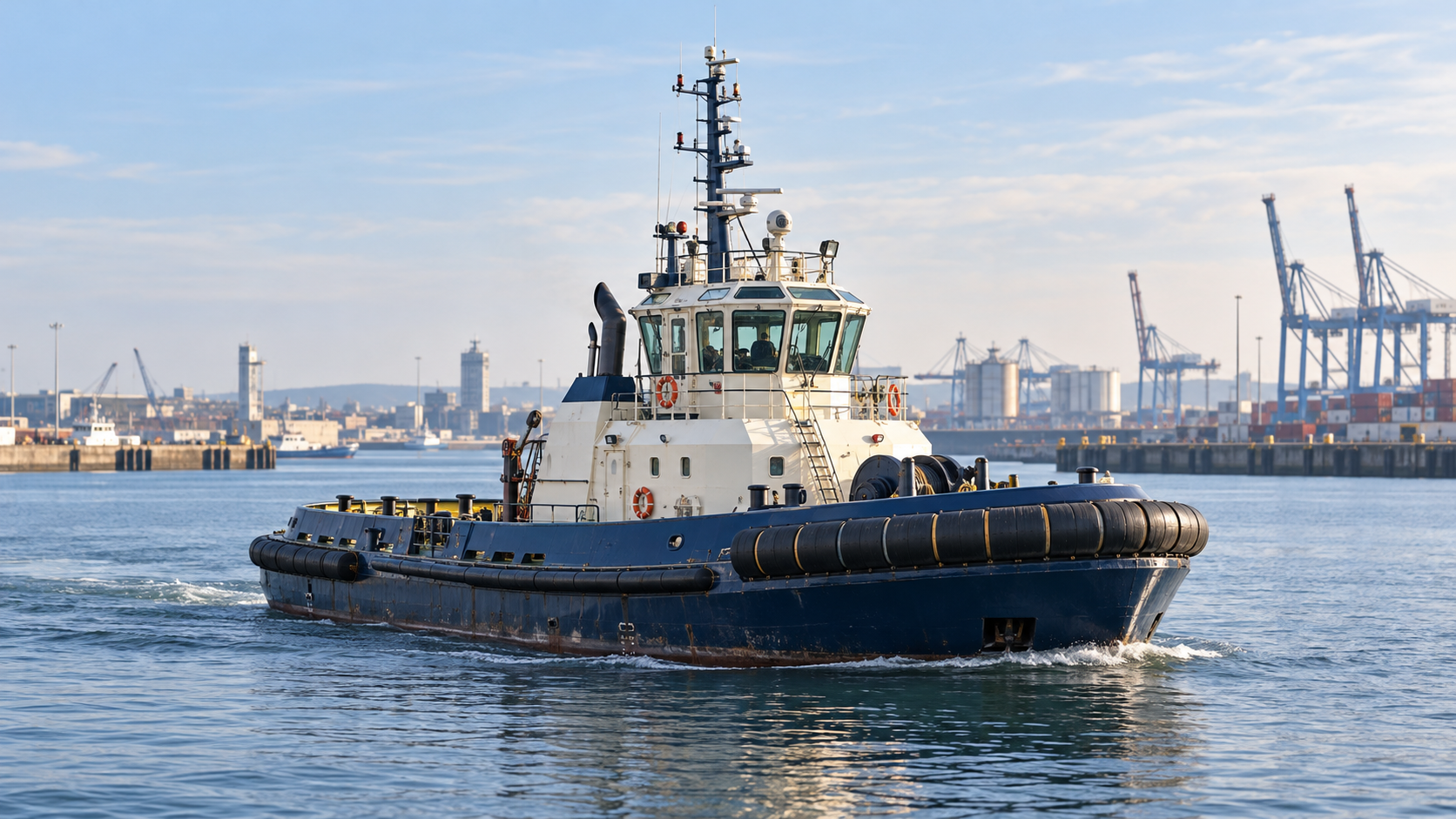
A used ASD tug can look ready for work while its thruster records leave expensive questions unanswered. A service invoice may cover only a seal replacement. A recent oil sample may follow an oil change. A short demonstration may show that both units steer and produce thrust without establishing how they behave under representative load.
Before committing to a candidate, connect three things: the equipment installed today, its maintenance and condition history, and the results of an agreed inspection and trial. This guide focuses on stern-mounted azimuth propulsion units. For vessel selection and transaction-wide checks, use our tugboat buyer’s guide; for propulsion layouts and pulling-force definitions, see harbour tugs and bollard pull explained.
1. Identify each installed thruster before reviewing its history
Create a separate equipment record for the port and starboard units. Record the maker, model, serial number and available nameplate photographs. Reconcile those details with the machinery list, drawings and service records. If a unit or major assembly has been exchanged, ask which records belong to the replacement and which describe the equipment removed.
Establish the actual drive arrangement before setting the inspection scope. Gear-driven units, their steering systems and their associated controls need checks appropriate to their design. Do not assume that another tug’s checklist, lubricant or overhaul interval applies simply because both vessels are described as ASD.
- Identify the fitted propulsion units and relevant drive components.
- Record available running hours and explain any counter changes or missing periods.
- List major repairs, replacements, modifications and control-system changes.
- Obtain the applicable operation and maintenance manuals and current service recommendations.
- Confirm what service support, software access and spare parts can be obtained for the installed configuration.
2. Check what “overhauled” actually included
Ask for the job report behind each major invoice. Use it to establish what was opened, inspected, measured, repaired or replaced, together with the findings and subsequent tests. A seal renewal and a documented gearbox overhaul represent different work scopes, even when both appear under a general maintenance heading.
Check the maintenance basis for the actual model and duty. SCHOTTEL’s preventive-maintenance guidance directs owners to confirm the correct interval for their vessel and identifies oil analysis and vibration measurements as tools for investigating condition before docking. A monitoring report does not, by itself, change a scheduled overhaul or survey requirement.
Where available, review inspection photographs, measurement sheets, replacement-parts lists and the service engineer’s recommendations. Trace deferred work into later reports. If the seller says a recommendation was completed, request the corresponding evidence rather than treating the original report as proof of repair.
Pay particular attention to repeat visits for the same symptom. Repeated leakage, temperature alarms or steering faults deserve a connected history: the original complaint, diagnosis, work performed and result. Ask the appointed thruster specialist to investigate any symptom whose cause or repair remains unclear.
3. Put oil analysis in its operating context
For oil-lubricated assemblies, request the available laboratory history for each relevant oil circuit, rather than a single summary marked satisfactory. Check the sample date, equipment identity, sampling point, lubricant, recorded operating hours and any oil changes or substantial top-ups. Keep propulsion lubrication and steering hydraulic records distinct where they concern separate systems.
Have the laboratory and a specialist familiar with the thruster model interpret water content, wear indicators and lubricant condition against the relevant test methods, lubricant specification and equipment guidance. Trends are easier to interpret when the sampling method and operating context are documented. Fresh oil and substantial top-ups can change the concentrations measured in a sample. Record both equipment hours and hours on the oil where available. A favourable result soon after an oil change does not establish the condition of internal components.
Manufacturer monitoring systems illustrate why several signals belong together. SCHOTTEL’s Smart Thruster services describe analysis of vibration, bearing and oil temperatures, and water-in-oil saturation. A sensor reading of water saturation is not interchangeable with a laboratory water-content result; check the method, units and temperature context before comparing readings.
- Recent clean sample, limited history: establish when the oil was changed and what earlier results showed.
- Adverse or changing result: request the specialist’s interpretation, corrective action and follow-up sample.
- Missing sample identity: reconcile the report with the correct unit before relying on it.
- No historical sampling: agree what fresh sampling and additional inspection can establish, and record the remaining uncertainty.
Review the equipment and oil history alongside each laboratory result. Agree representative sampling with the laboratory and the vessel’s engineer; do not improvise access to a pressurised or moving system.
Neither one favourable report nor one adverse result settles the purchase decision by itself. The question is whether the evidence supports the proposed next step: further investigation, a repair quotation, an agreed retest or acceptance subject to clearly recorded conditions.
4. Review leakage, alarms and monitoring records together
During the machinery-space inspection, have the survey team record visible leakage, oil-level history, accessible pipework condition and evidence of recent cleaning or repairs. Ask for consumption and top-up records where kept. A freshly cleaned area may require observation after operation to establish whether leakage recurs.
Request alarm histories and available temperature or vibration trends with their dates and operating context. Separate an isolated recorded event from a recurring fault, and check what investigation followed. If no dedicated condition-monitoring system is fitted, record that limitation and agree suitable alternative measurements with the specialist.
Kongsberg Maritime’s Remaining Useful Life service uses operating information and analysis to support thruster maintenance planning. If such a service is fitted, ask for its reports, unresolved recommendations and arrangements for continued access after sale. Age and running hours alone do not establish remaining component life.
5. Agree the sea-trial questions before leaving the berth
Prepare a written trial scope with the seller, master, independent condition surveyor and thruster specialist as appropriate. State the operating conditions, readings to capture, applicable maker limits and criteria for stopping a test. The master controls the vessel’s operation; equipment tests must follow the approved procedures for the installed system.
The useful output is a dated record of what each unit did under stated conditions. Where the arrangement and safe operating envelope permit, the agreed programme can include:
- Control response: compare commanded and indicated azimuth angles and observe steering response through the agreed manoeuvres. An indication alone does not independently confirm the actual unit position; agree any further verification with the specialist.
- Operation under load: record available engine or drive load, shaft or motor speed, relevant pressures and temperatures, together with the duration of each test. Record draught, water depth, weather and operating mode so that results can be interpreted in context.
- Noise and vibration: log when an abnormal symptom occurs, the affected unit, azimuth position and load; obtain specialist measurements where warranted.
- Control stations and operating modes: verify the agreed transfers and functions using the vessel’s procedures.
- Alarms and protective functions: use approved test methods under competent supervision; do not induce overheating, loss of lubrication or another damaging condition to prove an alarm.
- After-operation inspection: check for new leakage, recorded alarms and other changes once access is safe.
Compare the two units only with their configuration and test conditions in view. A difference is a reason to investigate, not an automatic diagnosis. Equally, a brief run at light load leaves questions about behaviour at other operating conditions.
A sea trial does not automatically verify the tug’s advertised bollard pull. If pulling performance requires a separate witnessed test, agree its scope independently. A satisfactory pull result also does not establish the internal condition of bearings, gears or seals.
6. Decide what needs underwater access or drydocking
Accessible machinery-space checks leave parts of the propulsion unit unseen. Have the specialist identify the external areas requiring inspection, which may include propeller blades, nozzles where fitted, housings, rope guards where fitted, and signs of impact, fouling or entanglement. Underwater work requires an agreed isolation and lockout procedure that prevents propulsion or steering movement.
A diver or remotely operated vehicle may document external condition where access and visibility permit. Any use of that inspection to satisfy a class survey requirement must be agreed with the classification society. It cannot answer every question about internal wear or replace measurements that require other access. Define any need for drydocking, opening-up or maker attendance from the actual findings, maintenance history and applicable survey requirements.
For suspected internal damage, ask the specialist to specify the next diagnostic step and its limitations. Avoid turning a broad recommendation such as “check gearbox” into a fixed repair budget before the scope is understood.
7. Record unresolved findings and repair costs
Give each unresolved issue its own entry. Record the affected unit, evidence reference, technical question, next action, responsible party and required verification. Add commercial consequences once a repair scope and quotation are available: parts, labour, access, docking, attendance and estimated downtime and the assumptions behind it.
For example, suppose the port unit has a recent seal-replacement invoice and a favourable oil report, but the report follows an oil change and the trial records a recurring temperature alarm. The next step is to reconcile the repair scope, sampling history and alarm investigation with the specialist. The invoice alone does not close the trial finding.
Before agreeing a repair allowance, establish what the quotation includes and what remains provisional pending opening-up. Confirm parts availability and mobilisation assumptions with the service provider. A low allowance offers little protection if the underlying fault and likely downtime remain undefined.
A useful pre-purchase thruster review ends with supported findings and explicit unresolved items. It gives the buyer a clearer basis for requesting repairs, arranging further inspection and budgeting entry into service. For help arranging an inspection or assessing a candidate, contact our ship sale and purchase team.
Buying, or want a second opinion?
Our sale & purchase desk can help you find, value and inspect the right tonnage. Tell us what you’re looking for and we’ll revert within one working day.