

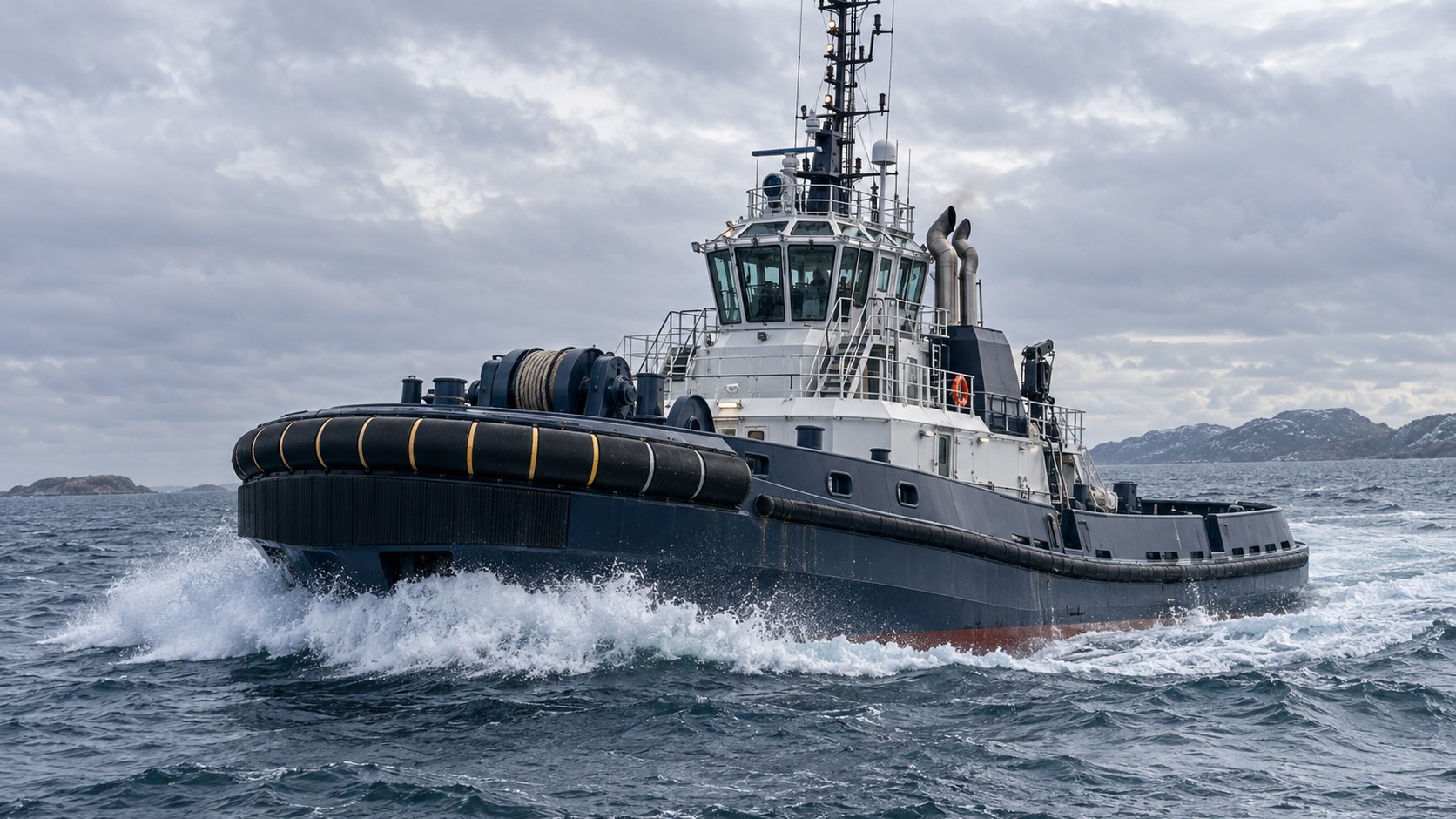
A harbour tug assists ships with arrival, departure, berthing and unberthing in port. “Harbour” describes its role; ASD describes a propulsion arrangement with azimuthing units at the stern. An ASD tug can therefore be a harbour tug. This guide explains how tug configurations differ and how to interpret bollard pull when comparing vessels.
What does a harbour tug do?
A harbour tug helps control a ship’s position and heading in confined waters, pushing against the hull or working through a towline as the operation requires. Its suitability depends on the port, the assisted vessel and the working conditions. Propulsion layout matters, but so do towing equipment, fendering, visibility and the crew’s operating procedures.
Use this article to compare propulsion and pulling performance. For machinery condition, survey records and purchase checks, see our tugboat buyer’s guide.
What bollard pull actually measures
Bollard pull measures a tug’s static pulling force through a towline connected to a fixed point. A trial records that force with calibrated measuring equipment. When comparing certificates, distinguish continuous performance from a short peak and check the direction and conditions of the test.
Length and gross tonnage are not substitutes for a measured pulling-force rating. Tugs of similar dimensions can perform differently because of their machinery, propellers, hull design and condition. Nor does a static rating describe every force available when the tug and assisted ship are moving.
Conventional propulsion and ASD: differences in manoeuvrability
- Conventional twin-screw tug: fixed propellers and rudders provide thrust and steering. Handling depends on the arrangement, hull and any additional manoeuvring equipment; it is too simplistic to say that every conventional tug is unable to move sideways.
- ASD tug: azimuthing propulsion units at the stern can redirect thrust without relying only on the rudders. This gives the operator flexibility when changing the direction of the applied force, but it does not mean the full certified bollard pull is available in every direction.
- Tractor arrangement: propulsion units positioned forward create a different relationship between thrust, hull and towing point. Assess the particular design and intended operation rather than choosing by a type label alone.
A manufacturer’s specification illustrates why direction matters: the Damen ASD Tug 2312 lists 70 tonnes of bollard pull ahead and 65 tonnes astern. Those are figures for that model, not a universal ASD ratio or a guarantee of another vessel’s present performance.
Comparison tip: Ask for the actual vessel’s bollard pull certificate and identify which operating direction each figure describes. Compare like-for-like trial results before comparing headline numbers.
Sizing bollard pull to the job
Start with the requirements of the port, terminal or towage contract. The assisted ship’s wind exposure, local current, available manoeuvring space and operating limits can all affect the required capability. Confirm whether a requirement applies to one tug or the combined assistance from several tugs.
A higher bollard pull figure alone does not establish suitability. Check whether the tug can apply the required force safely through its towing gear and fendering, in the positions and conditions the job demands. Extra installed power also brings costs that should be assessed against the work available.
Escort capability needs a separate check
Do not treat a static bollard pull certificate as proof of escort capability. Escort operations can involve steering and braking forces produced while under way, including indirect towing. For that work, examine the vessel’s relevant class notation, approved operating envelope and documented escort performance at the required speeds.
An ASD propulsion layout by itself does not establish that a tug is certified or equipped for the intended escort operation.
Reading a tug’s specification
- Trial date and conditions: establish whether an older test still represents the vessel’s current condition. Maintenance, machinery changes and propulsion condition matter; age alone does not quantify a loss of pulling power.
- Ahead and astern performance: record the certified figures separately and check any operating limits.
- Free-running speed: assess transit needs separately from pulling force.
- Fendering and towing gear: review the towing point, winch, towline and fender arrangement for the ships and operations intended.
- Class and equipment: verify any escort or firefighting capability against the actual notation and supporting records.
What this means for a tugboat buyer
Define the work first, then compare certified performance, propulsion layout and the vessel’s condition. Keep the detailed purchase inspection in your tugboat buying checklist. You can also browse vessels for sale or discuss a tug requirement with a broker.
Buying, or want a second opinion?
Our sale & purchase desk can help you find, value and inspect the right tonnage. Tell us what you’re looking for and we’ll revert within one working day.