

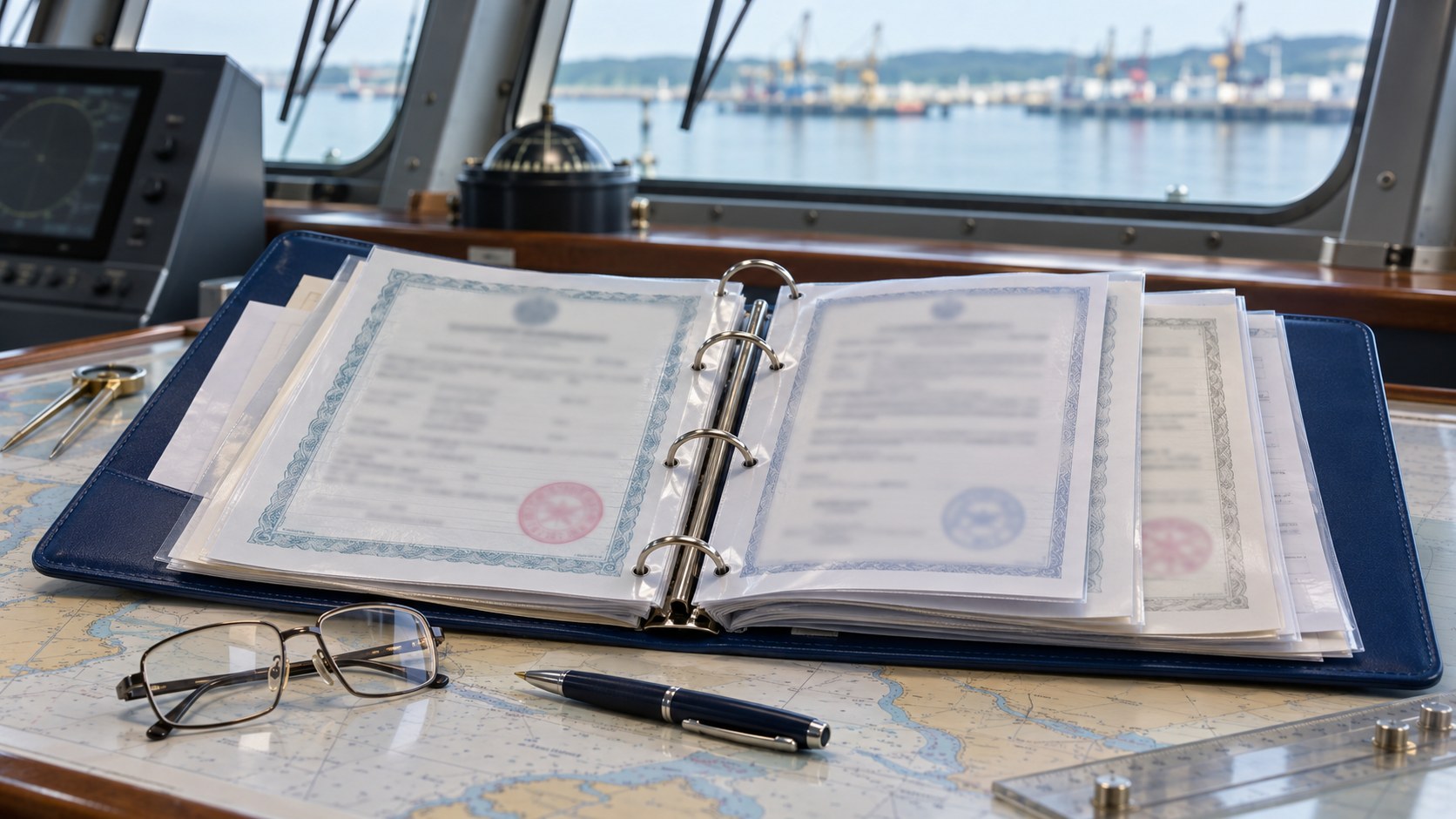
The seller’s broker sends a ship history: two previous names, one change of flag, the current manager since 2021. Before relying on it, compare it with the ship’s Continuous Synopsis Record (CSR). The CSR is a flag-issued record kept on board that lists, in sequence, who has owned, managed and classed the ship and under which flag. Its earlier entries cannot be altered. This guide shows how a buyer reads the file, what to compare it with, and what to ask for when it does not match.
The CSR is not proof of title. Ownership and encumbrances are confirmed through the registry and the transaction documents covered in our guide to ship registration and flag state. This article covers only what the CSR shows and how to check it.
What the CSR records
SOLAS regulation XI-1/5 requires a CSR for ships to which chapter XI-1 applies. Flag notices describe that scope as passenger ships and cargo ships of 500 gross tonnage and upwards on international voyages. Each CSR document records:
- the flag State, the date of registration with it and, when the ship leaves, the date she ceased to be registered;
- the IMO number, ship name and port of registry;
- the registered owners and any registered bareboat charterers, with addresses and the owner’s identification number;
- the ISM Company (the manager responsible for safety management), its addresses and identification number;
- every classification society with which the ship is classed;
- who issued the ISM Document of Compliance, the Safety Management Certificate and the International Ship Security Certificate.
The regulation states that previous entries shall not be modified, deleted, erased or defaced. When details change, the flag issues a new or amended CSR document within three months, and in the meantime the Company or master records the change on an amendment form. For ships built before 1 July 2004, the record must cover at least the period from that date. The CSR stays on board when the ship is sold, changes flag or changes manager. SOLAS regulation XI-1/5
In practice the file has three kinds of form: the CSR document itself (Form 1), amendment forms (Form 2) attached to the current document, and an index of amendments (Form 3). Bahamas Maritime Authority Marine Notice 48
How a change of flag shows up in the file
IMO’s guidelines, as amended by resolution MSC.198(80), set out what should happen at a flag transfer. The previous flag issues a final CSR document showing the date the ship left its register and sends a copy of the ship’s CSR file to the new flag, preferably within one month. The new flag issues its own CSR document within three months of the change.
If the previous flag has not sent the file within three months, the new flag issues a CSR based on the documents found on board. It skips one sequence number and explains the reason in the Remarks box. The guidelines treat that missing number as a deficiency of the previous flag State, not of the ship. IMO resolution MSC.198(80) A gap with an explanatory remark is therefore something to understand, not automatically a red flag. A gap with no remark is a question for the seller.
Copy this CSR review sheet
Use one sheet per ship, matched to the IMO number. Ask for scans of the complete file as held on board, not only the latest document.
| Check | What to look for in the CSR | Compare with |
|---|---|---|
| Complete file | Every CSR document from delivery (or from 1 July 2004 for older ships), with all amendment forms and indexes | The seller’s list of documents provided; ask for any document number not supplied |
| Sequence and flags | Document numbers run in order under each flag; skipped numbers carry a remark | The seller’s flag history and registry dates |
| Ship identity | The same IMO number throughout; each name change and port of registry with its date | Class records and the seller’s list of former names |
| Owners and charterers | Registered owners, owner identification numbers and any bareboat periods | The ownership chain shown in the registry transcript |
| ISM Company | Each manager, its identification number and addresses | The current Document of Compliance and the seller’s statement of management history |
| Classification society | Each society listed and when it changed | Class status report and any transfer of class records |
| Certificate issuers | Who issued the DOC, SMC and ISSC in each period | The certificates currently on board |
| Pending amendments | Amendment forms recording changes not yet reflected in a new CSR document | The date of the change; confirm the flag has been notified |
Inspection histories often list earlier names and managers too. Reading the CSR alongside the ship’s port State control inspection history helps confirm which records belong to this ship and which manager was responsible at the time.
Worked example: a missing number and a manager the seller did not mention
In this fictional purchase, a 2009-built bulk carrier has CSR documents 1 to 7 under flag A and documents 9 to 11 under flag B. There is no document 8. The seller’s summary says the ship has been managed by one company since 2021.
Document 9 has a remark: flag B issued it from the documents on board because flag A had not sent the file. That explains the gap and points to flag A, not to the ship. Document 10, however, shows a second ISM Company from 2023 to 2024, which the seller’s summary leaves out. Document 11 returns to the original manager.
The buyer’s open-items list records:
- Request: a copy of document 8 if one was ever issued, or flag A’s confirmation of the date the ship left its register.
- Request: the seller’s explanation of the 2023 to 2024 management period, with the Document of Compliance and SMC issued at the time.
- Check: port State control and incident records for that period under the second manager’s name.
None of these items is a reason to walk away on its own. Each one must be closed, or its effect understood, before the buyer relies on the seller’s history.
At delivery
The whole CSR file stays on board when the ship is sold. Make that a delivery item: the buyer’s representative should confirm the file on board matches the copies reviewed. If the ship is changing flag, the new flag will ask the previous flag for the file. The steps belong to ship registration and flag state, and the closing documents to how you pay for a ship.
Add the CSR review to your ship acquisition due diligence checklist and share the open items with the pre-purchase surveyor, who can confirm the file on board during the inspection. You can also browse vessels for sale.
Buying, or want a second opinion?
Our sale & purchase desk can help you find, value and inspect the right tonnage. Tell us what you’re looking for and we’ll revert within one working day.