

A seller’s broker says the ship’s next bottom survey “can be done by divers”, so the buyer will not lose time to a drydocking in the first year. Before that assumption goes into the employment plan, check whether this ship, at the age she will be when the survey falls due, can actually be examined afloat. The answer depends on her age and survey regime, the class society and flag, the condition of the hull and stern gear, and what the records show. This guide works through those checks for one candidate.
For how bottom surveys fit into the five-year class cycle, see special surveys, drydocking and the class cycle. This article covers only whether the next examination can be an in-water survey.
What the class rules allow
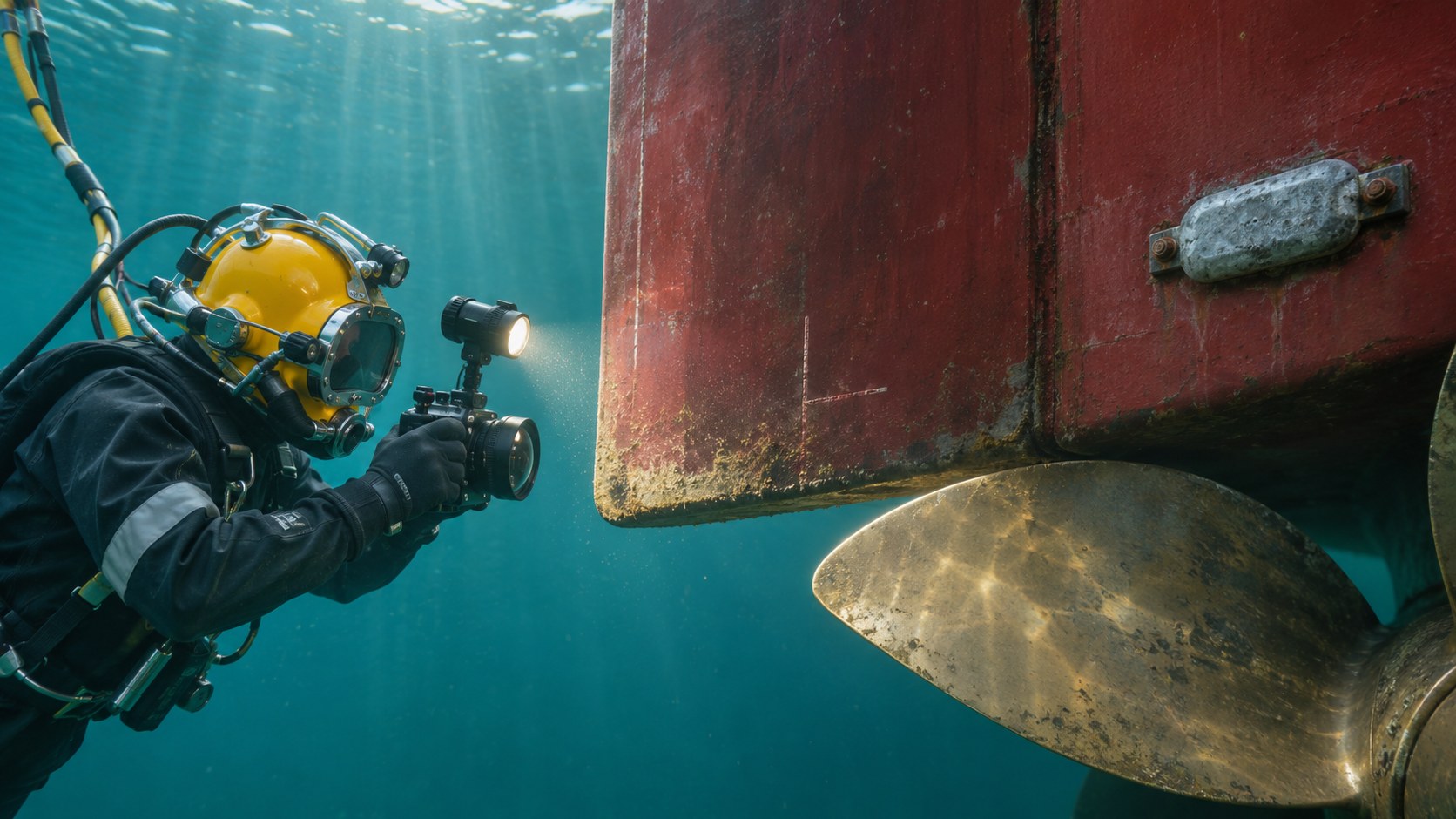
IACS Unified Requirement Z3 requires at least two examinations of the outside of the ship’s bottom in each five-year special survey period, one of them in conjunction with the special survey, with no more than 36 months between any two. Those examinations are normally carried out in drydock. An examination afloat may be considered as an in-water survey, but the requirement adds two limits that matter to a buyer:
- Special consideration is needed before ships of 15 years or over are permitted to have the examination afloat.
- Ships of 15 years and over that are subject to the Enhanced Survey Programme (ESP) are to have the examination in drydock.
The in-water survey has to provide the information normally obtained in drydock. It is carried out in sheltered water, under a class surveyor, by a diving or ROV firm approved by the class society. Where it finds damage or deterioration that needs early attention, the surveyor may require the ship to be drydocked. UR Z3 also states that it does not replace any shorter SOLAS intervals that apply to certain ship types. IACS UR Z3 Rev.7
Flag administrations add their own conditions. The UK guidance, for example, normally limits in-water surveys to ships up to 15 years old, excludes ESP oil tankers and bulk carriers over 15, and does not extend them to ships holding short-term certificates or extensions because of hull condition. UK MCA MGN 546(M), In-Water Surveys Treat it as one flag’s approach. Ask the class society and the intended flag which conditions apply to this ship.
Screen the candidate before relying on an in-water survey
Use one sheet per ship, matched to the IMO number. Record the document and date behind each answer.
| Check | What to establish | Ask the seller for |
|---|---|---|
| Age when due | The ship’s age on the date the next bottom examination falls due, not on the delivery date. Whether ESP applies to her type. | Delivery date, ship type entry in the class records, the dated class status report |
| Which examination is due | The due date and window of the next bottom examination, and whether it coincides with the special survey | Survey status listing the last bottom examination, its method and the next due date |
| Class and flag acceptance | Whether the class society and the flag after purchase will consider an in-water survey for this ship, and on what terms | Any notation or arrangement shown in the class records; correspondence on previous in-water surveys |
| Hull preparation | Coating condition, cathodic protection and hull markings that let divers orientate themselves on the plating | Last docking report, coating and anode records, hull marking plan |
| Rudder and stern gear | How rudder bearing and stern bush clearances will be established without docking | Recorded clearances from the last docking, stern tube oil sample reports, shaft survey status |
| Contact and grounding history | Any known contact or grounding below the waterline since the last docking | Master’s statement, incident reports, any related class records |
| Open hull items | Conditions of class, short-term certificates or extensions linked to hull condition | Full list of open conditions and memoranda with due dates |
| Areas divers cannot reach | Whether sea chests, valves and similar fittings are due for work that needs the ship out of the water | Hull fittings survey records and the last overhaul dates of ship’s side valves |
If an in-water survey has been carried out before, ask for the report and the surveyor’s findings. A previous in-water survey shows how the arrangement worked then. It does not establish that the next one will be accepted, especially once the ship has crossed an age limit.
Worked example: a bulk carrier that turns 15 at her special survey
In this fictional purchase, an ESP bulk carrier was delivered in March 2012. Her special surveys were completed in 2017 and 2022, and her last bottom examination was in drydock at the intermediate survey in January 2025. The next special survey is due in March 2027. The buyer plans to take delivery in February 2027 and has been told the next bottom examination “can be done afloat”.
One bottom examination in each period has to be carried out in conjunction with the special survey, so the next one is tied to the special survey due in March 2027, well within 36 months of January 2025. By March 2027 the ship is 15. Under UR Z3, the examination of an ESP ship of 15 years and over is to be carried out in drydock. The seller’s statement may have held for an earlier examination, but it does not hold for this one.
The buyer’s open-items list records: “Bottom examination with the special survey due March 2027 — drydock required, ship 15 and under ESP. Confirm due date and window with class; agree in the contract whether the seller docks her before delivery.” If the docking falls after delivery, the employment plan needs an off-hire window for it in the first weeks of ownership. The pre-purchase surveyor should review the items that docking will cover, such as rudder and stern gear records, so the buyer can plan the work scope.
For a younger ship, or one not subject to ESP, the outcome could differ. The same sheet still applies: confirm acceptance with the class society and flag, and check the hull and stern-gear evidence before counting on an in-water survey.
Plan for a drydocking anyway
Even when an in-water survey is accepted, the surveyor may require a drydocking if damage or deterioration is found. The UK guidance asks owners applying for one to undertake to drydock the ship if necessary. Keep a docking window in reserve in the operating calendar, and agree with the seller what happens if the survey falls due before delivery.
Share the screening sheet with the pre-purchase surveyor and check the class entries against our guide to ship class notations. For where survey items fit in the transaction, see the ship sale and purchase process and the ship acquisition due diligence checklist. You can also browse vessels for sale.
Buying, or want a second opinion?
Our sale & purchase desk can help you find, value and inspect the right tonnage. Tell us what you’re looking for and we’ll revert within one working day.