


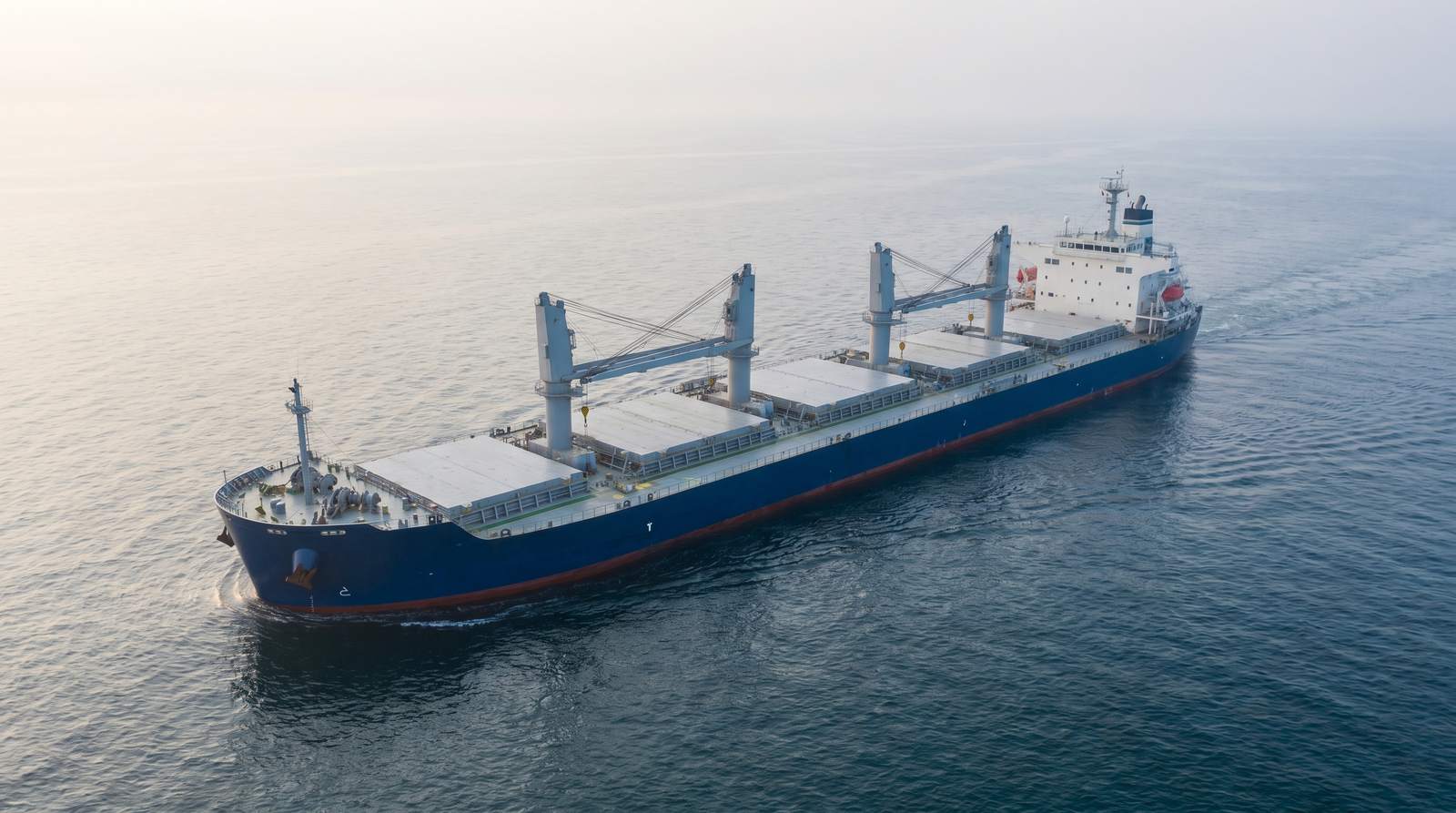
A Handysize bulk carrier does not have one universally agreed deadweight range. The same vessel can sit under different labels in a general vessel guide, a fleet database and a benchmark description. Handymax is particularly easy to misread: it can identify a narrower size band or a broader family containing smaller subcategories.
This guide explains the labels and the classification basis behind them. Start with the source’s definition, then retain the vessel’s actual particulars alongside its market name.
Bulk carrier size comparison: one stated convention
The table follows the Baltic Exchange’s general vessel-type guide, checked on 18 November 2026. Its approximate descriptions are a reference convention, not a complete partition of the fleet. Overlaps and gaps should not be filled by inventing boundaries.
| Market label | Approximate DWT in this guide | Cargo gear described |
|---|---|---|
| Handysize | 20,000–35,000 | Geared |
| Handymax | 36,000–49,000 | Geared |
| Supramax / Ultramax | 50,000–66,000 | Geared |
| Panamax / Kamsarmax | 65,000–82,500 | Usually gearless; exceptions noted by the source |
| Post-Panamax / Mini Cape | 87,000–120,000 | Gearless |
| Capesize | 120,000–200,000 | Gearless |
| Very large ore carrier, including Valemax / Chinamax | 220,000–400,000 | Gearless |
Source: Baltic Exchange, Main Vessel Types. Numbers are expanded from the guide’s abbreviated ranges. The combined rows preserve its grouping; they do not define separate cut-offs within each pair.
Handysize: why a 38,200 DWT benchmark can use the name
The Baltic’s general guide places Handysize at approximately 20,000–35,000 DWT. Its separate Handysize 38 time-charter description specifies a 38,200 DWT geared vessel, with five holds/hatches and four 30-ton cranes. This is a particular assessment specification, rather than the upper boundary of every Handysize ship. Baltic Exchange indices: Handysize 38 vessel description
The distinction matters when reading a reference to a “Handysize vessel”. Ask whether the author is using an indicative type description or a defined benchmark. A named assessment can have a precise reference vessel while the wider market term remains approximate. The two publications should not be combined into a new, supposedly official range.
Database categories provide another basis. MarineTraffic groups dry-bulk vessels below 40,000 DWT as Handysize and explicitly identifies its size bands as database classifications rather than universal definitions. Its lower bound also differs from the Baltic overview, so the two lists cannot be treated as interchangeable filters. MarineTraffic commercial market and size-class definitions
Handymax: a size band or a wider family?
First establish how the source uses the word. A glossary may give Handymax its own interval: VesselsValue lists 35,000–49,999 DWT. That differs from both the Baltic overview and MarineTraffic’s 40,000–59,999 DWT database band. These are identifiable classification choices, not a reason to substitute one unlabeled number range for another. VesselsValue glossary: Handymax Bulker
A broader usage appears in Eagle Bulk Shipping’s 2020 prospectus supplement. Its industry discussion groups Handymax at 40,000–64,999 DWT, then separates traditional Handymax, Supramax and Ultramax within that family. This is a dated example of the terminology, not a claim that every present-day database follows it. Eagle Bulk Shipping, 2020 prospectus supplement: dry-bulk fleet segments
| Source and purpose | Handymax treatment | How to read it |
|---|---|---|
| Baltic general vessel guide | Approximately 36,000–49,000 DWT | Indicative vessel-type description |
| VesselsValue glossary | 35,000–49,999 DWT | Named glossary convention |
| MarineTraffic dry-bulk database | 40,000–59,999 DWT | Database size category |
| Eagle Bulk 2020 prospectus industry discussion | 40,000–64,999 DWT, with subcategories | Broader family; traditional Handymax is 40,000–49,999 DWT |
The second table compares those sources as checked on 18 November 2026; the prospectus retains its 2020 date. It explains differing usage rather than selecting a single winning definition.
Worked naming example: the vessel stays the same
Consider a hypothetical 38,200 DWT bulker. Its deadweight lies inside MarineTraffic’s Handysize category and VesselsValue’s Handymax interval. Those classifications can differ without changing any physical property of the vessel. This is an illustration of the published bands, not a report that either provider has classified an identified ship.
Likewise, under the prospectus’s broader family, a hypothetical 62,000 DWT vessel falls within Handymax and within its Ultramax subcategory. Counting that vessel once under each label would double-count it if the purpose were to assemble mutually exclusive fleet totals. Keep the family and subcategory levels separate.
Use the specialist guide for the next question
A market label provides an orientation. It does not establish a vessel’s dimensions, cargo quantity or suitability for a purchase. Keep the terminology question separate from these next steps:
- Reading the particulars: use the ship specification guide for DWT, GT, length, beam and draught.
- Understanding the Kamsarmax name: follow the Kamsarmax explainer for the dedicated design discussion.
- Comparing the geared segments: use the Supramax versus Ultramax comparison.
- Checking a cargo parcel: use the cargo intake and stowage-factor guide for its stated preliminary calculation.
- Assessing a sale candidate: use the used bulk carrier buying guide for the buyer’s information and survey decision.
- Comparing acquisition routes: follow the newbuild versus secondhand comparison or the newbuilding buyer’s guide.
When browsing bulk carriers for sale, retain the actual DWT and the source of any category label. That makes particulars easier to compare without treating a database heading as a technical acceptance.
Buying, or want a second opinion?
Our sale & purchase desk can help you find, value and inspect the right tonnage. Tell us what you’re looking for and we’ll revert within one working day.