

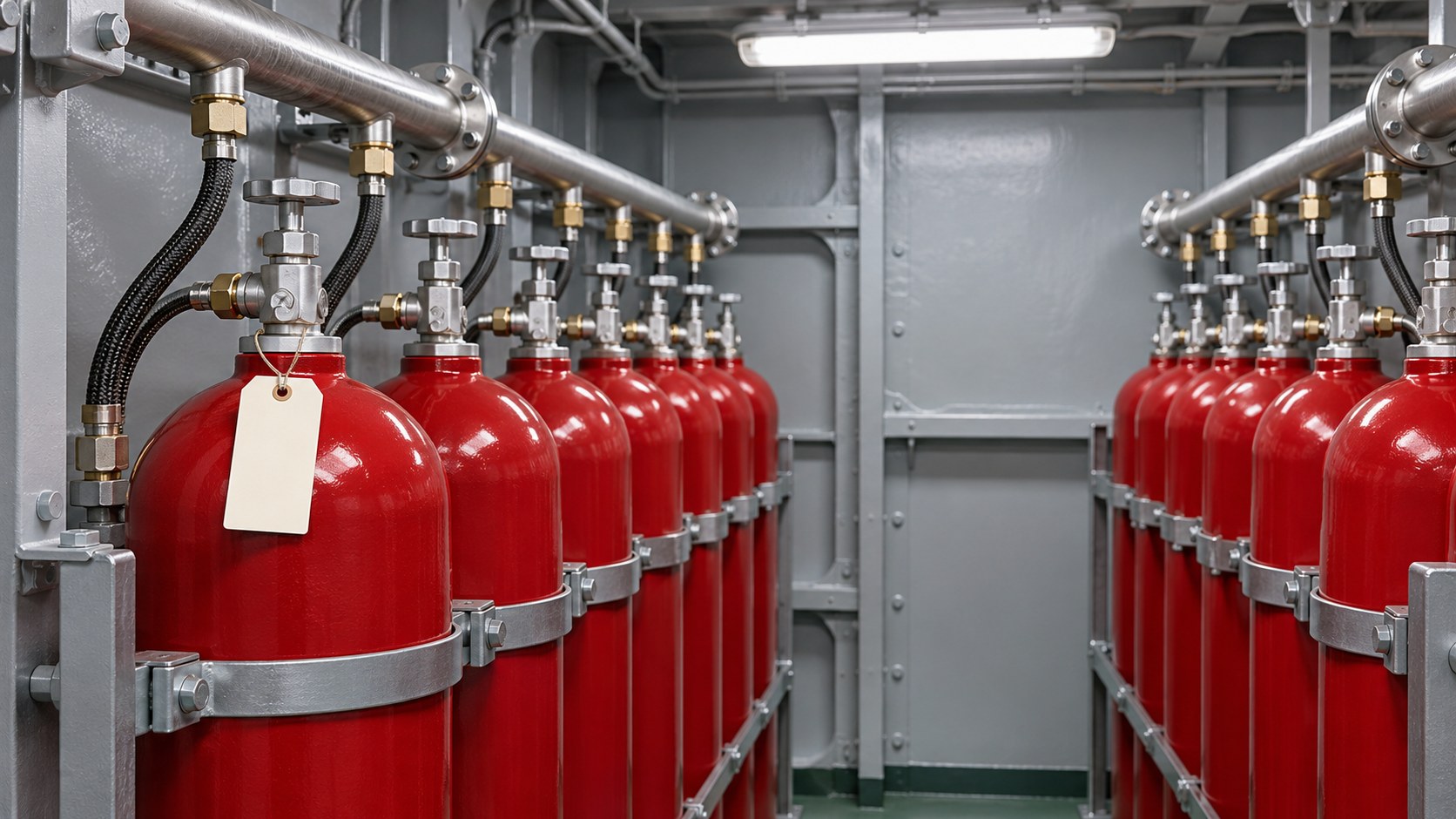
The seller’s file includes a service report for the engine room CO2 system, signed by a service company and dated within the last two years. Before relying on it, check what the report actually covered, whether the cylinders and hoses it lists are the ones on board now, and which maintenance items fall due in the first months after delivery. This guide works through the records for a high-pressure CO2 system, the type most buyers meet on cargo ships.
The CO2 system protects machinery spaces and, on some ships, cargo spaces. It is a statutory safety item, separate from any external fire-fighting (FiFi) capability a tug or offshore vessel may carry. This article covers only the maintenance records of the fixed CO2 system.
What the IMO guidelines expect
IMO’s revised guidelines for fixed CO2 systems, MSC.1/Circ.1318/Rev.1, set a minimum level of maintenance and inspection that supplements the manufacturer’s instructions. The onboard maintenance plan should form part of the ship’s safety management system and include procedures, schedules, recommended spares and records of inspections and corrective actions. The guidelines set out these intervals:
| Interval | What the guidelines list |
|---|---|
| At least every 30 days | General visual check: stop valves closed, release controls in position and accessible, piping intact, cylinders secured, alarm devices in place |
| Annually | Protected space boundaries, cylinder condition, piping and nozzles, manifold hoses and fittings, doors and warning signs |
| Cargo ships: each intermediate, periodical or renewal survey | Cylinder contents weighed or otherwise verified (refill below 90% of nominal charge), hydrostatic test dates checked, discharge piping and nozzles blown through |
| Cargo ships: each renewal survey | Activating heads, pilot lines and remote release tested by trained service technicians; alarms and any time delay checked |
| At least every five years | Internal inspection of all control valves |
| Cylinders and hoses | High-pressure cylinders tested at intervals of no more than 10 years: at least 10% at the 10-year inspection, all cylinders before the 20-year anniversary and every 10 years after. Flexible hoses replaced as the manufacturer recommends and at least every 10 years |
Passenger ships follow a fixed two-yearly cycle for the survey-linked items. If a cylinder fails at the 10-year test, the guidelines call for 50% of the cylinders to be tested, and all of them if further cylinders fail. IMO MSC.1/Circ.1318/Rev.1
The flag Administration and class society apply these guidelines to the individual ship. Ask which survey the last service was tied to and when the next one falls due. Our guide to special surveys and the class cycle explains where intermediate and renewal surveys fall.
Copy this CO2 records review sheet
Use one sheet per ship, matched to the IMO number. Ask for the last two service reports, not only the latest one, so you can see how the records carry forward.
| Item | What to look for | Ask the seller for |
|---|---|---|
| System particulars | Manufacturer, number of main and pilot cylinders, protected spaces, number of distribution lines | The technical description page of the service chart and the fire control plan |
| Service report scope | Which items were marked carried out, not carried out or not applicable, and the comments against each | The full service chart, signed, with the service company’s name |
| Cylinder contents | Every cylinder weighed or verified, with any refilled cylinders identified | The weighing list by cylinder number |
| Hydrostatic test dates | The oldest cylinder test date, and whether the 10-year or 20-year test falls due soon | Test records for cylinders already tested and the cylinder serial list |
| Flexible hoses | Date fitted or renewed, against the manufacturer’s interval and the 10-year limit | Hose renewal record or delivery note |
| Release and alarms | Pilot lines, remote release, alarms, fan stop and any time delay tested at the last renewal survey | The service report covering that test |
| Control valves | Date of the last internal inspection, within five years | The report recording it |
| Monthly and annual checks | Entries in the maintenance system without long gaps; corrective actions closed | Extracts from the planned maintenance records for the last 12 months |
Fire safety items also appear in port State control reports. Reading the CO2 records alongside the ship’s port State control inspection history shows whether any earlier deficiency on the system was closed and how.
Worked example: a full cylinder test due soon after delivery
In this fictional purchase, a cargo ship delivered in 2008 has a high-pressure CO2 system with original cylinders. The buyer plans to take delivery in March 2027. The seller’s latest service report, from the intermediate survey in 2025, shows all cylinders weighed and above 90% of nominal charge. It records the oldest cylinder test date as 2008 and notes that 10% of cylinders were tested in 2018. The flexible hoses were renewed in 2017.
Two items fall due within about a year of delivery. All cylinders must be hydrostatically tested before the ship’s 20-year anniversary in 2028. The hoses reach their 10-year limit in 2027, earlier if the manufacturer’s interval is shorter. The service report also lists two fewer cylinders than the fire control plan.
The buyer’s open-items list records:
- Request: an explanation of the cylinder count, and confirmation that the quantity on board still meets the required charge for the largest protected space.
- Request: the manufacturer’s hose replacement interval and the hose renewal record.
- Decide: whether the seller completes the cylinder test and hose renewal before delivery, or the buyer plans them into the first months of ownership. Record the agreement in the contract.
The surveyor should count the cylinders on board and compare the serial numbers with the weighing list. None of these items means the system is unsafe today. They are work the buyer will have to schedule, and they belong in the delivery plan.
At delivery
The planned maintenance records, service reports and cylinder test certificates stay with the ship. Ask the buyer’s representative to confirm on board that the system is in its normal state: stop valves closed, release controls in position, and no cylinders removed without replacement. If cylinders are ashore for testing at delivery, the guidelines say replacement cylinders should be on board so that the CO2 quantity still meets the requirement.
Share the open items with the pre-purchase surveyor, and add the CO2 review to your ship acquisition due diligence checklist. For where delivery conditions fit in the transaction, see the ship sale and purchase process. You can also browse vessels for sale.
Buying, or want a second opinion?
Our sale & purchase desk can help you find, value and inspect the right tonnage. Tell us what you’re looking for and we’ll revert within one working day.