

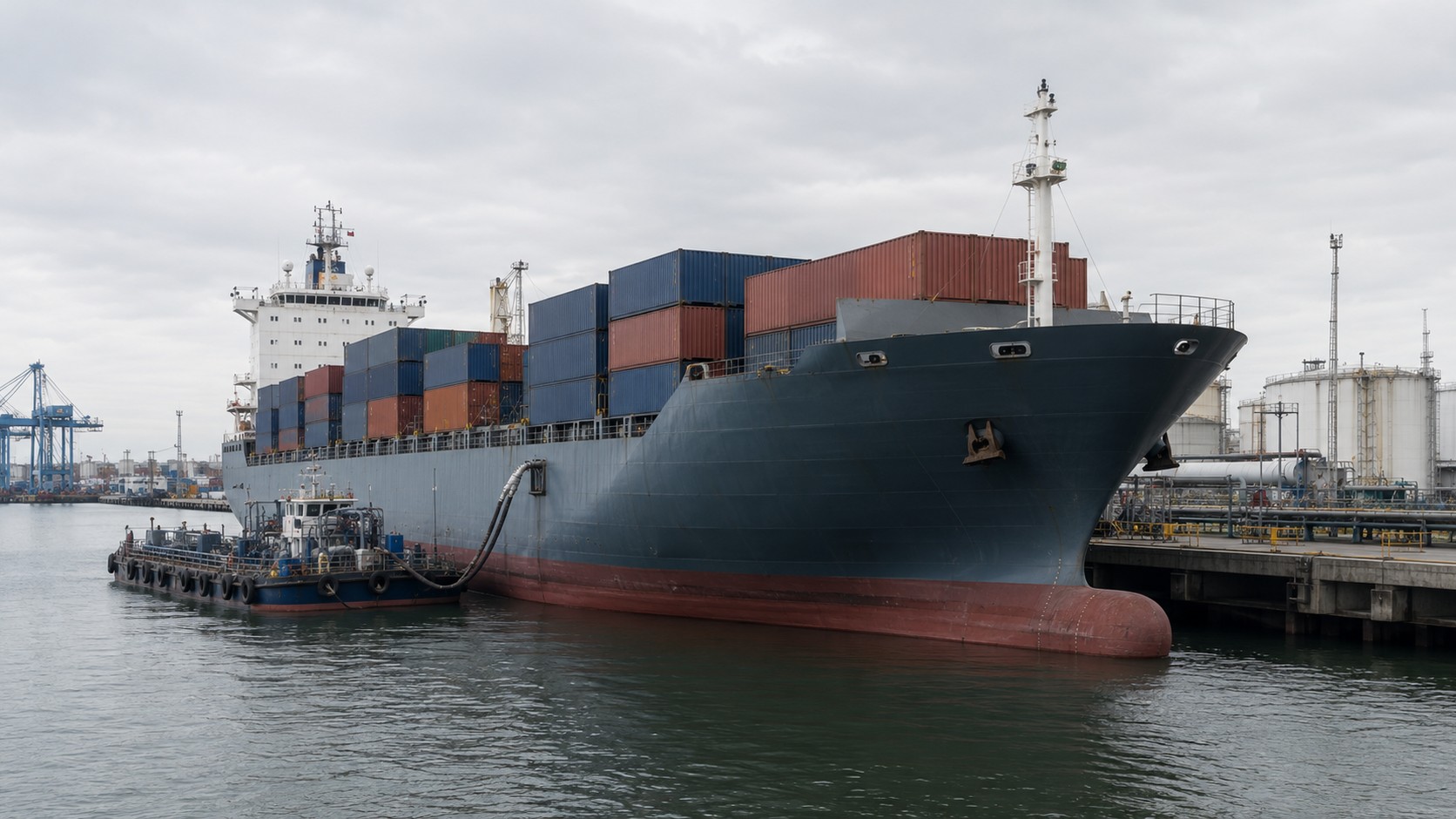
A feeder newbuild order is a bet on what fuel you’ll be able to buy for the next 20-plus years, made years before the ship is delivered. Methanol dual-fuel capability is now a real option even at feeder scale — DP World named its first methanol dual-fuel feeder, the 1,250 TEU DP World London, in April 2026 — but “real option” and “obvious choice” aren’t the same thing. This is the capex trade-off, for anyone weighing a methanol-ready order against a conventional one. See our feeder container ship buyer’s guide for the rest of the spec sheet.
What methanol-ready actually costs
The clearest public data point on the premium comes from a larger ship, not a feeder: when Cosco converted an existing order for four 16,000 TEU neopanamax boxships from conventional to methanol dual-fuel specification, the switch added roughly $28.5 million to a $155 million contract price — an increase of about 18%. That’s not a feeder-specific number, and the premium doesn’t scale down cleanly with vessel size: a dual-fuel engine, methanol fuel tanks, fuel supply system and additional safety systems are largely fixed-cost additions, so they land proportionally harder on a $20 million, 1,000–1,350 TEU feeder hull (current 2026 feeder newbuild pricing — see our container ship cost guide) than on a $155 million neopanamax. Expect the percentage premium on a feeder order to run higher than 18%, not lower, until dual-fuel feeder machinery reaches real production scale.
The real constraint isn’t the engine — it’s the bunker supply
The bigger problem for a methanol-ready feeder isn’t building it, it’s fuelling it. As of early 2026 there were around 112 methanol-capable ships in service with roughly 300 more on order globally, but only about 48 ports worldwide offer methanol bunkering — against 200-plus for LNG, and effectively universal availability for conventional fuel oil. That gap is widening, not closing, even as new methanol bunkering services launch: US Gulf and West Coast capability came online through 2026, the UK’s first commercial biomethanol bunkering service started at Immingham in February 2026, and India’s Kandla Port is targeting real e-methanol volumes only by 2028–29. A feeder trades short regional routes and calls smaller, less-developed ports far more often than a deep-sea neopanamax — which means the ships best suited to methanol’s short-range trading pattern are, right now, the ones least likely to find methanol on the routes they actually run.
Tip: Before ordering methanol-ready, map your actual rotation against the current bunkering port list, not the industry-wide port count. DP World London works because its operator controls terminals and can plan the bunkering chain around a known trade; a feeder ordered speculatively for whatever charter comes up doesn’t have that guarantee.
Methanol-ready doesn’t mean methanol-only
Most dual-fuel newbuilds, feeder included, can run on conventional fuel oil when methanol isn’t available at the ports they’re calling — the “dual” in dual-fuel is the whole point. That flexibility is what makes the capex premium defensible even where bunkering is patchy today: you’re not stranding the asset, you’re buying the option to switch fuels as infrastructure catches up, on a ship you’ll likely own for 20-plus years against emissions rules that only get tighter. Whether that option is worth 18%-plus on the build price depends entirely on your own regulatory exposure and charter profile, not on the industry-wide trend — see our broader read on alternative fuels in shipping for the LNG and ammonia alternatives, and the current feeder container ship market for what’s actually being ordered.
The middle option: methanol-prepared, not methanol-powered
Between a full dual-fuel order and a purely conventional one sits a third path that a growing share of owners are actually choosing: a conventional feeder built “fuel-ready” or “methanol-prepared” — extra tank space reserved in the design, structural and piping routes worked out on paper, but no methanol engine or fuel system fitted at delivery. It costs a fraction of the full dual-fuel premium, because you’re paying for design allowance rather than actual dual-fuel machinery, and it defers the decision on which fuel to retrofit to until bunkering infrastructure and fuel pricing are clearer. The trade-off is real, though: a retrofit still means yard time and cost later, on a ship that’s already earning, and the design allowance only helps if the yard actually delivers on the reserved specification rather than treating it as a marketing line. For a buyer who isn’t ready to commit to methanol specifically but wants to avoid a total dead end on future compliance, fuel-ready is a genuine middle ground — for a buyer who already knows their trade needs methanol from day one, it just delays the capex without avoiding it.
What this means for a feeder buyer in 2026
Order methanol-ready if you already know the trade — fixed rotations through ports where bunkering exists or is credibly funded, or charter counterparties who will pay a premium for compliance headroom. Order conventional, or a conventional hull with space reserved for a later retrofit, if you’re building for the spot and short-term charter market where the ship needs to work anywhere, because a methanol-ready feeder with no methanol on its rotation is just a more expensive conventional ship. See our newbuilding buyer’s guide for the general order-to-delivery process, browse current feeder container ships for sale, or talk to a broker about a specific newbuild slot.
Buying, or want a second opinion?
Our sale & purchase desk can help you find, value and inspect the right tonnage. Tell us what you’re looking for and we’ll revert within one working day.