

The seller of a used harbour tug quotes a continuous bollard pull and sends a certificate from a trial several years ago. Before that figure goes into your tender, charter offer or port application, check two things. Does the certificate describe the tug as she is today? And was the trial run under a procedure that your port, terminal or charterer will accept? This guide works through the certificate and test record line by line.
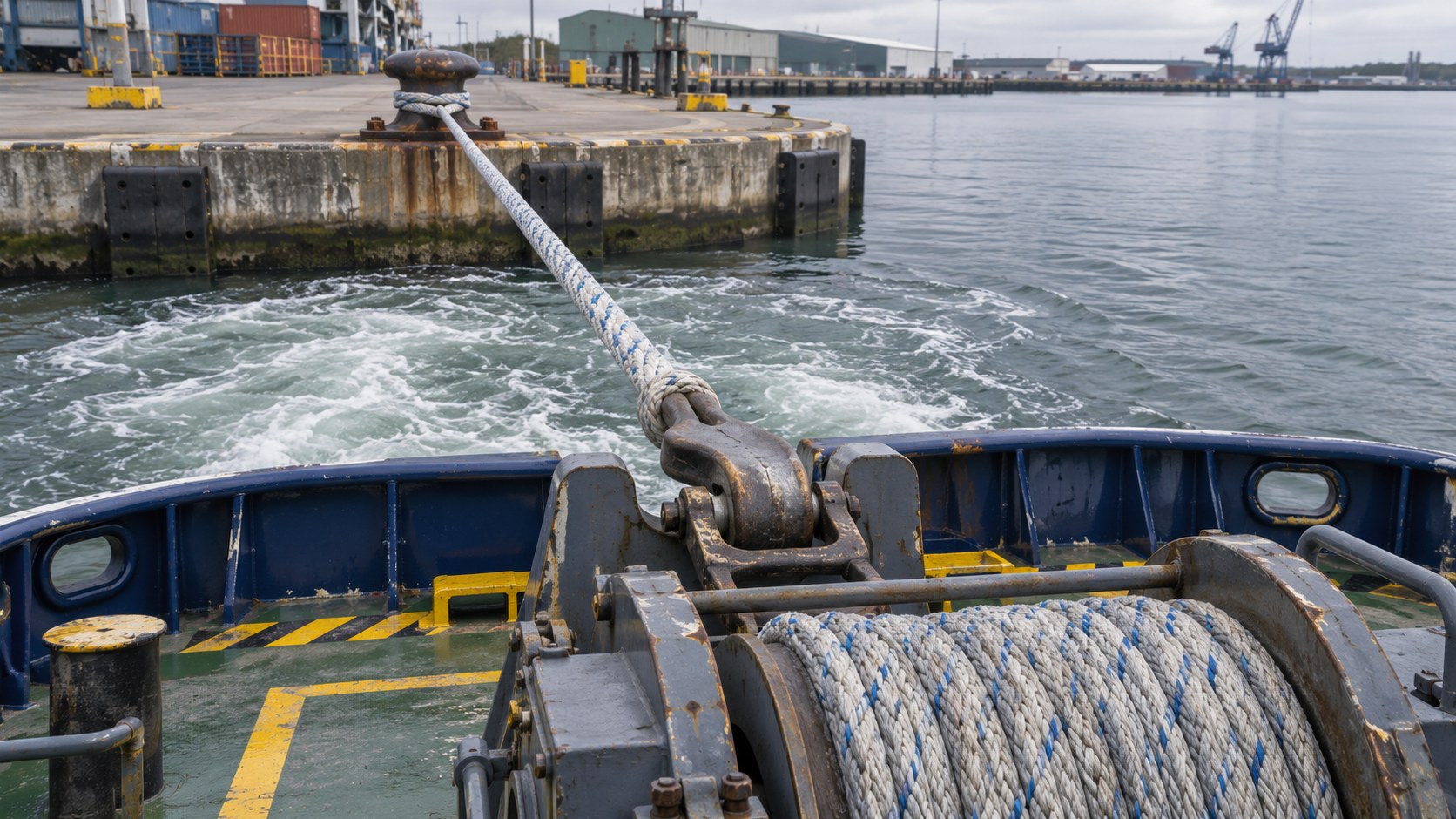
Bollard pull is the static pulling force a tug produces against a fixed point. For what it measures and how it differs between propulsion layouts, see harbour tugs and bollard pull explained. This article covers only the evidence behind a specific tug’s figure.
Find out which procedure the trial followed
A bollard pull figure is only comparable with others measured the same way. Published procedures share the same basic set-up: engines at their maximum continuous rating, the tug pulling on a towline against a shore point, and a load cell recording the force. Their limits are not the same, though. Two published examples show the differences:
| Test element | Türk Loydu procedure | LA/Long Beach escort tug report (2001) |
|---|---|---|
| Duration | Tug must be able to hold a fixed course for at least 10 minutes while pulling; no averaging period stated | Certified figure is the average force over at least 15 minutes, without a significant tendency to decline |
| Water depth | At least twice the tug’s draught within 100 m, and not less than 10 m | At least 45 ft |
| Current and wind | Current up to 0.5 m/s; wind up to 5 m/s | Current up to 1.0 knot; wind up to 10 knots |
| Towline | More than 100 m, certified, with a breaking load of twice the expected pull | At least 300 ft |
| Load cell | Continuous monitoring, valid calibration certificate, error within ±2% | Calibrated within the past 12 months, verified by the class surveyor; continuous and graphical read-out |
| Retest | Not stated in this document | The form states testing every three years for escort tugs in that harbour |
Sources: Türk Loydu, test conditions and procedures for bollard pull · Los Angeles/Long Beach Harbor Safety Committee, Appendix C.2 bollard pull report
The industry has also worked on harmonising trial procedures. Bureau Veritas reported in 2022 that it had joined a joint industry project on a new bollard pull standard and taken it into its rules. Bureau Veritas on the bollard pull standard So the first entry on your review sheet is the procedure named on the certificate. The second is the procedure your intended port, terminal or charterer requires. Ask them in writing whether they accept the existing certificate, and for how long after the trial date.
Copy this certificate review sheet
Use one sheet per tug, matched to the IMO or official number. Next to each answer, note which document supports it.
| Item | Check on the certificate and test record | Ask the seller for |
|---|---|---|
| Identity and witness | Tug name and number, trial date and location, who witnessed the test and signed the certificate | The full test report, not only the one-page certificate |
| Type of figure | Whether the headline number is a continuous average or a short maximum, and over what period it was averaged | The force record or graph for the whole pull |
| Direction | Separate ahead and astern results, if the work needs both | The astern result, or confirmation that none was measured |
| Machinery output | Engine and shaft speeds recorded, engines at maximum continuous rating, normal engine-driven auxiliaries connected | Engine particulars at the time of the trial |
| Site conditions | Recorded depth, current, wind and towline length, not just a statement that conditions were “within limits” | The measurements given to the surveyor |
| Measuring equipment | Load cell make, model and calibration date relative to the trial | The calibration certificate |
| Tug condition at trial | Draught and trim at the test; propellers the same as those used in normal service | Loading condition entered in the report |
| Changes since the trial | Propulsion units, propellers or nozzles, gearboxes and main engines overhauled, exchanged, modified or derated after the trial date | Maintenance records and service reports for the propulsion train |
The last row needs the most work. A certificate records performance on the trial date. When the propulsion train has been changed since then, the certificate no longer shows on its own how the tug performs now. Check the service history alongside our used ASD tug thruster inspection guide, and give the open items to the pre-purchase surveyor. A sea trial alone does not verify the bollard pull figure.
Worked example: one exchanged thruster and a certificate without a graph
In this fictional purchase, a 2016-built ASD harbour tug has a 2021 certificate showing a continuous ahead figure, witnessed by a class surveyor. There is no astern figure. The report lists the wind speed but leaves the current blank, and no force graph is attached. The service records show that one azimuth unit was replaced with an exchange unit in 2024.
The certificate supports the 2021 ahead figure under that day’s trial conditions. It does not cover astern performance or the replaced unit. Three items stay open:
- Request: the full 2021 test report, the force record and the load cell calibration certificate.
- Request: the 2024 service report, with the exchange unit’s identification and any later sea trial or load test.
- Decide: whether the intended port and charterer accept the 2021 certificate. If not, or if the propulsion change leaves doubt, make a witnessed retest a condition of the purchase.
If a retest is needed, write it into the deal
A retest agreed only in emails tends to lead to arguments at delivery. Put the following points in the memorandum of agreement or an addendum:
- Procedure: name the procedure and set the site, depth, current, wind and towline limits.
- Witness: say who witnesses and signs: the class surveyor, the buyer’s representative, or both.
- Tug condition: state the loading condition, engine settings and propellers to be used.
- Acceptance: give the continuous figure required in each direction, and how it will be averaged.
- Shortfall: agree the remedy, such as repair and retest, or the buyer’s right to cancel.
- Timing and costs: say when the test takes place relative to notice of readiness and delivery, and who arranges and pays for it.
Your lawyer and broker should draft the wording to suit the contract form used. For where the test fits among the other steps, see the ship sale and purchase process. Choosing the right tug for the work comes earlier and is covered in the tugboat buyer’s guide. You can also browse tugs and workboats for sale.
Buying, or want a second opinion?
Our sale & purchase desk can help you find, value and inspect the right tonnage. Tell us what you’re looking for and we’ll revert within one working day.